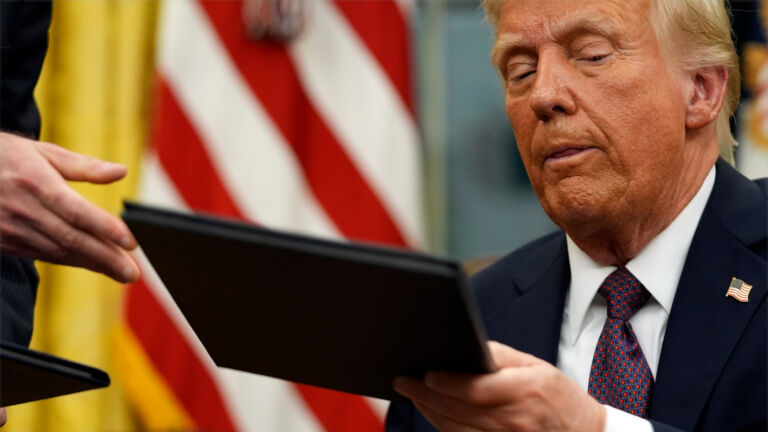
Credit: (AP Photo/John McDonnell)
WASHINGTON — To start last week, Sen. Andy Kim (D-NJ) tried to enter the Washington, D.C., headquarters of the U.S. Agency for International Development, an independent agency created in 1961 and a target of Elon Musk’s effort to cut funding across the U.S. government and access federal data.
A security guard denied him access, Kim said, after receiving “specific orders to prevent employees of USAID from entering the building.”
On Tuesday afternoon, Rep. LaMonica McIver, the congresswoman for New Jersey’s 10th congressional district, tried, with dozens of other Democratic lawmakers, to enter the Treasury Department, another Musk target. “We will not take this,” McIver said, her voice reverberating against the Treasury building as she addressed a crowd outside. “Donald Trump thinks that he is a dictator.”
And to protest Russell Vought, President Donald Trump’s pick to lead the White House budget office, Sen. Cory Booker (D-NJ), Kim and other Senate Democrats held the Senate floor all Wednesday night through Thursday morning. “It is about raising voices. It is about not being silent,” Booker said of the all-night talkathon.
Denied entry
None of these efforts worked. Kim didn’t enter USAID. McIver was rebuffed at Treasury. Vought was confirmed 53-47, and over the weekend he moved to close the Consumer Financial Protection Bureau, a federal watchdog created by Congress after the 2008 financial crisis.
Congress created the CFPB by passing legislation that became law in 2010 as part of an effort to reform Wall Street and protect consumers from banks.
Since then, the agency has returned tens of billions of dollars in savings to the public and issued billions of dollars in fines over illegal financial practices, such as surprise overdraft fees, mismanaged auto loans and redlining — the racist practice of banks denying service, like loans, to Black and brown Americans based on their neighborhood.
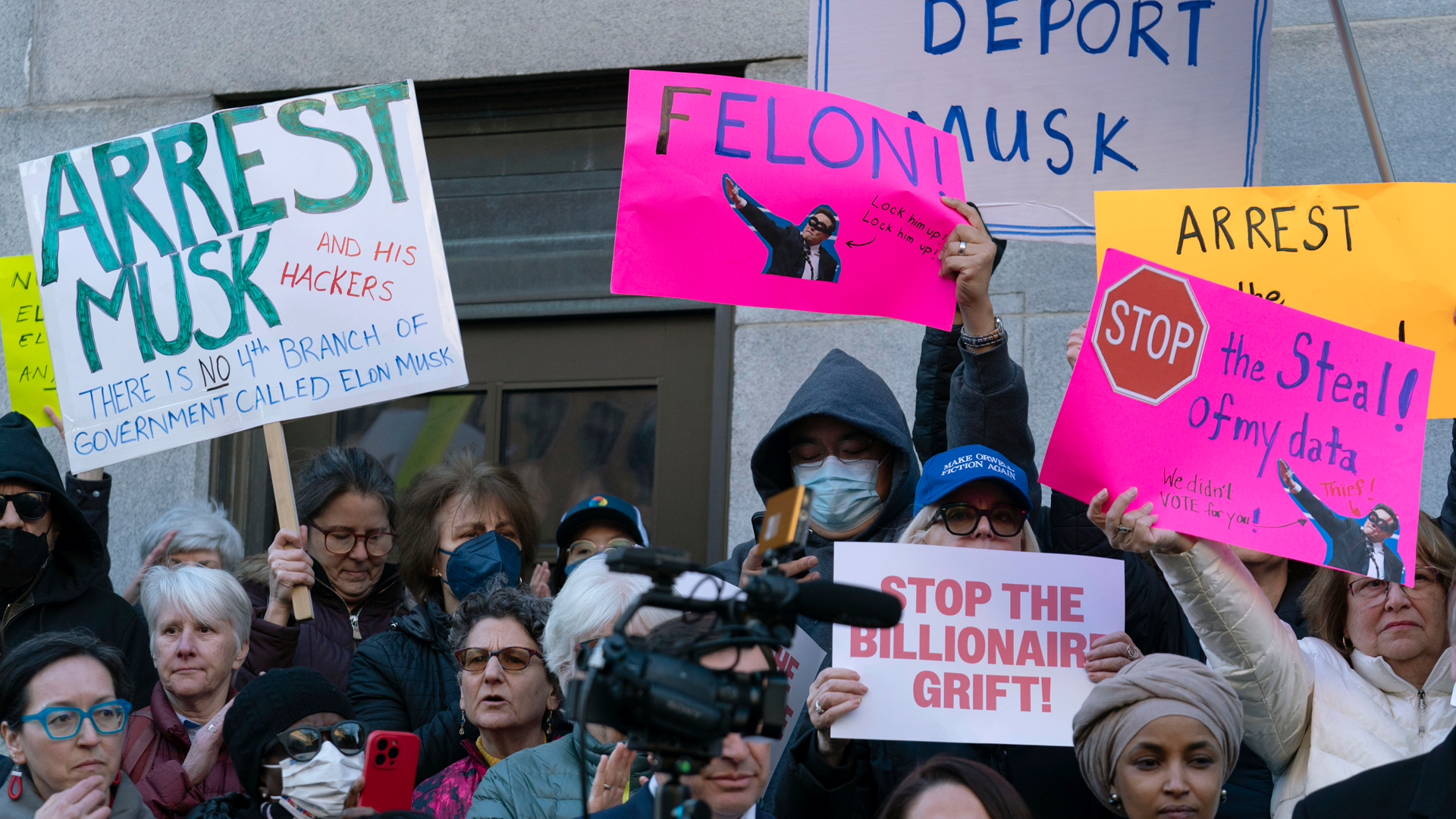 Credit: (AP Photo/Jose Luis Magana)
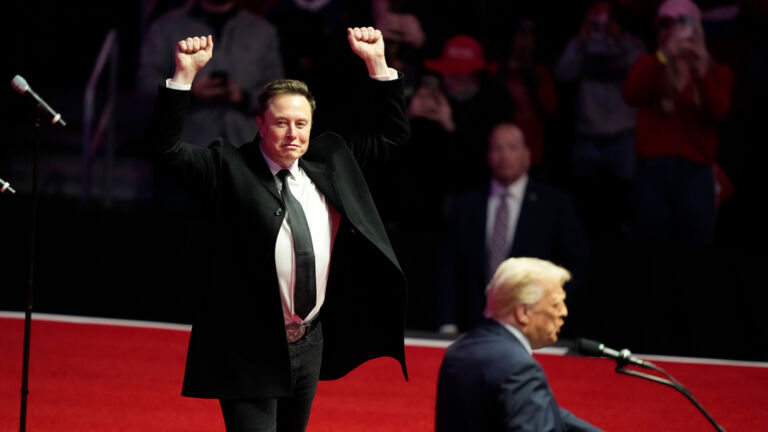
In opposition to Trump’s fresh presidency and attempts by Musk, one of the world’s richest people whose companies are supported by large government contracts and subsidies, to close federal agencies, Democrats within New Jersey’s congressional delegation last week found a more combative tone than they had in the weeks since Trump’s inauguration on Jan. 20.
Tone changes, challenge remains
But a change of tone does not obscure the fact that Democrats have few immediate tools to challenge the Trump administration, and New Jersey lawmakers have often come up empty-handed in recent days when trying to get information out of the White House or federal agencies.
“There’s so much just coming at us right now,” Kim told reporters Thursday.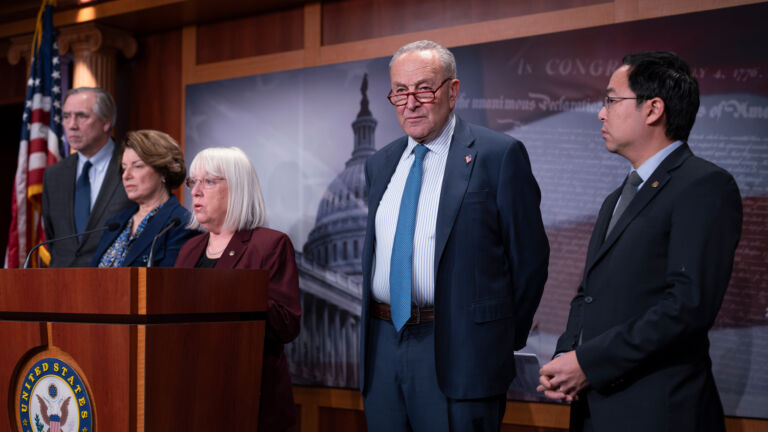
While dozens of federal lawsuits have been filed against the new Trump administration — 37, according to a list from Just Security, a research group within New York University — those could take months or years to be resolved.
On Monday came another legal data point: New Jersey Attorney General Matt Platkin filed a lawsuit, along with other Democratic attorneys general, against a Trump administration move to cut research funding from the National Institutes of Health.
Maybe filibuster?
In the meantime, Democrats on Capitol Hill can use the filibuster to block legislation in the Senate, and in the House they can negotiate with House Speaker Mike Johnson on a bill to keep the government funded past mid-March, when funding is scheduled to expire.
Democrats could also force votes by filing what are known as “privileged” motions — legislation that both chambers of Congress, Senate and House, would have to take up, as former Rep. Tom Malinowski (D-7th) suggested in a column last week in The Bulwark, a website led by a group of anti-Trump conservatives.
Yet in setting the broad trajectory of the federal government, Republicans are in charge. “I’m trying to figure out what leverage we actually have,” Hakeem Jeffries, a Democrat from New York and the party’s top lawmaker in the House, said last week. “They control the House, the Senate and the presidency. It’s their government.”
Strategizing with Gov. Murphy
New Jersey Democrats in Congress met with Gov. Phil Murphy, also a Democrat, on Thursday afternoon.
After the meeting ended and reporters were allowed in, lawmakers were light on specifics about how they plan to protect the state’s interests.
“The challenge we have now is we have already seen Trump No. 1,” Booker said of the first Trump administration.
“We saw us be targeted as a state. And the freezing of a lot of our transportation funding and resources.”
Booker added: “We have a lot of work to do to protect New Jerseyans.”
Republicans ‘don’t want Elon Musk to put in millions of dollars against them in some primary or general election.’ — Sen. Andy Kim (D-NJ)
Murphy said the group had been “wargaming” how he in New Jersey and congressional Democrats in Washington should lead.
Threats of mass deportations, tariffs and the recent attempted government funding freeze have sown confusion in New Jersey, Murphy told reporters.
“People want to see reliability. This is the opposite of that,” Murphy said of the Trump administration.
While New Jersey Republicans have largely cheered Trump’s early moves, such as his administration’s rollback of offshore wind projects, Democrats have focused on how Trump’s decisions affect the public.
Rep. Herb Conaway (D-3rd) mentioned a call he said he’d received from a physician who worked in the federal government.
“She works with young children and is concerned about their health,” Conaway said. “We have someone who might very well lead that department who doesn’t believe in vaccines and has a lot of other, let’s just say, odd ideas about health care,” he said, alluding to Robert F. Kennedy Jr., Trump’s pick to lead the Department of Health and Human Services. Depending on the Senate schedule, Kennedy could be confirmed this week.
Kim’s approach
Kim said he tries to “personalize” the ways the Trump administration has affected average people.
“The more USAID is just some amorphous acronym,” Kim said, “the more that Trump and Musk can just try to attack it and berate the employees there.”
Kim said he didn’t think his Republican colleagues are any more successful at getting answers about Musk than he is.
“They’re not interested in getting answers,” Kim said in an interview with NJ Spotlight News. “They don’t want Elon Musk to put in millions of dollars against them in some primary or general election.”