Credit: (AP Photo/Ben Curtis)
WASHINGTON — A majority of senators voted this week to enshrine nationwide protections for and insurance coverage of in vitro fertilization, a medical treatment that helps people who struggle to conceive naturally become parents.
Once again, a majority was not enough to pass the bill.
For the second time this year, legislation to protect IVF did not clear the Senate, even though a majority of members present voted for it.
A vote in June on IVF legislation, which blended bills from several senators, including Sen. Cory Booker (D-NJ), received 48 votes in favor and 47 against.
The final tally for the vote Tuesday was 51-44, with every Senate Democrat except Booker and two Republicans — Lisa Murkowski of Alaska and Susan Collins of Maine — voting for the bill. Booker did not vote due to a scheduling commitment, a spokeswoman said.
In the clutches of filibusters
Tuesday’s vote is the latest reminder that the majority in Congress often does not get its way and that a minority of lawmakers, in this case Senate Republicans, can block legislation and grind the act of governing to a sluggish pace.
To proceed on a bill, the Senate requires 60 votes in favor to stop a delay strategy — the filibuster — and bring up a final vote.
The filibuster does not exist in the Constitution and is not part of federal law. Instead, it’s a Senate rule born in the 1850s and rewritten and overwritten since.
In modern form, the filibuster plays out quietly, nothing like the scene in Frank Capra’s classic 1939 film “Mr. Smith Goes to Washington,” in which Jimmy Stewart’s character collapses from exhaustion after a 25-hour-long filibuster.
 Credit: (AP Photo/ Evan Vucci)
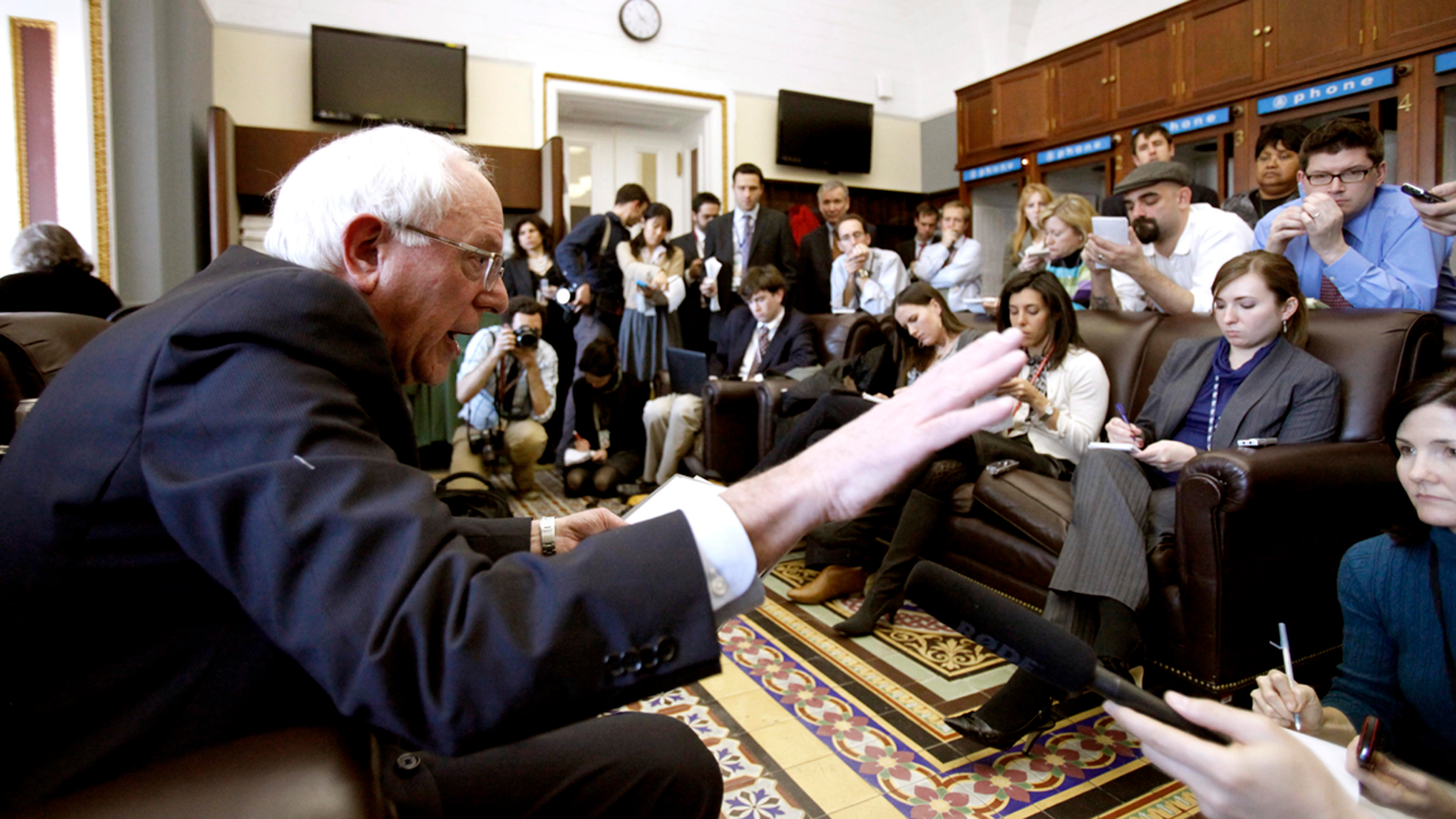
That is what’s known as a “talking” filibuster, like the one Texas Republican Sen. Ted Cruz gave in 2013 to oppose the 2010 health care law known as Obamacare or the speech Vermont Independent Sen. Bernie Sanders reeled off for eight and a half hours against a tax deal then-Vice President Joe Biden brokered in 2010.
Today, a group of 41 senators or more can simply threaten to filibuster a bill — a “silent” filibuster — and quash the legislation or related debate.
Sign of the times
Filibusters were once rare. Though lawmakers from southern states used them to challenge civil rights bills — South Carolina Sen. Strom Thurmond, a segregationist, infamously managed a 24-hour filibuster in 1957 against voting rights for Black citizens — both Democrats and Republicans have used the filibuster mechanism increasingly in recent decades to oppose the other party’s agenda.
 Credit: (AP Photo)
A clear path to ending filibusters would be to rewrite Senate rules and end the 60-vote requirement to advance a bill. But that would require support from two-thirds of the senators present and voting — a highly unlikely outcome in today’s political landscape.
Many Democratic lawmakers and government-reform advocates have called for the filibuster to be scrapped and replaced with a process that would allow a simple majority to pass legislation, as happens in the House.
The votes do not exist in the Senate to reform the filibuster, and the House during this Congress has also struggled to advance bills that have a clear majority of support, due to leverage from far-right Republicans and that chamber’s own procedural hurdles.
Kim and Bashaw differ
Rep. Andy Kim (D-3rd), the Democratic nominee for New Jersey’s open U.S. Senate seat, has called for changing the filibuster.
“No single person should be able to hold up efforts to expand and protect our basic rights. Families deserve access to IVF, and the Senate should be able to do its job in bringing bills on critical issues like these to the floor for a vote,” Kim said.
In a statement, Curtis Bashaw, the Republican candidate in the Senate race, said he supports the filibuster.
“No, the Senate filibuster has been around for hundreds of years. It’s an important check so we don’t have radical policies — such as the ones that Andy Kim and the Squad support — passing every time the majority changes parties. The Founders wanted the Senate to be the ‘cooling saucer’ where rash ideas and pure partisanship would go to die,” Bashaw said in a statement.
“The Squad” is the term given to an informal group of left-leaning Democrats in the House who often vote and work together. Kim is not a part of that social circle.
Legend has it that, over a breakfast meeting, George Washington told Thomas Jefferson: “We pour our legislation into the senatorial saucer to cool it.” There is no proof that conversation ever happened, and historians are skeptical it did.
 Credit: (AP Photo/Harry Hamburg)
Early in his term, President Biden trod lightly on the topic. But in January 2022, at a speech in Atlanta, and under pressure from voting-rights groups in the city, Biden endorsed an exception to the filibuster for legislation about voting.
Then in June that year, days after the Supreme Court had overturned the precedent of Roe v. Wade that allowed for abortion access nationwide, Biden backed changing the filibuster rules in order to codify abortion rights into federal law.
“I believe we have to codify Roe v. Wade into law, and the way to do that is to make sure that the Congress votes to do that and if the filibuster gets in the way [there] should be … an exception,” Biden said.
Harris versus Trump
Vice President Kamala Harris, the Democratic nominee for president, has pledged to sign legislation protecting national abortion access if she wins the White House and such a bill reaches her desk.
Former President Donald Trump, who nominated three of the six Supreme Court judges who overturned the Roe decision, bragged about his role in that outcome.
“I did a great service in doing it,” Trump said last week at the presidential debate about overturning Roe. “It took courage to do it. And the Supreme Court had great courage in doing it, and I give tremendous credit to those six justices.”
Issuing that ruling took “genius and heart and strength” from those judges, Trump said.
Democrats view safe abortion access and IVF as winning political arguments for them during elections in November.
Maya Krishna-Rogers, a spokeswoman for Booker, said the senator did not vote on the IVF bill because he had an engagement in New Jersey.
“Senator Booker had a previously scheduled commitment in Newark and was unable to be in DC for yesterday’s vote on the Right to IVF Act, legislation that he leads along with Sens. Murray and Duckworth,” Krishna-Rogers said by email. “Senator Booker would have voted in favor of the bill, just as he did earlier this summer, and remains committed to protecting IVF and reproductive freedoms for all Americans.”