Credit: (AP Photo/Alex Brandon, File)
With gun violence a concern for people in New Jersey and across the country, both major presidential candidates are offering different approaches to how they would address the issue if elected.
About half of Americans see the issue as a major problem, according to a May survey from the Pew Research Center. This is down from 60% in June 2023, but roughly on par with views in previous years, the center said.
In early September, the topic of gun violence was back in the national spotlight after a 14-year-old student shot and killed four people at Apalachee High School in Winder, Georgia. Days after the incident, several schools in South Jersey were closed due to shooting threats posted to social media, renewing anxieties about gun violence among parents, students, mental health professionals and school staff across the state.
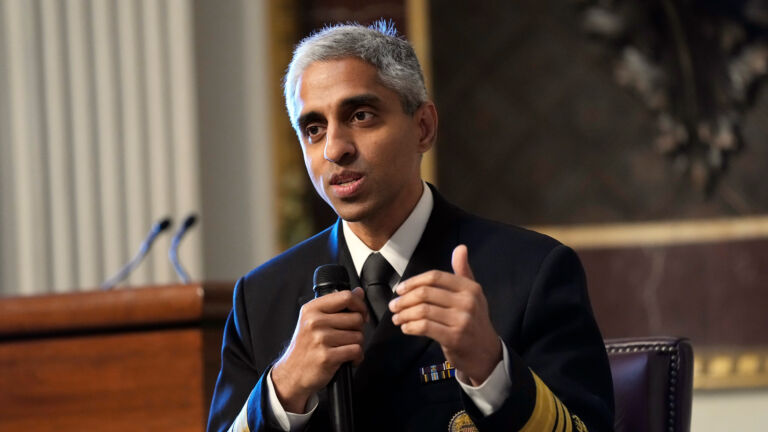
Gun-related injury has been the leading cause of death for children and adolescents across the country since 2020, surpassing car crashes, cancer, drug overdoses and poisonings, according to an advisory released in June by U.S. Surgeon General Dr. Vivek Murthy. Nearly 200 children have been killed by guns across the country so far this year, according to the Gun Violence Archive. Some 48,204 people in the U.S. died in 2022 from gun-related injuries, including suicides, homicides and unintentional deaths, according to a study cited in the advisory.
Contrasting proposals
Vice President Kamala Harris, the Democratic candidate, aims to ban assault weapons and high-capacity magazines, require universal background checks and supports “red flag” laws, according to her campaign website. Extreme-risk laws, sometimes referred to as “red flag” laws, allow loved ones and law enforcement officers to intervene when a person is in crisis by petitioning a court for an order to temporarily prevent that person from accessing guns, according to Everytown for Gun Safety, the largest gun violence prevention organization in the country.
Former President Trump, the Republican candidate, has suggested on multiple occasions that armed citizens could stop mass shootings, including after the Pulse nightclub shooting in Orlando in 2016, according to KFF, a nonprofit health policy research, polling and news organization based in San Francisco. At times, Trump has partially walked back this suggestion, according to the organization.
Additionally, in response to a 2017 mass shooting at a music festival in Las Vegas, the Trump administration banned bump stocks, which allow semi-automatic weapons to fire rapidly like automatic firearms, though that ban was overturned by the U.S. Supreme Court in June. A press secretary for the Trump campaign said at the time of the court’s ruling that the Supreme Court “has spoken and their decision should be respected.”
Harris disagreed with the Supreme Court’s decision to overturn the banning of bump stocks, according to KFF. In a statement after the decision, she called on Congress to ban bump stocks immediately.
Political analysts, including Micah Rasmussen, say that if Harris is elected president, people can expect to see the White House “continuing to find common ground” in Congress around gun violence prevention policies, as much as that’s possible.
“Seeing if background checks are something that Republicans and Democrats can see eye to eye on [and] whether or not red flag laws are something that you can find common ground on,” said Rasmussen, the director of the Rebovich Institute for New Jersey Politics at Rider University.
If Trump wins, Rasmussen said, people will not see the White House trying to broker compromise deals on gun violence prevention.
“I don’t think it’s a priority,” Rasmussen said.
‘Ghost guns’
Policy analysts, including Nirmita Panchal of KFF, say that Harris is looking to reduce illegal trafficking of guns and the proliferation of “ghost guns,” along with providing a boost to behavioral health services for people affected by gun violence. “Ghost guns” are weapons without serial numbers that are often made at home from kits or partially complete frames and receivers, which can be bought without background checks, according to the New Jersey attorney general’s office.
“We know that gun violence can affect mental health and the well-being of individuals exposed, so it’s possible that with a reduction of gun violence based on these policies, we could see some improvements in mental health outcomes and potentially fewer individuals exposed to gun violence,” said Panchal, a senior policy manager at KFF.
Harris also oversees the White House Office of Gun Violence Prevention, created in 2023 by President Joe Biden, which aims to address gun violence by partnering directly with states and encouraging them to institute their own gun violence prevention offices, according to KFF. Additionally, the Biden-Harris administration supported and signed into law the Bipartisan Safer Communities Act, which enhanced background checks for people under 21, funds crisis intervention orders and invests in mental health services, including school-based mental health services, according to the organization.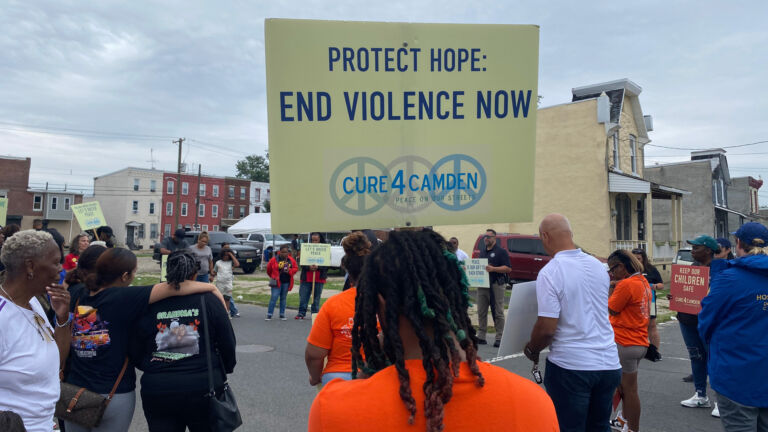
“This is really an election where we can … vote for continued progress [and] protecting the progress that we’ve made under the Biden-Harris administration to address this country’s epidemic of gun violence,” said Shani Nuckols, a volunteer with the New Jersey chapter of Moms Demand Action, which is part of Everytown for Gun Safety. “We can protect that progress and move it forward or we can see it turn back. The choice is just so clear and stark,” she said.
Moms Demand Action endorsed Harris for president in July along with several other gun safety groups.
Shifting attitudes
Social justice advocates, including Racquel Romans-Henry, say that each candidate’s decisions have the potential to shift not just policies, but attitudes around the issue, and that will “ultimately dictate” whether or not gun violence in one’s respective neighborhood is prioritized.
“When you see teams such as the Trenton Restorative Street Team, Newark Community Street Team and the establishment of community-based violence interruption programs in this state, much of that is the direct result of federal funding,” said Romans-Henry via email.
“If you are in a community that has directly benefited from these teams or similar teams and their violence interruption and youth mentorship programs or wish to see the establishment of these programs where you live, then this election absolutely matters.”
Through both executive action and the American Rescue Plan Act, the Biden-Harris administration funded and supported local public safety and community violence prevention programs, according to KFF.