
 Credit: (AP Photo/Joshua A. Bickel)
Electric cars have become a focus in this year’s presidential election.
Both major-party candidates, Vice President Kamala Harris and former President Donald Trump, have made sure to talk about electric vehicles during frequent visits to Michigan, a key swing state that is the heart of America’s auto industry.
Harris has a claim to the legacy of President Joe Biden’s administration, which has made historic investments in electric vehicles and created new regulations to push carmakers away from gas and diesel, and Harris has won the endorsement of the powerful United Auto Workers union.
Trump, meanwhile, has made misleading claims about possible vehicle mandates under Harris and has decried Biden’s efforts. But despite his vocal opposition to pro-EV policies, Trump has a powerful ally in Elon Musk, the world’s richest man and the leader of pioneering electric car company Tesla.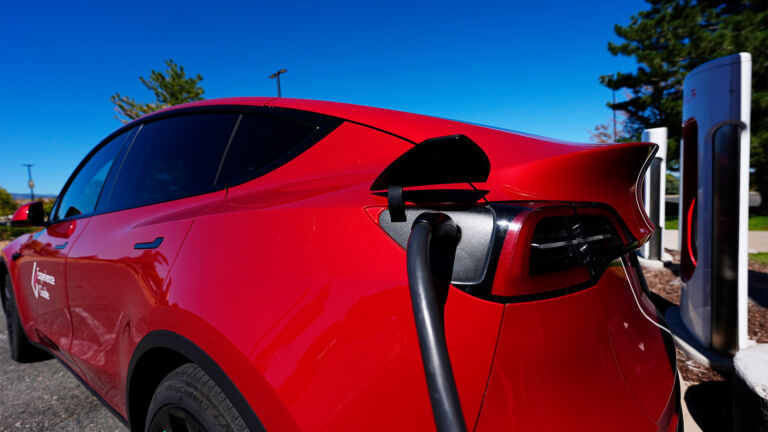
Voters’ choice in November may ultimately decide if valuable government incentives remain available for car buyers and how much money the federal government is willing to invest in the electric vehicle industry and its supporting infrastructure. But experts say that regardless of who wins, the transition to electric vehicles is almost certain to continue.
Greenhouse gas pollution
The transportation sector is the largest producer of greenhouse gas pollution in New Jersey and around the United States. Electrifying cars and trucks is seen as a critical step toward slashing the emissions that fuel climate change.
Biden’s biggest climate legacy may likely be shaping and signing the landmark Inflation Reduction Act, and boosting electric vehicles is a central part of that legislation. The law created new incentives for people to buy and lease electric vehicles and offered incentives for carmakers to base their electric vehicle manufacturing in America.
So far, it appears to have worked.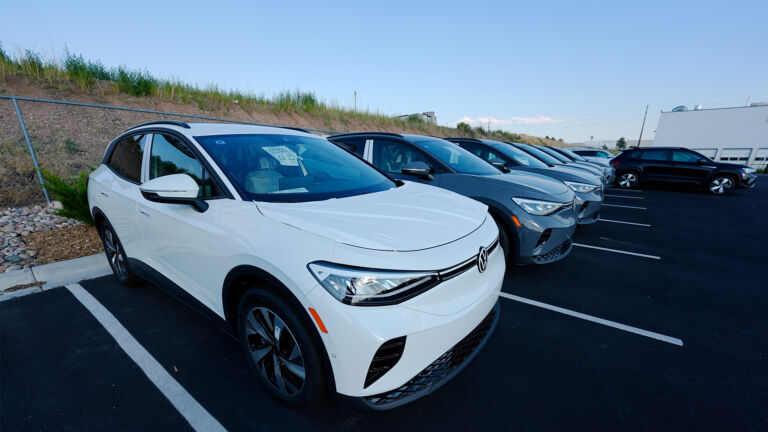
A recent analysis by Kelley Blue Book of electric vehicle sales nationwide in the third quarter of 2024 found sales were up 11% year over year, and that electric vehicles now make up nearly 9% of all car sales in America. That’s a record high, and a continuation of an upward trend.
Since the start of 2023, roughly 12% of new car purchases in New Jersey have been electric, according to Nick Nigro, the founder of Atlas Public Policy, a consulting firm that analyzes the industry. As of the end of June, more than 185,000 electric vehicles are on the road in the Garden State, according to the state Department of Environmental Protection.
“New Jersey is certainly in the top tier of states right now in terms of adoption,” Nigro said.
EV sales
As carmakers continue to bring new models to market, especially lower-cost models, sales will continue to increase, said Jim Appleton, president of the New Jersey Coalition of Automotive Retailers. Still, Appleton noted that sales have slowed in 2024 and are flattening after an initial surge of early adopters. Nigro agrees that sales won’t always grow evenly.
“It’s not going to be continuing up that slope. There are going to be fits and starts, this is a once-in-a-century transition,” Nigro said. “But it’s clear that the federal government’s return to leadership in this market has been transformative.”
Kelley Blue Book’s third-quarter analysis found that on average, incentives cover about 12% of the transaction price of an electric vehicle in America.
Doug O’Malley, the president of ChargEVC, which advocates for electric vehicle adoption, said federal incentives are critical to moving the needle in New Jersey. They are larger than the state incentives that they can be combined with, and the state incentive program often runs out of funding. He also noted that recent changes to state policy, which remove a sales tax exemption and increase registration fees for EVs, have made the federal incentives even more important.
“Rhetoric is one thing, but that investment has been historic,” O’Malley said.
Accessing the incentives can be tricky: The Treasury Department sets guidelines that restrict which cars are eligible based on where they are made, and from where their parts are sourced (though there are loopholes that make the incentives easier to get for leases.)
The guidelines “have made it very difficult for dealers to communicate to buyers that buying an electric vehicle is a good economic choice for them,” Appleton said.
Tariffs on imported EVs
Still, the public is taking advantage of the subsidies. Kelley Blue Book’s third-quarter analysis found that on average, incentives cover about 12% of the transaction price of an electric vehicle in America.
Biden has also pushed electric vehicles from a different front. The Environmental Protection Agency has written new tailpipe emissions standards that heavily pressure car companies to produce and sell more hybrid and fully electric models. And just last month, the Biden administration finalized a new 100% tariff on imports of electric vehicles from China.
One Biden policy seems very unlikely to change regardless of who wins in November: tariffs on Chinese EVs.
Harris has said she plans to continue Biden’s electric vehicle policies.
“We will ensure that the next generation of breakthroughs, from advanced batteries to electric vehicles, are not only invented but built right here in America by American union workers,” Harris said at a rally in Flint, Michigan earlier this month. “And Michigan, let us be clear, contrary to what my opponent is suggesting, I will never tell you what kind of car you have to drive.”
“To the extent that a Harris administration would continue strict EPA rules and continue to invest in publicly available charging infrastructure, I think you’re likely to see EV adoption continue,” Appleton said. “If the Trump administration eliminates cash-on-the-hood incentives, if it pulls back commitments to charging infrastructure, I think you’ll see a real dip in consumer demand for EVs.”
Trump not a fan of incentives
Trump has said he would consider ending the $7,500 federal incentive program for electric vehicle purchases, though getting rid of that program entirely requires the help of Congress. Michael Busler, a free-market economist and finance professor at Stockton University, said he expects Trump would call on Congress to do just that.
“His view will be that when markets are making transitions, it’s best to let the marketplace do it itself,” Busler.
A Trump administration could use executive action to reshape how those incentives are handed out, potentially making them more difficult to access. Even if Trump made such changes, or convinced Congress to scrap the incentives altogether, Sean Tucker, the lead editor of Kelley Blue Book, doesn’t anticipate much impact on the market.
“I think we’re reaching a tipping point with or without them,” Tucker said of the incentives.
Trump’s first presidency featured the rollback of a wide range of environmental protections, and experts say it’s likely he would try to undo the EPA tailpipe emissions rules set under Biden.
One Biden policy seems very unlikely to change regardless of who wins in November: tariffs on Chinese EVs. Trump has pitched an economic plan based on creating more tariffs on foreign goods, not fewer, and he has specifically touted tariffs on cars.
“Chinese cars have been absolutely drowning Europe, drowning it, it’s killing it. But because of me, they are not drowning America,” Trump said last week while speaking at the Detroit Economic Club. “You see very few of them because of the tariffs, and when they do come in, they pay a lot of money.”
“Both parties have come to the conclusion that the United States needs to build a lot more vehicles and parts of the supply chain in this country, and in allied countries,” Nigro said. “They both agree that we need to avoid the mistakes of the past, where our dependence on oil led to a lot of compromises in foreign policy.”
The California factor
It’s unclear how much impact the election of either Kamala Harris or Donald Trump will have on electric vehicle sales in New Jersey. The EPA tailpipe regulations are set to make an impact until the early 2030s, and even if they’re struck down, Appleton notes that New Jersey is one of multiple populous states bound to California’s more stringent standards.
“The auto market in New Jersey is not regulated by the federal government. It’s regulated by the California Air Resources Board,” Appleton said. “Our policies in New Jersey are set in Sacramento.”
Tucker also pointed out the other big subsidies in the Inflation Reduction Act, which offered lots of federal money to carmakers to transition American factories to EV production, and to build new factories. That kind of investment creates its own momentum.
“They’re not just going to build these new EV factories and then just leave them silent for 20 years,” Tucker said.
Ultimately, the shifting winds of federal policy may zigzag more quickly than car companies care to chase.
“Automakers don’t make planning decisions on a four-year horizon,” Tucker said. “It’s more like a 10- to 15-year horizon.”
_
