Credit: (NJ Spotlight News)
The killing by police of a Fort Lee woman experiencing a mental health crisis is raising new questions about the availability of a program that pairs mental health professionals with police to avoid such deadly incidents.
The woman’s death, one of several such incidents involving police and people in crisis in New Jersey over the last few years, has activists, community leaders and criminal justice experts asking for more details about the program and efforts by state and local leaders to keep people safe.
The woman’s brother called police in the early hours of July 28, reporting that his sister was having a mental health crisis. She needed to go to the hospital, the brother said, and had a knife in her hand. The woman, identified as 26-year-old Victoria G. Lee, was at some point shot and killed by police after officers arrived.
Update on Fort Lee case plus more on Arrive Together program
The state’s Arrive Together program, which pairs mental health professionals and law enforcement on emergency calls, is not yet available in Fort Lee.
How to keep people safe during mental health crisis
Criminal justice experts and advocates say more needs to be done to expand programs that help keep people experiencing mental health crises safe.
“You have a family member or a friend in crisis, and you dial 911 for help and they end up dead. It’s really not the way it’s supposed to play out,” Brian Higgins, a professor at John Jay College of Criminal Justice and the former chief of police and director of public safety for Bergen County, said of the shooting in Fort Lee before additional details were released.
Criminal justice experts say that the state should also focus on holding police accountable for misconduct — not just expanding programs like Arrive Together.
“Whether it’s Arrive Together or whatever other such mechanisms, it’s not going to be enough. These are, at most, Band-Aids,” said Jason Williams, a professor of justice studies at Montclair State University.
For years now, New Jersey has been pushing a model of policing called Arrive Together that pairs police officers with clinicians to reform the way police respond to people in a mental health crisis. The program, which began as a pilot in December 2021, is led by the state attorney general and operates in all 21 counties.
Arrive Together program is not universal
A 2023 study of the program showed that an overwhelming majority of Arrive Together calls did not result in arrest or in use of force by police. But not every police department in New Jersey, including Fort Lee’s, currently has the program.
Teaneck and Fort Lee are “finalizing the agreements necessary” to launch their Arrive Together programs in partnership with CarePlus NJ, Inc., according to Tara Oliver, a public information officer with the state attorney general’s office. CarePlus is a Paramus-based nonprofit that provides behavioral health services, medical care and social services through dozens of facilities in northern New Jersey.
Fort Lee Mayor Mark J. Sokolich did not return a request for comment.
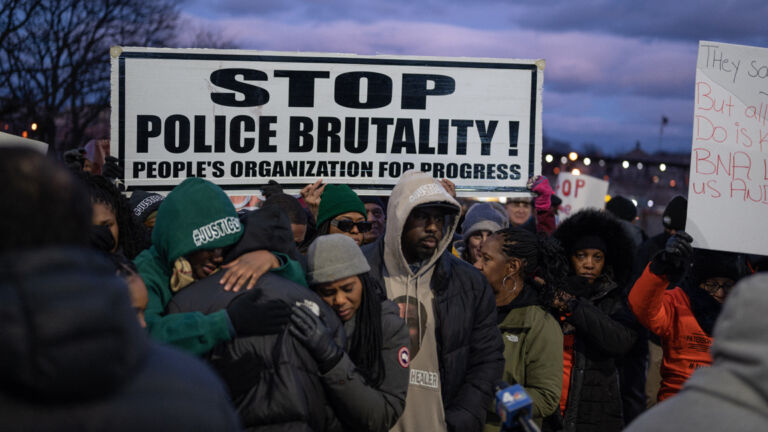
Arrive Together expanded over the last year, especially since Paterson police killed Najee Seabrooks in March 2023 while he was experiencing a mental health crisis. Seabrooks’ colleagues were trained to de-escalate mental health emergencies and were notably barred by police from helping the day of his death.
Reevaluating public safety in NJ
Liza Chowdhury, who worked alongside Seabrooks at the Paterson Healing Collective, said that the public safety landscape in New Jersey must change to a “shared safety paradigm,” recognizing that police officers cannot solve all problems because they are not mental health experts.
“We need to create more of an infrastructure that allows other folks that are trained and that are culturally informed and know the community, so that they can also be a part of this ecosystem of responding to these type(s) of calls specifically so that these types of tragic ends don’t happen,” Chowdhury, the executive director of the Paterson Healing Collective and Reimagining Justice Inc., said of the shooting in Fort Lee.
The Arrive Together program has received some criticism from advocates, who believe it is a police-first solution or refer to it as a “good first step.” Instead, they’ve called for further investment in community-led public safety programs.
In response, the state passed a law earlier this year called the Seabrooks-Washington Community-Led Crisis Response Act, named after Seabrooks and another man, Andrew Washington, who was killed by Jersey City police in August 2023 after experiencing a mental health crisis. The bill has allocated funding for grassroots organizations to carry out public safety measures in their cities, with grant recipients announced in July.
How these organizations will be allowed to work alongside — or instead of — law enforcement is yet to be seen. And only a few were eligible for this year’s round of funding, while dozens exist across the state.
Waning interest in reforms?
“I think we have a crisis of not only not having enough of these community-based organizations, but not really nurturing them in a way that they ought to be nurtured,” said Williams.
Meanwhile, police accountability measures have largely languished at the state level over the last several years. While there appeared to be a bipartisan fervor for police accountability in the wake of George Floyd, Breonna Taylor and Ahmaud Arbery’s killings in 2020, support for reform has largely diminished.
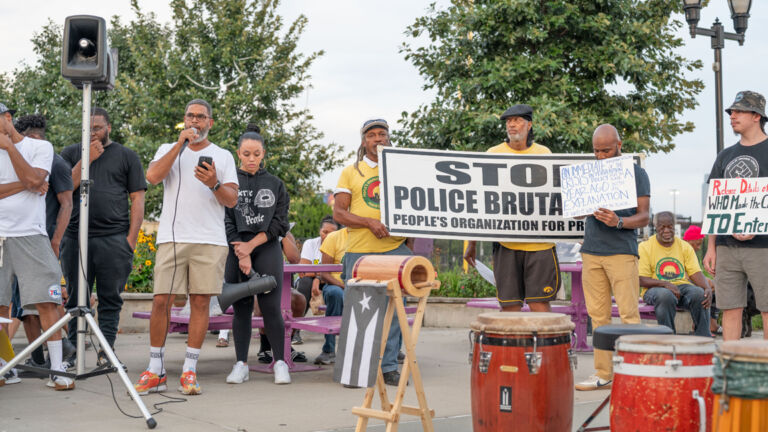
“It’s hard to imagine where we go from here, and especially since right now, a lot of the focus is on the community-based organizations, and necessarily so,” said Williams. “I’m inclined to believe that [lawmakers] see that almost as a proxy for also addressing the crisis in policing.”
Advocates, including Ashanti Jones of the New Jersey Institute for Social Justice, say that the shooting in Fort Lee is “exhausting.”
“This is not the first time that we’ve experienced something like this where people who are in the throes of a mental health crisis are met with a militarized response,” said Jones, a policy analyst at the organization. “It’s our belief, and really my belief, that people who are in the middle of a mental health crisis deserve to be met with care and appropriate responses.”