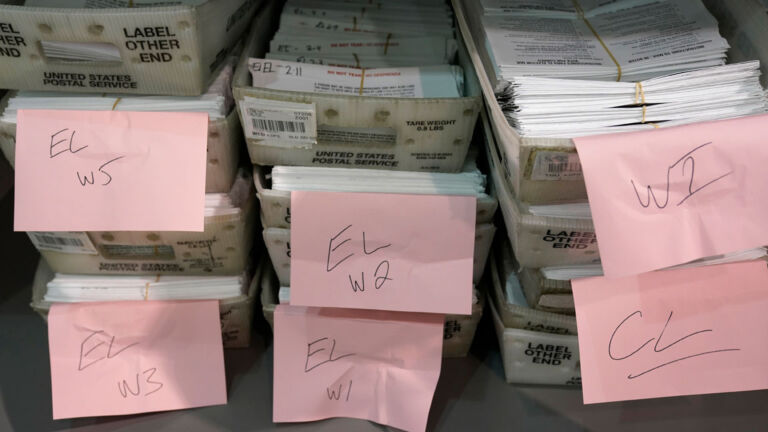
Credit: (AP Photo/Jose Luis Magana)
WASHINGTON – Every New Jersey Republican in Congress voted to make it more difficult for citizens to vote by requiring them to provide proof of citizenship when registering to vote, and two House Democratic members expected to run for governor next year joined them to criticize a local voting policy in the nation’s capital city.
Speaking last month, Sen. Mike Lee, a Utah Republican, touted his bill to require proof of citizenship to register to vote, calling it a step to ensure “that no American vote would be canceled out by a vote cast illegally by a noncitizen.”
Congressional Republicans, including Reps. Jeff Van Drew (R-2nd), Chris Smith (R-4th) and Tom Kean Jr. (R-7th) voted in May for that bill (H.R. 8281), which cleared the House 221-198. Five Democrats in tough reelection races joined Republicans. The legislation is in the Senate, where Democrats hold a thin majority, and it stands little chance of becoming law due to opposition from Democrats and the Biden administration. Van Drew and Smith are also co-sponsors of the bill.
On a separate bill (H.R. 192), Reps. Josh Gottheimer (D-5th) and Mikie Sherrill (D-11th), considered possible candidates for the Democratic nominee for governor in 2025, voted with the state’s Republicans to strike down a new policy in Washington, D.C. that allows for residents who are not citizens to vote on local matters.
All five lawmakers also voted last year to disapprove of the D.C. policy.
Rare evidence
The myth that people who live in the U.S. but are not citizens are voting in significant numbers in American elections is again a centerpiece of Republicans’ election strategy this year, though it is already illegal for noncitizens to vote in federal elections.
Though there are cases of noncitizens registering to vote and voting, such instances are rare.
A federal law enacted in 1996 explicitly bars people who are not U.S. citizens from voting in federal elections, and no state allows noncitizens to vote in statewide elections. Voting illegally is a felony charge that can also result in fines, prison time and deportation.
Asked in May to provide examples of noncitizens voting, House Speaker Mike Johnson, a Louisiana Republican, could not.
San Francisco allows noncitizen parents and guardians to vote in school board elections, and some cities in Maryland and Vermont allow noncitizens to vote in municipal elections, according to the Bipartisan Policy Center.
In Washington, D.C., which has no voting representative in Congress, residents who are not citizens got a chance on June 4 to vote for candidates for D.C. Council — the city’s political body.
And last year Newark became the first municipality in New Jersey to allow residents 16 years and older to vote for school board seats, though implementation is delayed until 2025.
A matter of intuition
Asked in May to provide examples of noncitizens voting, House Speaker Mike Johnson, a Louisiana Republican, could not.
“The answer is that it’s unanswerable,” Johnson told reporters during a press conference about the Republican bill to require proof of citizenship to register to vote. “We all know, intuitively, that a lot of illegals are voting in federal elections, but it’s not something that is easily provable.”
Election experts have shown the volume of noncitizen votes is slim.
Shortly after he became president in 2017, Donald Trump said, incorrectly, that he would have won the popular vote in the presidential election against former Secretary of State Hillary Clinton, his Democratic opponent in the race, if undocumented immigrants had not voted.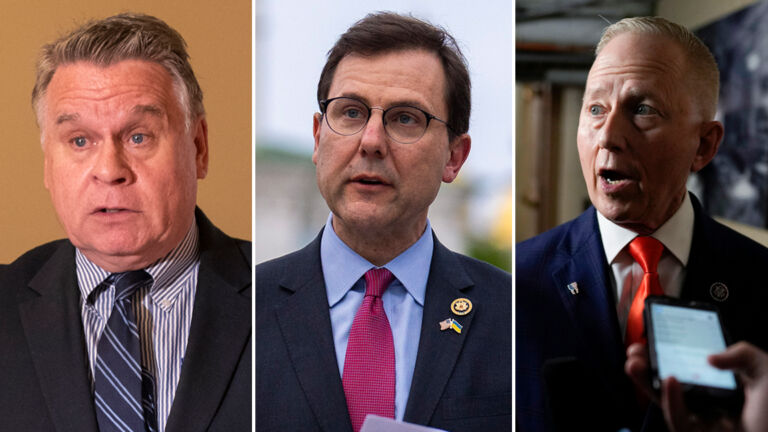
Trump later established a federal commission to investigate voter fraud, including voting by noncitizens, but it disbanded in 2018 after turning up no evidence of widespread fraud.
In an online post after the 2020 election, which Trump falsely claimed was “rigged,” Alex Nowrasteh, an immigration expert at the right-leaning Cato Institute, debunked claims of noncitizens voting in any way that swings elections.
State elections officials routinely check voter registrations for people who should not be allowed to vote.
“There are likely many problems with America’s voting system and there is no doubt that a non-zero number of non-citizens illegally voted, but there is no good evidence that noncitizens voted illegally in large enough numbers to actually shift the outcome of elections or even change the number of electoral votes,” Nowrasteh wrote in an essay entitled “Noncitizens Don’t Illegally Vote in Detectable Numbers.”
After the 2016 election cycle, researchers at the Brennan Center for Justice at New York University examined a sample of 23.5 million votes across more than 40 jurisdictions. They found 30 instances of noncitizens voting — a microscopic result.
Existing safeguards
People who register to vote in federal elections provide their Social Security number and a state ID, like a driver’s license.
Adding ID barriers, such as proof of citizenship provided in person, has been shown to disenfranchise people without easy access to documents that can show they are citizens, such as their birth certificates.
Voter ID laws lowered Latino turnout 10.3 percentage points and multiracial Americans’ turnout by 12.8 percentage point, according to a 2016 study by researchers at Michigan State University.
They also lowered turnout from naturalized citizens — people who were born elsewhere who became citizens — by 12.7%.
The study was based on a survey of more than 50,000 respondents.
A separate analysis House Democrats released last month highlighted two ways voting is more difficult for Native people within the U.S. — tribal IDs are often rejected and a scarcity of ballot drop sites.
Tribal ID cards are only accepted in 16 of the 36 states with voter ID laws, the report authors found, and Native voters often have to travel long distances to vote. For example: On the Hopi Reservation, a sovereign nation in Arizona that covers 2,532 square miles, there is one single drop box location.
State elections officials routinely check voter registrations for people who should not be allowed to vote.
This spring, the Ohio Secretary of State Frank LaRose, a Republican, announced his office had found 137 people registered to vote who are believed to have been noncitizens.
On Thursday, LaRose directed Ohio election boards to eliminate 499 additional noncitizens from voter rolls — a sliver of the roughly 8 million registered voters in Ohio.
— Charts by Genesis Obando