
New Jersey now has its first statewide requirements for election officials to report results, including a mandate to publicly post vote totals starting on election night and continuing until final results are tallied.
Elections in the state are conducted by county boards of election and county clerks and they have wide latitude, within state parameters, over most aspects, including ballot design, voting machines and polling locations.
On Thursday, Gov. Phil Murphy signed a bill (A-5176) that provides the first statewide parameters for when and how often officials must report results on their websites.
And it requires, for the first time, counties to provide the New Jersey Division of Elections with updated results daily while the counting continues. The division is to post those results on its website, which would mean people could find results for any race in the state in one spot, rather than having to visit 21 different county websites. The law gives the division $1.5 million to implement the reporting requirements.
The need for standardization
Legislators began to recognize the need for some minimal standardization in results reporting over the last several years as the increased use of voting by mail, in particular, has stretched the counting of ballots several days beyond the close of polls and as public mistrust of election results grew following the election of Donald Trump in 2016 and his loss in 2020. The bill passed earlier this year with near unanimous backing.
In particular, rumors and conspiracies flourished in the wake of the 2021 gubernatorial election. As most people went to bed on election night, Republican Jack Ciattarelli had a slim lead in the results that had been reported. But once Bergen County reported more votes, that put Murphy ahead and subsequent mail-in ballots sealed his victory. Murphy won by little more than 3% of the vote.
‘This law will further ensure that clarity, eliminate confusion about results, and serve to counteract misinformation that circulates on social media and elsewhere.’ — Sen. Andrew Zwicker (D-Middlesex)
“Standardizing the way we provide information between election day and certification in New Jersey will increase transparency and enhance voter confidence in the outcomes of our elections,” said Lauren Zyriek Enriquez, acting director of the Division of Elections.
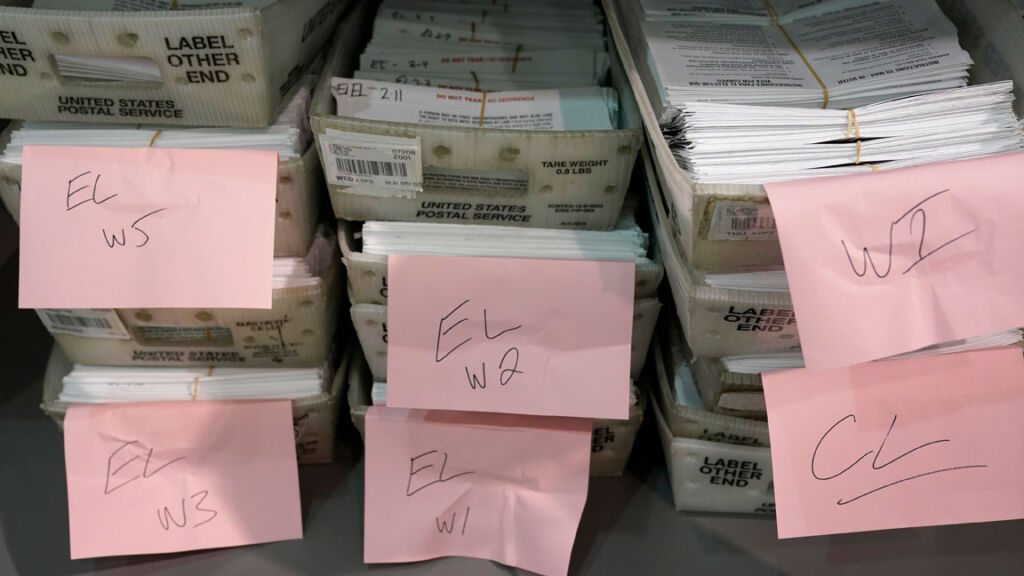
Counties use a number of different programs for providing results, some more detailed than others, and will be able to continue to do so. But at a minimum, all will now have to report the number and types of ballots — early in-person, Election Day, mail-in and provisional — that have been received and, when possible, the number and types of ballots that have been counted and remain to be counted. Officials will have to post the first report by 11:59 p.m. on the day of the primary and general election and update it by 9 p.m. daily until the election is certified.
Keeping up with the numbers
Until now, county officials usually have posted at least some results, though not necessarily counts by type of ballots, well before 11:59 p.m. on election night. And most, though not all, have posted daily updates. But it has not always been clear how many votes and of what type are outstanding, information that can be especially important in close races where late-counted mail-in or provisional ballots could determine who wins. The law also requires the reporting of the data at the legislative district level, as well as the county and municipal levels.
The law does not require county officials to keep a daily count of mail-in ballots as they arrive; a county could decide to wait until the deadline for receipt of late mail-in ballots before counting them all at once. But they must report the numbers counted daily.
The Division of Elections is to create a standardized reporting template for all counties to follow, beginning with this November’s election.
“A clear and open election process is one of the foundations of our democracy,” said the bill’s prime sponsor in the Senate, Andrew Zwicker (D-Middlesex). “This law will further ensure that clarity, eliminate confusion about results, and serve to counteract misinformation that circulates on social media and elsewhere.”
