
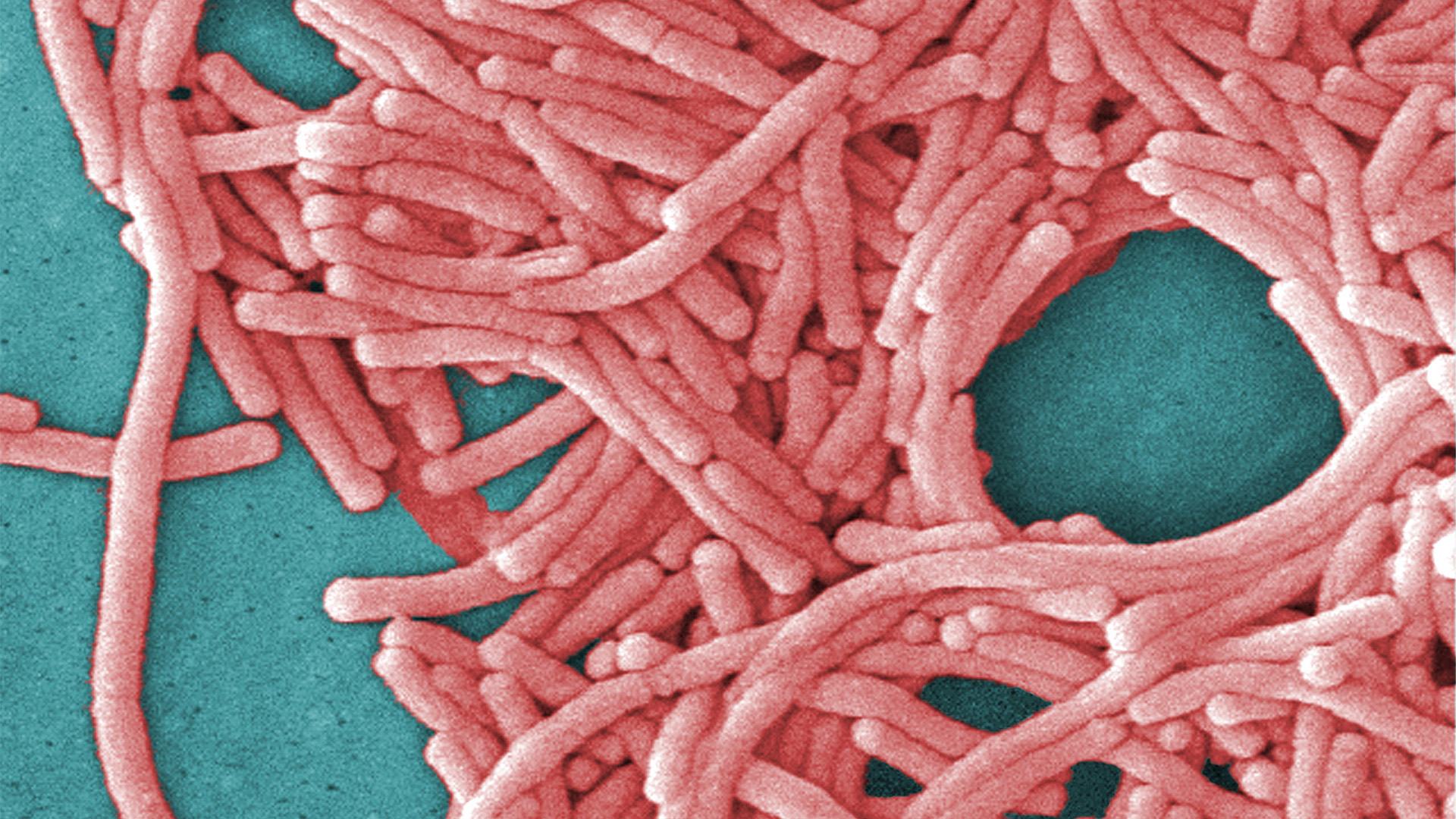
 Credit: (Janice Haney Carr/Centers for Disease Control and Prevention via AP)
Seven years ago, Morristown resident Kevin Hanlon, then 47, was recovering from lung cancer when he encountered something in a Manhattan office building that proved even more deadly: Legionella.
The bacteria, spread through water droplets propelled by powerful commercial air conditioners, resulted in Legionnaires’ disease, a serious pneumonia that is particularly dangerous to people with preexisting health conditions. Ten months later he was dead.
“It blows my mind that in the state of New Jersey I cannot get a plastic bag, but our water will kill you,” his widow Gwen Hanlon told the Senate Health, Human Services and Senior Citizens Committee in May. It was her seventh time in nearly as many years testifying in favor of a bill that would overhaul how New Jersey regulates public drinking water systems, which lawmakers passed in June and now awaits Gov. Phil Murphy’s signature to become law.
“My family still has no answers,” Gwen Hanlon told lawmakers.
In New Jersey 269 people were diagnosed with Legionnaires’ in 2023, state officials said, including 20 who died, and the state investigated outbreaks in Bergen, Passaic and Mercer counties in recent years.
Legionnaires’ disease — first identified in 1976 following an outbreak at an American Legion convention in Philadelphia — is a severe lung infection that typically kills one in 10 people infected, according to the federal Centers for Disease Control and Prevention, although the rate is closer to 25% among people who have underlying health conditions. Treatment involves antibiotics and often requires hospitalization.
Summertime risks
Reports of the disease often emerge during the summer months, when people are spending more time in air-conditioning or around pools and other water sources, but infection can happen at any time of the year, according to state health officials. The bacteria live in fresh water and can infect people who inhale microscopic droplets in air circulated by powerful commercial HVAC systems, or water from baths and showers or untreated spas, pools and fountains. People can also be infected if they incorrectly swallow contaminated water and droplets enter their lungs.
It is not found in home air-conditioning units, which don’t use water.
Experts suggest that the real impact of Legionnaires’ disease could be two or more times greater than the number of diagnoses now recorded nationwide.
At least 20 other states have taken steps to better monitor drinking water systems, lead sponsor of the legislation Sen. Teresa Ruiz (D-Essex) told the health committee in May, but she said New Jersey has lagged. Nationwide, cases of Legionnaires’ soared some 900% between 2000 and 2018, federal data shows.
Ruiz told NJ Spotlight News that she introduced the bill following media reports of a “devastating” outbreak in New York City in 2015 and “equally disturbing” cases that then cropped up in Newark. “The personal impact of these outbreaks in my own community drove me to take proactive measures not only for the people of Newark but for the entire State. Over the years, we’ve seen Legionnaires’ outbreaks in several New Jersey counties. We cannot afford to wait for a statewide crisis to act,” she said in a written statement.
What new regulations would entail
The legislation (S-2188), championed by Assemblywoman Shanique Speight (D-Essex) in that house, calls on the state Department of Environmental Protection to draft regulations for the operation and maintenance of public water systems that serve at least 100 facilities. The state Health Department would need to further codify how Legionnaires’ cases are investigated. The two agencies would be charged with working together on a public awareness campaign, under the bill, and expand the system of alerts if something worrisome is discovered.
In addition, the bill calls for owners of public water systems to regularly update state officials with data reflecting their work. Hospitals, nursing homes, high-rise residential buildings, senior complexes, hotels, motels and various other commercial and industrial facilities would be required to develop water management plans designed to reduce the development and spread of Legionella bacteria.
Ruiz said some drinking water providers had worried that additional regulation would be onerous but told lawmakers in May that most were already meeting the criteria outlined in the bill. The New Jersey Business and Industry Association, American Water, the New Jersey Utilities Association and others opposed the measure in May, with some suggesting the bill would only make the problem worse. Other stakeholders — including real estate interests, other drinking-water providers and the Chemistry Council of New Jersey — testified in support of the bill. Some Republicans voted against the measure, citing industry concerns.
Legionnaires’ in NJ
The Health Department now maintains a Legionella website that includes educational material about the bacteria and the disease, and guidance for homeowners on how to clean shower heads, flush water heaters and keep drinking water safe. There are also resources for people who manage hospitals, nursing homes and other buildings, and steps on how clinicians must report cases of the disease.
“The Department receives approximately 250-375 reports of Legionnaires’ disease each year and works closely with local health departments to investigate reports of Legionnaires’ cases and potential sources of infection. Investigations can be lengthy and identifying the exact source is often challenging,” communications director Dalya Ewais said in an email.
The number of cases diagnosed in New Jersey has wavered in recent years, while deaths appear to be declining, according to state data. In 2022, 235 cases were reported, with 21 fatalities. In 2021, the state recorded 246 cases, but 32 deaths.
But Gwen Hanlon, who has become an advocate in the wake of her husband’s death and now serves on the board of Prevent Legionnaires,’ a nonprofit founded last year, notes that the disease — with symptoms like coughing and body aches — can easily be mistaken for COVID-19 or other conditions and is often missed. Experts suggest that the real impact of Legionnaires’ disease could be two or more times greater than the number of diagnoses now recorded nationwide.
