
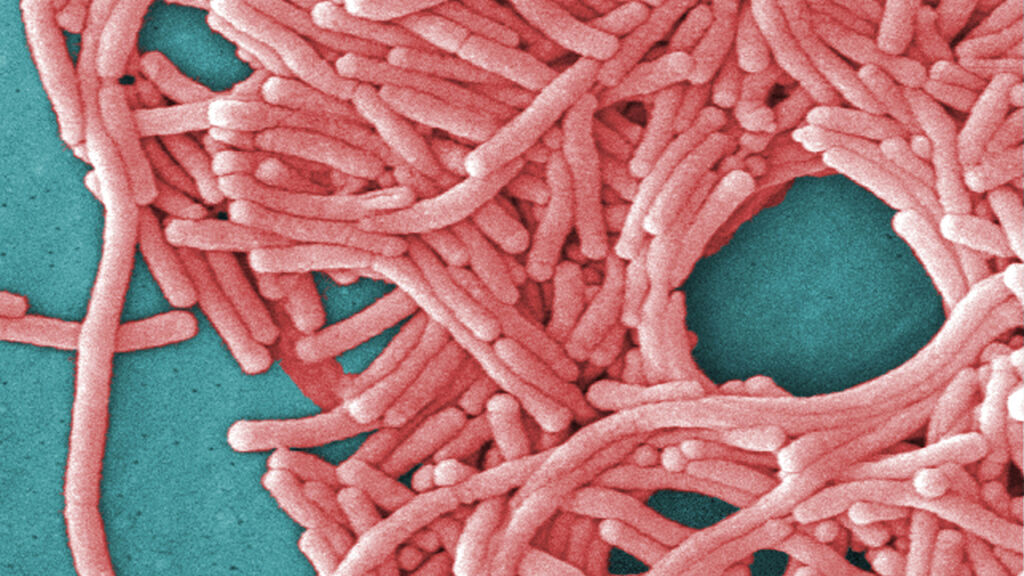
New Jersey officials announced four new cases of Legionnaires’ disease — one of which was fatal — in Hamilton Township, the site of several previous outbreaks in recent years.
While this was not the first Legionnaires’ death this year, it is the first one linked to this community, where several people died last year from this form of pneumonia.
The state Department of Health is working with other state and local officials to identify the source of the Legionella bacteria, which live in fresh water — including air-conditioning systems — and were found in the water systems of roughly a dozen Hamilton Township homes served by the same company, Trenton Water Works.
All four new cases involved people who lived in homes served by Trenton Water Works.
Legionnaires’ disease was diagnosed in 246 New Jerseyans last year, at least 30 of whom died. People can be infected when they breathe air containing Legionella-infected droplets or also through aspiration if they swallow tainted water “down the wrong tube,” health officials said.
It is not clear if the latest Hamilton Township outbreak is connected to the nine cases identified in the township last summer, at least three of which were fatal, according to The Trentonian, or diagnoses in that community in previous years. State officials said these latest cases are not related to a trio of cases in May involving people who had stayed at the Hilton/Hampton Inn Parsippany Hotel between July and October 2021. Overall case and death numbers are not yet available for 2022.
The health department is working to identify the source of the Legionella bacteria, which were found in the water systems of roughly a dozen Hamilton Township homes served by Trenton Water Works. This includes the four new cases.
While healthy people are rarely sickened by exposure to Legionella, people over age 50, smokers and those with lung issues, immune disparities or other chronic conditions are more at risk, according to the health department. Symptoms are similar to those seen with COVID-19 and include cough, shortness of breath, body aches and fever. Health officials urged New Jerseyans — Hamilton Township residents in particular — to watch for signs of infection and seek help if needed, as the disease is treatable with antibiotics.
The news of Legionnaires’ disease comes as New Jersey continues to grapple with the COVID-19 pandemic — nearly 2.7 million residents have tested positive for COVID-19, and more than 34,500 have died as a result — and several other outbreaks, both rare and regular occurrences. While daily COVID-19 case numbers have trended downward for much of the month, related hospitalizations have hovered near 800 for weeks, according to an NJ Spotlight News analysis of state data.
Latest monkeypox, West Nile cases
Health officials had also recorded more than 500 cases of monkeypox as of Monday, a quarter of which are in Hudson County alone, according to state health department figures. Three dozen of those infected in New Jersey have been hospitalized. Nationwide, monkeypox has been diagnosed in nearly 17,500 Americans in what has quickly become the largest U.S. outbreak ever, but no one has died from the virus.
Monkeypox is transmitted primarily by close contact, causes body aches, fever and later a rash and pimple-like sores, and is currently spreading almost exclusively among men who have sex with men. New Jersey has mobilized a vaccination campaign with nearly a dozen locations following an outcry from gay advocates, but access to the shots remains somewhat limited.
Last week, the health department reported the season’s first human cases of West Nile virus involving three adult males in three different counties. West Nile is a mosquito-borne illness that can cause headache, fever, muscle weakness and, when serious, paralysis or coma. People 50 years and older and those with weakened immune systems are most at risk for sickness, the department said, urging residents to use bug spray and otherwise avoid mosquito bites, as treatment options for West Nile are limited.
A quarter of monkeypox cases are in Hudson County alone, according to state data. Three dozen of those infected statewide have been hospitalized. The health department has also reported the season’s first human cases of West Nile virus involving three adult males in three different counties.
While West Nile virus is diagnosed in eight New Jerseyans a year, on average, the state recorded 36 cases last year — and could see double-digit numbers again in 2022. The level of virus found in mosquitoes trapped from nearly 300 different pools shows high concentrations of the virus this year, the DOH said, noting this aligns with a five-year cyclical trend. Horses can also be infected, although none have been diagnosed with the virus this year.
“August and September are the months that we see most West Nile virus cases in New Jersey,” said state health commissioner Judy Persichilli. “It is important that residents take steps to protect themselves by using an EPA-registered insect repellent, wearing long sleeves and pants and avoiding the outdoors during dawn and dusk when mosquitoes are most active.”
Some good news about polio, measles
On the plus side, New Jersey has not reported any cases of polio recently. While the U.S. effectively eradicated the virus decades ago through an aggressive vaccination campaign, it has resurfaced recently among people in Rockland County, New York, where immunization rates lag far behind national norms.
New Jersey also has not seen any new cases of measles this year — another condition that was nearly stamped out in this country through vaccinations — after dozens of people were diagnosed in Lakewood during 2018 and 2019. At the time, officials believed these cases were linked to outbreaks then occurring in Rockland County and Israel. All three locations are home to large Orthodox Jewish communities, and some members travel among these and other sites regularly.
Next steps in Legionnaires’ prevention
With the new reports of Legionnaires’ disease, state health and environmental officials are working with Hamilton Township leaders and those at Trenton Water Works to identify other locations — in that township or other jurisdictions — that may have bacteria-laden water systems. They recruited 20 homeowners with Trenton Water Works service to be screened for the bacteria, and more than half were found to be infected by Legionella, health officials said.
While diagnoses of Legionnaires’ disease are still limited to four people from Hamilton Township, state officials said there is no safe level of Legionella in water and encouraged home and business owners to take steps to keep themselves safe. Those at higher risk for the disease should avoid hot tubs, power washing and other activities that can generate water mist. Shower heads, taps, humidifiers and other water-related appliances should be kept clean, they said, and water heaters should be set at a minimum of 120 degrees.
More guidance for homeowners, commercial building operators and health care providers can be found on the health department website.
— Graphic by Genesis Obando
