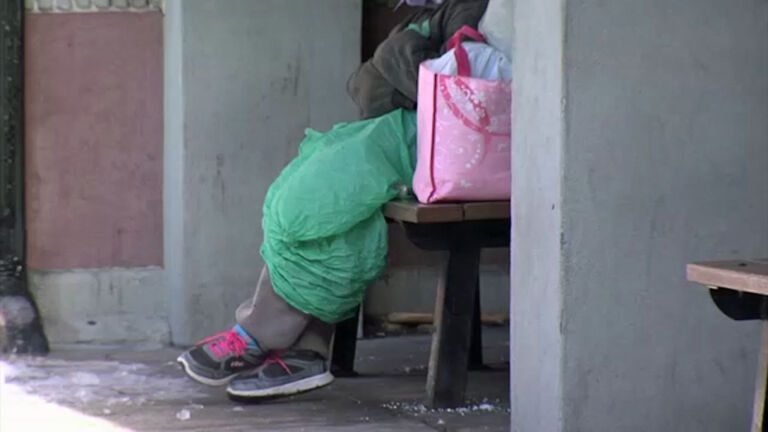
Credit: (AP Photo/Jenny Kane)
More New Jersey towns could soon prohibit sleeping or camping in public places after the U.S. Supreme Court said a small Oregon city can enforce a ban on people sleeping outside, even if they have nowhere else to go.
The decision is likely to affect how cities and states across the country set ordinances that impact people who are homeless.
The ruling is the most significant to come before the court in decades on the issue of homelessness and comes as several New Jersey towns already make it illegal for people to sleep on streets, in public parks or in their cars.
“At the end of the day, this is like a new type of segregation,” said Tiffany Travia, pastor at the First United Methodist Church in Hammonton. “Historically, segregation has been on the basis of race and gender, but now we’re basing it on class.”
Hammonton is one of at least three towns in South Jersey that do not allow people to sleep on streets, sidewalks or in public parks at any time. Violators face a fine of up to $1,000 or 90 days in prison, among other penalties. Hammonton police officers have not issued any summons under the ordinance since it was amended and enacted last September, according to Steve DiDonato, the town’s mayor.
How the court divided
The 6-3 decision issued Friday by the Supreme Court, which was split along ideological lines, reversed a ruling by a San Francisco-based appeals court that found outdoor sleeping bans amount to cruel and unusual punishment. The majority of the Supreme Court justices found that the Eighth Amendment prohibition does not extend to outdoor sleeping bans.
“Homelessness is complex. Its causes are many. So may be the public policy responses required to address it,” Justice Neil Gorsuch wrote for the majority.
“A handful of federal judges cannot begin to ‘match’ the collective wisdom the American people possess in deciding ‘how best to handle’ a pressing social question like homelessness,” Gorsuch wrote.
Justice Sonia Sotomayor disagreed, writing in her dissent that sleep is a “biological necessity, not a crime” and that for some people sleeping outside is their “only option.”
‘This decision is inhumane. It punishes people who are struggling simply because they are struggling.’ — U.S. Rep. Bonnie Watson Coleman (D-12th)
The city of Grants Pass jails and fines people for sleeping anywhere in public at any time, including in their cars, if they use as little as a blanket to keep warm or a rolled-up shirt as a pillow, Sotomayor wrote.
“For people with no access to shelter, that punishes them for being homeless. That is unconscionable and unconstitutional,” Sotomayor wrote.
Grants Pass started fining people $295 for sleeping outside to manage homeless encampments that sprang up in the city’s public parks as the cost of housing escalated, The Associated Press reported.
Fears over how the decision will reverberate
National housing advocates, including Steve Berg of the National Alliance to End Homelessness, said they will be working “very hard” to convince communities that even though the Supreme Court said they can criminalize homelessness, doing so is a bad idea.
“If they [cities seeking to adopt the court’s ruling] want to have less homelessness, the way to deal with that is by getting people into housing as quickly as possible with the services they need to stay stabilized in the housing,” said Berg, the chief policy officer at the Washington, D.C.-based nonprofit.
‘Homelessness is complex. Its causes are many. So may be the public policy responses required to address it.’ — Justice Neil Gorsuch wrote for the majority.
In New Jersey, well over 10,000 people were homeless on a single night in late January 2023, according to NJ Counts 2023, the state’s annual point-in-time count of homeless people in the state. Additionally, there is a shortage of over 214,000 rental units that are affordable and available for extremely low-income renters in New Jersey, according to the National Low Income Housing Coalition.
“This decision is inhumane. It punishes people who are struggling simply because they are struggling,” U.S. Rep. Bonnie Watson Coleman (D-12th) said in a statement.
Housing advocates across the state, including Richard Uniacke of Bridges Outreach, Inc., said they are “extremely disappointed” but not surprised that the Supreme Court ruled in favor of Grants Pass.
“It underscores the job that we have in front of us to do everything we can to solve chronic and unsheltered homelessness,” said Uniacke, the president of the nonprofit corporation, which works to address and end chronic homelessness in Essex and Union counties.
Similar laws in some NJ towns
In addition to Hammonton, Middle Township in Cape May County and Egg Harbor Township in Atlantic County also have similar laws in place against sleeping in public. In Middle Township, a person convicted of violating its law can be fined up to $2,000 or be incarcerated for 90 days. And in Egg Harbor Township, violators of a similar measure face a fine between $100 and $2,000 or up to 90 days in jail. Meanwhile, Shore towns like Avalon do not allow people to sleep in or live out of their cars on public or private property within the borough.
These laws are not unique to South Jersey. In Union County, Roselle Park does not allow people to sleep in a public space if they create any “disturbances or annoyance to the comfort and repose of any person.” The borough also bans people from using a car or trailer for sleeping or living in any public place.
“This ruling paves the way for those kinds of ordinances,” said Uniacke.