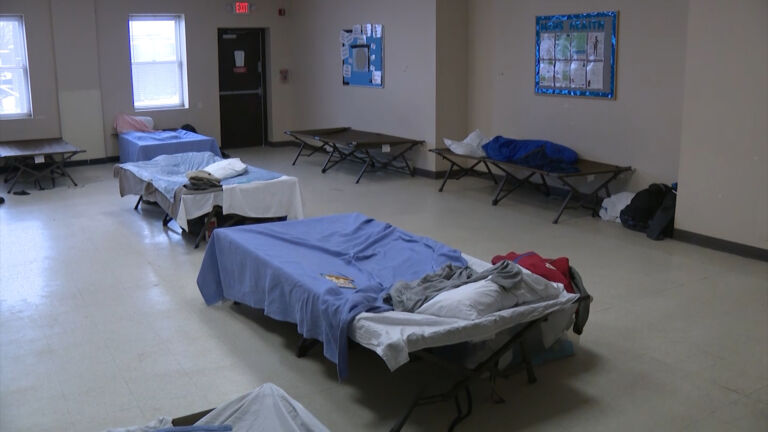
As housing advocates in New Jersey await the U.S. Supreme Court’s ruling in the City of Grants Pass, Oregon v. Johnson, many remain concerned about the case’s impact on homeless people in the state.
The Supreme Court will decide, likely in the coming months whether fining, ticketing or jailing people with nowhere else to go for sleeping outside on public property is an unconstitutionally cruel and unusual punishment.
A ruling in favor of the plaintiffs, the city of Grants Pass, Oregon, would make it easier for communities to clear out tent encampments, even if no available housing or shelters exist.
In late April, the court heard oral arguments on the case, with a majority of the justices appearing to side with the city. The case has sweeping implications for how cities across the country address homelessness and is the most consequential case in decades concerning the rights of homeless people.
The number of homeless people in the United States between 2022 and 2023 increased by 12%, or roughly 70,650 people, according to the 2023 Annual Homelessness Assessment Report to Congress from the U.S. Department of Housing and Urban Development. And in New Jersey, over 10,200 people were experiencing homelessness on a single night in January 2023, according to a summary of NJ Counts, the state’s annual point-in-time count of homeless people.
Meanwhile, legislation that would create a Homeless Bill of Rights has not yet been voted on in the Legislature. The bill, if signed into law, would aim to ensure that a person does not “suffer unnecessarily” or is “subject to unfair discrimination” based on their homeless status.
With the Supreme Court ruling pending, NJ Spotlight News spoke with Jeff Wild, an attorney at Lowenstein Sandler LLP and a co-founder and trustee of the New Jersey Coalition to End Homelessness. The conversation touched upon the legal implications of the decision for people experiencing homelessness in New Jersey and the right to emergency shelter in the state.
This transcript has been edited for length and clarity.
NJ Spotlight News: Could you explain the legal implications for people experiencing homelessness in New Jersey if the U.S. Supreme Court were to rule in favor of Grants Pass?
Jeff Wild: If the court overrules precedent and finds that criminalizing homelessness is legal, it would be unthinkable to anyone with a conscience and it would be a new low in basic human rights.
It would be the first time, I believe, in U.S. history where involuntary conduct can now be a crime. Imagine that a city or state government in America could put you in jail for something involuntary — having green eyes, a seizure disorder — it’s unthinkable. But it is the same situation, or it would be, if the court goes the wrong way for tens of thousands of men and women living in New Jersey right now, including dozens of my clients from the northern tip of the state to the southern tip of the state. They are retired senior citizens on oxygen, some of them. Some are veterans who have served their country and they absolutely hate being forced to live outdoors. But they are in New Jersey, where there’s no emergency shelter beds. And if they have a choice of trespassing on private property, which is clearly illegal, or collapsing and sleeping on public property, they have no choice. They sleep on public property in the woods or wherever they can.
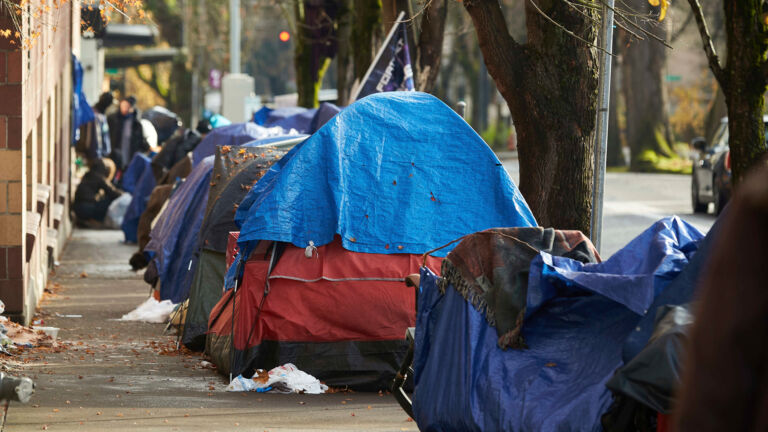
Court will rule if people who are homeless can be fined or jailed for camping on public property — even if they have no other viable option for shelter
Under the law as of today, it violates the Eighth Amendment to the U.S. Constitution to punish people for being unhoused because it is cruel and unusual punishment. It’s something which they cannot do anything about. And my clients, they are going to the emergency shelter sources and they’re being turned away because there are no available beds. And in New Jersey, they have been charged by the police for the involuntary homelessness and that’s something, under current law, [that] is unconstitutional under the U.S. Constitution.
NJSN: How could this ruling potentially impact the safety of homeless people in the state?
JW: I have known clients who have died in the winter outside. This is a life-and-death issue. And it’s about life in a broader sense. If you lose your home or lose your job and you are outside, all you can do is try to survive. You can’t get a job. You don’t have an address to put on your job application. This is as important an issue as you can imagine legally to my clients here. And these are people who are just like you and me. They are people who work when they can. They are people who had jobs just like you and me. They had homes just like you and me. But a little bit of bad luck, you could find yourself and I could find myself outside just like them.
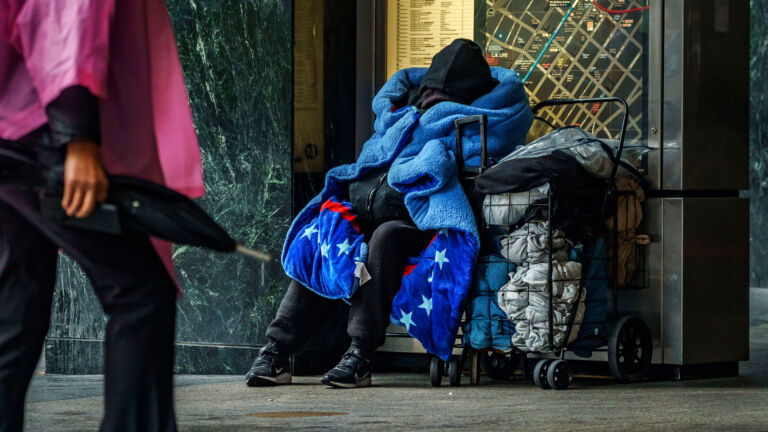
Services will include clinical assessments, case management, medication management and counseling
I am not in favor of people living outdoors. I think it is shocking and it should never happen. If the court rules that people cannot live outdoors, then the government will have no incentive to actually solve the problem, which could be easily solved by making more emergency shelter and more affordable homes available.
NJSN: What more needs to be done in the state to address the rights of people experiencing homelessness?
JW: Well, it’s not a big ask. All that we are asking for is that there should be a right to emergency shelter.
All we’re asking is that New Jersey recognize that there is a right to emergency housing, and that no one should be outside living on public land. It’s completely solvable. It would be wonderful and common sense if there were laws that prevented people from having to live outside.
NJSN: Can you walk through the legal process of what happens when somebody cannot afford to pay a fine for sleeping outside? How could that then impact their life for years to come?
JW: It is sort of a Catch-22 because if you are arrested for involuntary conduct, even if you are fined $100 for involuntary conduct, you can’t pay the fine. Eventually, you end up in jail. And even if you eventually do get out of jail, well now you have a criminal record behind you and it’s even harder than it was before to get a job and afford housing on your own. So it is counterproductive, and terrible policy, to think that the problem of homelessness should be dealt with just by ticketing people, arresting people or jailing people.
NJSN: How could this ruling impact families who are homeless or are being threatened with eviction?
JW: It’s particularly a scary situation for families. I’m a father. I’m a grandfather. And the thought that a parent could not keep their children housed and would be forced to find someplace to live outside is unthinkable, but it is unfortunately a reality that does happen. And it’s hard to understand — where we worry about so many other things day to day here — that we can’t have laws that allow parents to house their children, that allow men and women to live indoors.
It ends up costing the taxpayer so much more not to house people. We pay for the social services where people are put in a motel as a Band-Aid and we waste money on motels and they end up outside or people end up in the hospital. It’s tremendously wasteful for all of us who pay taxes in New Jersey. But if the Supreme Court allows the criminalization of homelessness, I fear that we’re going to continue to punish innocent men and women and children. And we’re going to continue to waste millions of dollars of taxpayer money.