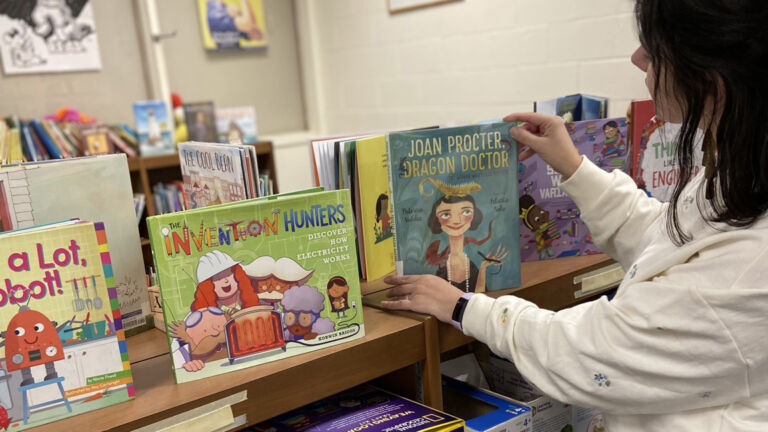
Credit: (Hannah Gross/NJ Spotlight News)
New Jersey is one of just a handful of states that does not have legislation outlining how children should be taught to read. But this could change soon as a bill that would require universal literacy screenings for elementary school students and professional development for teachers cleared its first committee Thursday.
The bill would establish a working group on student literacy that would recommend best practices to the state Department of Education. Its prime sponsors are Sen. Majority Leader Teresa Ruiz (D-Essex) and Senate Education Committee Chair Sen. Vin Gopal (D-Monmouth). It cleared the Senate Education Committee unanimously and had widespread support from groups representing students with learning disabilities, teachers and school administrators.
The bill focuses on foundational literacy, which it defines as evidence-based reading instruction that addresses language acquisition, phonological and phonemic awareness, comprehension, phonics, spelling and other skills.
Improving literacy rates
In New Jersey, 42% of third graders met or exceeded expectations on state English language arts assessments taken in spring 2023. Passing rates were lower for some of the most disadvantaged groups of students, including those with disabilities, multilingual learners, Black students, Latino students and students who receive free or reduced-price lunch.
Reading proficiency dropped during the pandemic and has yet to recover to 2019 levels in many New Jersey school districts. But even before the pandemic, many New Jersey students moved on to fourth grade without the ability to read at grade level.
“COVID shined a light on it, but the problems existed long before that,” said Liz Barnes, executive director of the Decoding Dyslexia advocacy group.
In The Change Project, NJ Spotlight News explored methods for improving reading instruction that have shown promise in New Jersey and across the country, including universal screeners and professional development.
Ella, a student NJ Spotlight News spoke to as part of The Change Project, testified at the hearing in support of the legislation. Ella is entering a general education class for fifth grade after completing fourth grade in special education. She said becoming a stronger reader has helped her confidence and will help her peers succeed, as well.
“My teacher told me if I can do the work now it would be easier than when I am older,” Ella said.
Caden, a sixth grade student from Union Township Middle School, said he understands the importance of getting help to struggling readers as soon as possible. At the beginning of fourth grade, Caden was reading below grade level. He said explicit instruction in reading helped him improve his reading skills significantly and prepared him to move from a special education classroom to general education for fifth grade.
“This is because I had a teacher who was a certified structured language teacher. She taught in ways that are known to help struggling readers. I was also able to get tutoring from my teacher over the summer, but not all families can afford tutors,” Caden said. “Every child deserves to learn to read and that means they need a teacher who knows how to do it.”
Screening for reading deficiencies
The bill would require universal literacy screening for students in kindergarten through third grade to catch any reading deficiencies early in a student’s education to get them the support they need faster. Universal literacy screening is defined in the bill as a process that gathers information about a student’s literacy skills to identify those with reading difficulties to inform instruction and differentiate targeted intervention.
Screening must happen at least twice a year under the proposed legislation. Within 30 days of screening, schools must notify a parent or guardian of how their student performed and provide information about opportunities for reading intervention and other supports under the bill. The school district must also share screening data with the Department of Education.
Many districts are already screening students for reading deficiencies, but the bill would make it a statewide requirement. Natalie Franzi Dougherty, supervisor of elementary education in Metuchen, said that school district has been screening students since the start of the 2021-2022 school year. Screening helped the district shift instructional practices to meet students’ needs and deliver higher-quality instruction, she said. But it wouldn’t have been possible without federal funding, she said, urging lawmakers to provide funding to support districts.
“The bill proposed by Senate Majority Leader Ruiz supports all schools in implementing these practices. And together with our newly adopted standards it provides a framework for all students to be successful,” Dougherty said.
Professional development
The bill also requires the Department of Education to create a free professional development program on evidence-based foundational literacy instruction.
Under the bill, the program would include different topics for early and later elementary grades, as well as for teachers and administrators. Schools would use the program or another similar one to provide annual professional development to teaching staff, school library media specialists and school administrators.
‘We’re a little late in the state to be honest. Other states have already implemented strategies in a uniform approach, which we’re hoping this bill can do.’ — Sen. Teresa Ruiz (D-Essex)
The Education Department previously offered free professional development on reading through its RAPID program, which stands for Reading Acceleration Professionally Integrated Development. Some educators called for more in-depth training and for the program to become widespread after participating during the 2023-2024 school year.
The bill also requires the state to create an online resource center to help districts select evidence-based, high-quality literacy instruction materials as part of the implementation of updated student learning standards in English language arts.
Working group
Much of this work would be guided by a new state-level working group on student literacy, which would include literacy experts and practitioners, such as members who have worked with students with disabilities, multilingual learners, students in preschool through third grade and students with dyslexia. The group would also include a school library media specialist, a certified speech-language specialist, a parent and a representative from a public charter school.
The group will be tasked with making recommendations to the Department of Education on implementing evidence-based literacy strategies, tools for universal literacy screening and high-quality literacy instruction materials. The department would then consider the recommendations and develop guidance for school districts to use starting in the 2025-2026 school year.
The bill that cleared the education committee Thursday is a committee substitute for three bills introduced by Ruiz in February. S-2644 would have established a reading intervention program for students with reading deficiencies, S-2645 would have required literacy screening three times each school year, and S-2646 would have required school districts to provide annual training on the science of reading.
After introducing the bills Ruiz convened a working group of more than 20 educators and lobbyists to gather feedback and develop the combined version of the legislation. Key education groups initially expressed concerns that the bill would put too much work on local school districts instead of the Department of Education. With the changes, the bill now has widespread support.
“I think everybody recognizes the crisis that we have here in the state of New Jersey,” Ruiz said at the committee meeting. “We’re a little late in the state to be honest. Other states have already implemented strategies in a uniform approach, which we’re hoping this bill can do.”
Academic recovery
Another bill Ruiz introduced in February (S-2647) also cleared the Senate Education Committee on Thursday. The bill would establish the Office of Learning Equity and Academic Recovery in the Department of Education. The office would improve the department’s capacity to make data-driven decisions about literacy and learning equity, coordinate department resources in support of effective literacy and learning acceleration policies and conduct research on best practices.
Gov. Phil Murphy said improving student literacy rates was a priority during his State of the State address in January. New Jersey already updated its English language arts standards to include decoding and encoding words and analyzing word parts as foundational reading skills for grades K-5. Encoding refers to spelling spoken words while decoding refers to sounding out written words.
Murphy’s proposed state budget includes $2.5 million to help districts acquire literacy screening tools, but Ruiz plans to push for a greater investment in literacy during budget negotiations, which would have to be wrapped up within the next 10 days under state budget law.