
How to best teach reading: A few strategies that stand out for NJ schools
NJ Spotlight News series examines New Jersey’s literacy challenge and possible solutions
This is the fourth part in The Change Project series examining New Jersey’s social and economic challenges — and focusing on promising actions that have led to positive change.

Every day, teachers in elementary school classrooms across New Jersey employ a variety of strategies to teach their students how to read — a priority in the early years of schooling.
Yet the best approach to reading instruction is hotly debated and quite complex. Phonics versus “whole language,” whatever the battle lines, the “reading wars” have persisted for decades. But they have intensified as schools continue to grapple with learning loss following the COVID-19 pandemic and growing achievement gaps separating the highest-achieving students and their peers.
Potential for change
A significant number of New Jersey students are not reading on grade level by fourth grade, a measure that is correlated with future academic and professional success.
Some methods for improvement that have worked include:
- Using evidence-based reading practices, which improved scores in Mississippi and other states;
- Providing current and future teachers with up-to-date information on best practices in reading instruction;
- Screening students in early elementary grades for reading deficiencies.
Through it all, much has been studied and learned in this debate as well, and attention is turning to instruction methods that have shown promise and progress both in New Jersey and elsewhere.
In this fourth installment of The Change Project, NJ Spotlight News examines some of those strategies both in and outside New Jersey and related questions and challenges for the state’s schools.
Among the most prominent and effective strategies have been more literacy-focused teacher training, screening of students for reading deficiencies and other school interventions that have been employed, including in some unexpected places. Proponents of these strategies emphasized that there is no magic bullet — improving literacy rates requires a comprehensive approach that addresses where school communities are starting out and the resources they need to meet their goals.
One surprising model has come out of Mississippi, known for being among the country’s poorest states — and lowest-spending on education.
“It’s just so unlikely that it would happen here. It shows that it can happen anywhere,” said Kymyona Burk, Mississippi’s former literacy director. “It is definitely something that can be replicated.”
One teacher’s experience
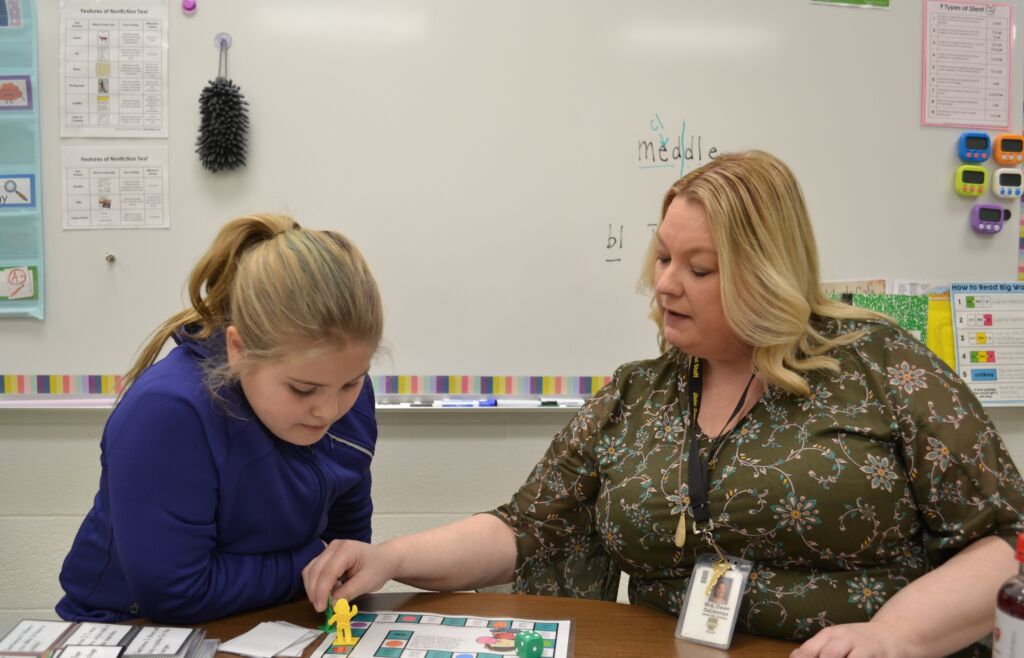
Dawn De Lorenzo knows firsthand the value of using research-based strategies to improve literacy. The veteran teacher said reading on grade level by third grade is linked to stronger academic performance in later years, which means the pressure is on for the students in her fourth grade class at Union Township Middle School.
“Once you’re past the third-grade level, fourth grade and beyond, it takes [more] effort to help them. And some of them, research shows, will never catch up. By fourth grade, my hair is on fire,” De Lorenzo said.
Tag us using #ChangeProjectNJ on social media and stay tuned for live events.
She has worked as a special education teacher for 23 years, which she said has taught her to stay up to date with the latest research on reading instruction to respond to her students’ needs. “I truly believe every child deserves to be instructed and to leave as a literate student,” said De Lorenzo.
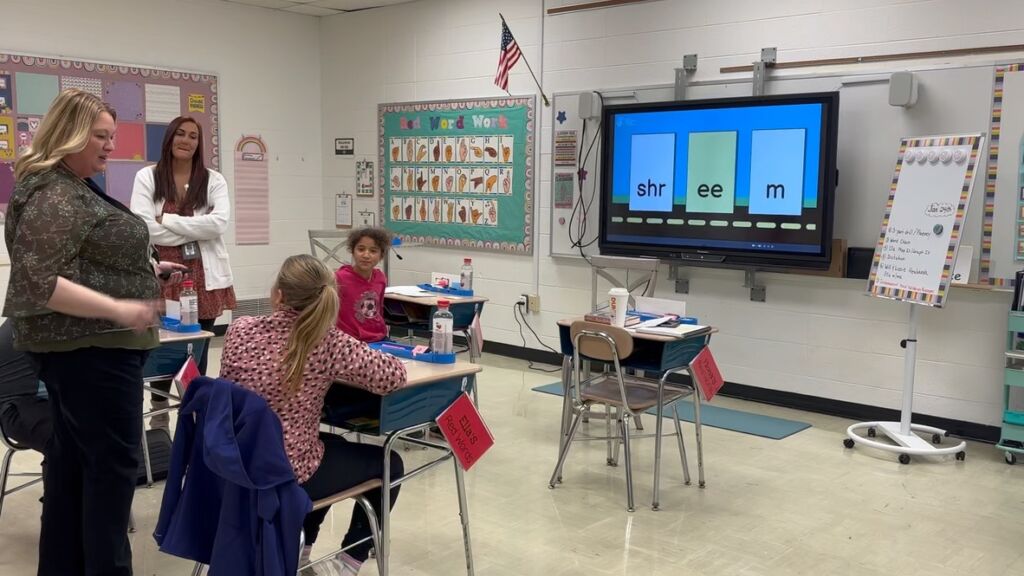
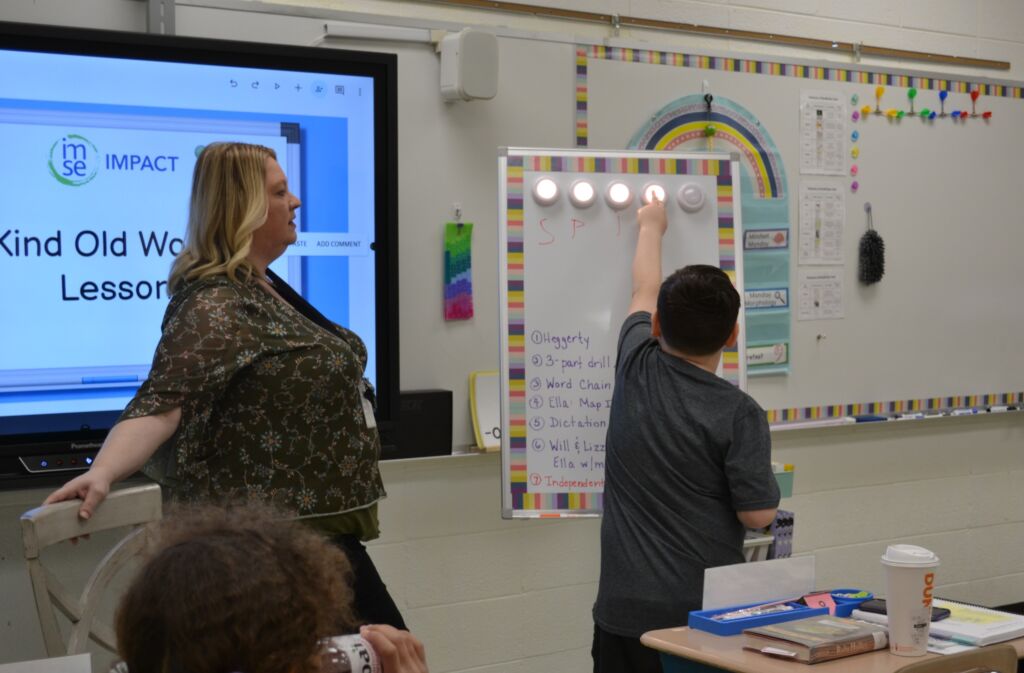
De Lorenzo invited NJ Spotlight News to visit her fourth-grade class with three students who receive intensive intervention in literacy, spending an hour and a half each day on reading and writing in a small-group setting. She said the extended instruction period and small class size allow her to deliver personalized support to each of the students, with additional help from a paraprofessional.
De Lorenzo spent time helping students build their confidence, encouraging them to share their answers with the class and letting students serve as “teacher for the day” by leading a short lesson on a topic they know well.
At the end of the lesson, the “teacher,” Ella, handed out stickers to her classmates, all of whom earned an A+. Ella, who was home-schooled for first grade, a critical reading year, has shown a lot of improvement over the course of the school year, De Lorenzo said.
“I like reading now that I can read better than I can before. Now I can really read the books and understand and it’s really fun for me to read now,” Ella said.
Another student, Lizzie, said she used to scramble up her words, but now she’s “reading like a champion” after practicing more.
De Lorenzo said evidence-based reading instruction benefits all students but is essential to the students in her class. Her students receive “intensive intervention” outside of the general classroom setting as part of the state’s tiered system of supports, a framework designed to align resources with students who need them. The low teacher-to-student ratio only helps.
De Lorenzo tailors her lessons to match the needs of the students. Twice a week, she delivers supplemental instruction to Ella for 30 minutes while the other students work with the paraprofessional.

A literacy lesson
One place where an evidence-backed approach to reading instruction is employed is Teresa Dispenziere’s second grade class at College Achieve Public Charter School in Asbury Park.
NJ Spotlight News joined Dispenziere’s class in February to observe reading instruction. After a whole-group lesson led by reading specialist Kathleen Deeken, students split into three groups of around six students each, to focus on different skills.
“What teachers do in general is like bowling — we aim for the middle because we want to get the most number of students. We really shouldn’t be doing that. Good bowlers know to aim for the outside pins,” De Lorenzo said, borrowing an anecdote from another teacher. “If you aim for the outside pins, you’re more likely to get the largest number of students at grade level.”
New Jersey’s numbers
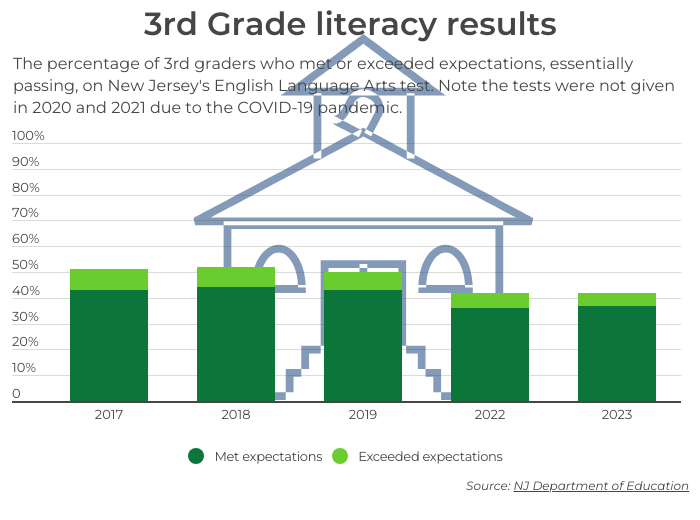
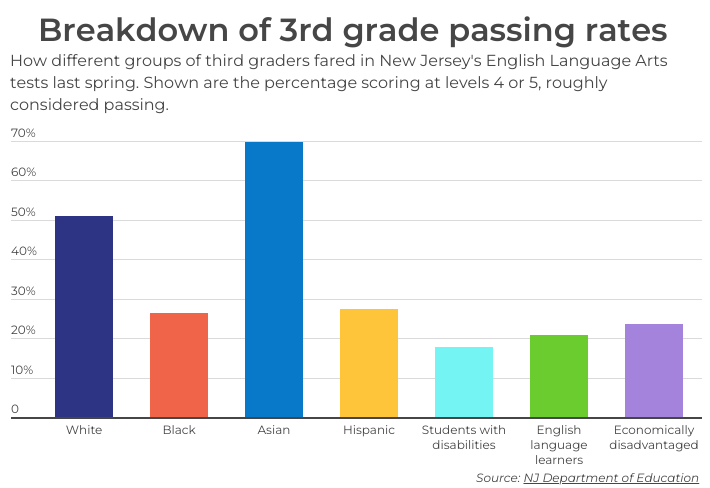
In New Jersey, 42% of third graders met or exceeded expectations on state English Language Arts assessments taken in spring 2023. Passing rates were even lower for some of the most disadvantaged groups of students, including those with disabilities, multilingual learners, Black students, Latino students and students who receive free or reduced-price lunch.
Reading proficiency dropped during the pandemic and has yet to recover to 2019 levels in many New Jersey school districts. But even before the pandemic, many New Jersey students moved on to fourth grade without the ability to read at grade level.
In Union Township School District, where De Lorenzo teaches, 64.6% of third grade students met or exceeded expectations on the state English Language Arts assessment in 2023. Some districts saw far lower scores, such as in Camden, where only 5.9% of students met or exceeded expectations. Millburn, a wealthy school district that has made significant investments in teachers’ professional development, saw 83.6% of students meet or exceed expectations.
New Jersey is looking to address these gaps, with Gov. Phil Murphy, state lawmakers and school superintendents taking a close look at the research and pushing to implement best practices, such as offering professional development for teachers and screening students for reading deficiencies early in their schooling.
The ‘science of reading’
The term “science of reading” has become increasingly widespread in recent years, but the practice of using evidence-based strategies to guide reading instruction has been around for decades. The science of reading does not have a single definition and is often closely associated with phonics instruction, although that is not the only focus of the research. Phonics emphasizes the connection between how words are written and how they sound when spoken aloud.
In New Jersey, the Murphy administration has been wary of using the term “science of reading” in public statements, although the administration told NJ Spotlight News that using evidence-based best practices in literacy instruction is crucial.
During his State of the State address in January, Murphy announced a new focus on improving literacy rates through phonics-based reading strategies in elementary schools.
“It is simple: an emphasis on phonics in reading instruction is essential to the lifelong success of our children,” Murphy said in the speech.
Phonics is just one aspect of learning to read, researchers emphasize. The National Reading Panel in 2000 included it as one of five components of effective reading instruction along with phonemic awareness, fluency, vocabulary and comprehension. Phonemic awareness focuses on understanding the individual sounds that make up words.
Fostering a love of reading
At Millburn’s Deerfield Elementary School, instructional supervisor Audra Berger said that while phonics is critical at the K-2 level, it is only one component of learning to read.
“If you make phonics the central thing and ignore everything else, you’re going to have great decoders who can’t make meaning. And the purpose of reading is to make meaning,” Berger said.
Many teachers say it’s important to make sure a love of reading is fostered, even as there are calls to move away from what is termed “balanced literacy,” which combines phonics instruction with whole-language instruction, a manner of teaching reading that focuses more on making meaning, including through context and pictures.
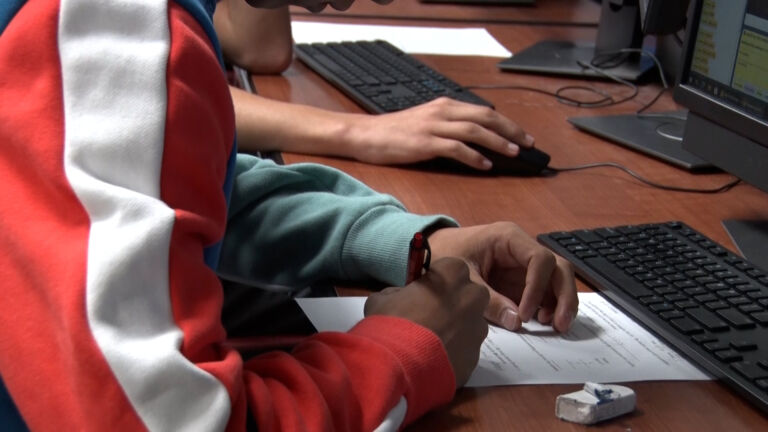
Measures of student literacy
Data on New Jersey elementary school student performance: Find fourth grade standardized test scores for all schools.
The Murphy administration has already taken several steps in the direction of phonics-based instruction, including updating English Language Arts standards to include decoding and encoding words and analyzing word parts as foundational reading skills for grades K-5. Encoding refers to spelling spoken words while decoding refers to sounding out written words.
The state Department of Education offered free professional development in literacy to K-3 teachers and school leaders that aligned with the new standards in the fall and winter. New Jersey also committed $52 million to high-impact tutoring in 300 school districts to help students in third and fourth grades recover from learning disruptions caused by the pandemic.
Reading instruction can vary greatly from district to district, and even from classroom to classroom. Paula White, one of the state’s leading advocates for the science of reading with JerseyCAN, described New Jersey’s approach to literacy instruction as “eclectic.” She said a balanced literacy approach is common throughout the state.
“We’re on the right track with standards. Now let’s make sure they are given life in each and every classroom in the state of New Jersey,” White said. This means focusing on what’s happening in the classroom, screening students, training teachers and involving parents, she said.
State Sen. Teresa Ruiz (D-Essex) has been one of the biggest advocates in the Legislature for science-based reading instruction across the state. In February, she introduced several bills to target literacy rates and learning loss, all of which have been referred to the Senate Education Committee. Ruiz convened a working group of educators and lobbyists to gather feedback and she expects there will be changes before any of the bills come up for a vote.
“It’s looking at this not solely through the lens of COVID and its impact to education,” Ruiz said. “It’s looking at it through the lens of ‘How do we improve literacy overall? How do you continue to improve literacy so that all children are within that mark of grade level?’”
‘Mississippi miracle’
One bill would require school districts to screen students for reading deficiencies. Another would establish a reading intervention program for students in kindergarten through third grade who score below grade level on a screening assessment. A third bill would require districts to provide annual training to K-12 teachers who handle reading intervention, which is used to remediate reading deficiencies through individual instruction, tutoring or mentoring that target specific reading skills and abilities.
In his budget address in late February, Murphy proposed spending $2.5 million to help districts acquire literacy screening tools, which would help direct resources to kids who need it most. Ruiz said she doesn’t believe $2.5 million is enough and she will push for more spending Tuesday when Education Commissioner Kevin Dehmer is scheduled to appear before the Senate Budget Committee.
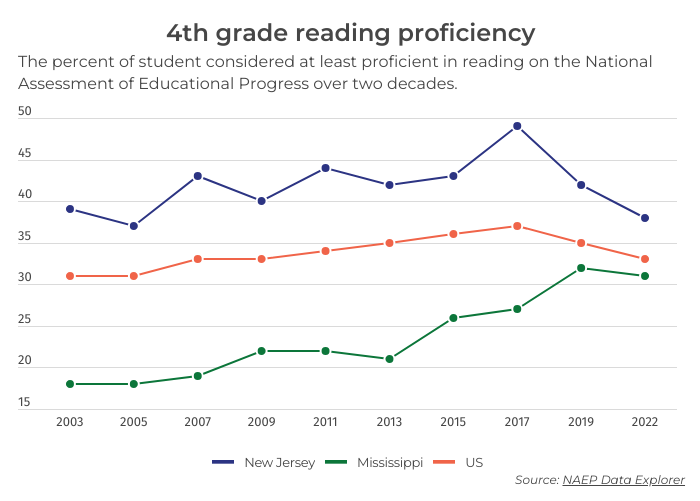
Once known for poor educational outcomes, Mississippi lately has been cited as a potential national model of effective literacy practices after the state saw significant gains in the National Assessment of Educational Progress since 2013. Some are calling it the “Mississippi miracle.”
In 2013, Mississippi passed the Literacy-Based Promotion Act, which placed a new emphasis on reading at grade level in grades K-3. The law includes support for educators to implement research-based teaching methods through professional development and the deployment of literacy coaches to provide teachers with job-embedded support. The law also requires third grade students who do not read on grade level by the end of the year to repeat third grade, which is one of the more controversial aspects.
“It’s not something that happened overnight,” said Kristin Javorsky, professor of early literacy education at Mississippi State University. “It’s several different pieces working in tandem.”
That same year, Mississippi passed the Early Learning Collaborative Act which directed the state Department of Education to establish a voluntary pre-K program to reach more 4-year-olds. New Jersey is already moving toward universal preschool for 3- and 4-year-olds.
How NJ compares
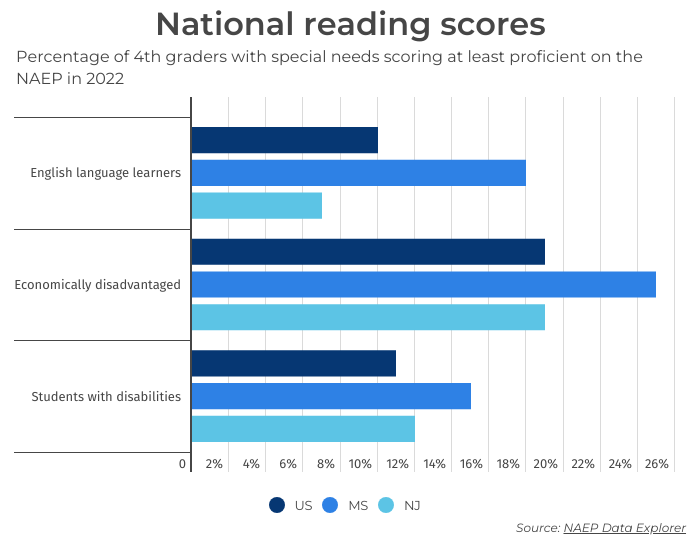
New Jersey’s reading scores on the National Assessment of Educational Progress — known as the “Nation’s Report Card” — remain higher than Mississippi’s overall. But students belonging to some of the most marginalized groups perform better in Mississippi, such as English language learners and students from low-income families. Test scores for these students and students of color have improved since 2013 in Mississippi.
The National Assessment of Educational Progress, which is congressionally mandated and taken by a sample of students in each state, has higher proficiency standards than most state assessments and is not a direct measure of reading on grade level. Proficiency on NAEP means “solid academic performance” and “competency over challenging subject matter,” according to the National Center for Education Statistics.
In 2003, Mississippi students from low-income families scored lower on NAEP than New Jersey students from low-income families. Now, Mississippi has surpassed New Jersey and the national average, ranking second-highest in the country for low-income students. Those who are eligible for the national school lunch program scored an average of nine points higher in Mississippi than in New Jersey in 2022.
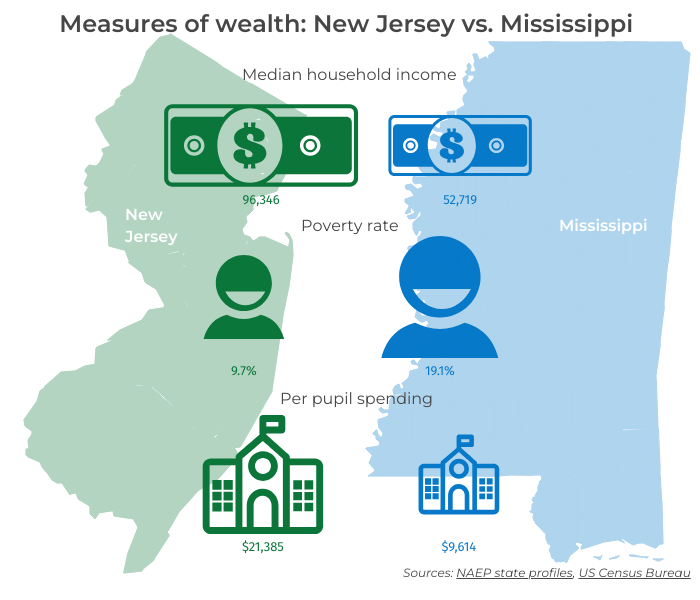
The percentage of the population living in poverty in Mississippi is about double the population in New Jersey, and these students tend to score lower on assessments like NAEP. New Jersey also spends more than $10,000 more per student than Mississippi on average, according to data from NAEP. During the 2021-2022 school year, New Jersey spent $21,385 per student while Mississippi spent $9,614.
Mississippi also screens students in kindergarten through third grade for reading deficiencies three times a year and creates individual reading plans for students who read below grade level. These are measures Ruiz is trying to bring to New Jersey.
Universal screeners themselves can be free or cheap, said Matt Burns, a special education professor and researcher at the University of Florida Literacy Institute, but districts may need to pay to use an accompanying data management system if they do not already have a system they use. He said one or two people in every school should know how to use the data, which can be accomplished with about an hour of training and some follow-up.

The effectiveness of screeners depends on whether they screen for the right measures and whether teachers understand the data, said Burns, who has conducted extensive research in this area. This means focusing on skill-based assessments so teachers can see what students can already accomplish and where they have room to improve, he said.
Many New Jersey school districts have already implemented some of these strategies, and there are existing efforts to expand them further. Nationally, more states have taken these steps as well.
Yet Burns said there is a significant gap between how research explains reading should be taught and what is happening in classrooms. And that’s where teacher training comes in.
Teaching teachers
New Jersey has been criticized by groups that have pressed for more phonics-based instruction. One of them, the National Council on Teacher Quality, found New Jersey among the worst laggards in preparing future teachers to use evidence-based reading instruction in their classrooms.
According to the report, none of the 10 colleges and universities with educator prep programs that provided data adequately taught all five components of effective reading instruction identified by the National Reading Panel; more than half did not address any of them. Thirteen colleges and universities with programs did not participate in the study.
Fourth-grade teacher De Lorenzo, for one, said teachers are lucky to get one or two classes on how to teach reading when they are in college. New Jersey teacher candidates are required to study how to teach literacy, but exact requirements vary across educator prep programs. De Lorenzo said a lot of what she has learned has been thanks to professional development and independent reading she has done since entering the classroom.
Teachers’ literacy instruction skills can be improved through teacher preparation programs and training for teachers who are already in the classroom, Burns said. He said this includes showing pre-service teachers how to use and understand data.
“I don’t blame the teachers per se, but I do think we have to do a better job of putting them in a position to be successful,” Burns said.
Making sure instruction is based on research requires teacher training on best practices. The state’s RAPID program, short for Reading Acceleration Professionally Integrated Development, is one example of this, but some educators have called for more in-depth training and for it to become mandatory for all teachers.
Between RAPID’s launch in October 2023 and March 2024, the state Department of Education estimates more than 3,000 teachers and 1,000 administrators participated in the program, which focused on supporting literacy in K-3. New Jersey has about 41,000 elementary school teachers and 10,000 administrators, according to data from recent state performance reports.
RAPID received favorable reviews and requests for expanded instruction and opportunities to reach more teachers, according to the Education Department.
Susan Miller, president of Reading League New Jersey, a provider of RAPID in Monmouth, Mercer and Ocean counties, said training teachers to use evidence-based practices is key. She said RAPID should be offered again during the next school year with the ability to reach more people. “It was a drop in the bucket,” Miller said.
Success in Millburn
Millburn School District has made teacher training a priority over the last decade, which Superintendent Christine Burton said has helped general education and special education students learn to read more effectively. Fourth graders have already made up the ground they lost in reading during the pandemic, according to recent scores on the New Jersey Student Learning Assessments.
The district invested in a five-day, 30-hour intensive training for teachers from the Institute for Multi-Sensory Education, which is based on the Orton-Gillingham model, a sequential, multi-sensory approach to literacy. This cost the district about $1,500 per teacher, Burton said.
Burton said the investment was worth it “without a doubt.” Millburn trained K-2 classroom teachers and special education teachers, intervention teachers and teachers of English language learners for all grades.
Audra Berger, the district’s instructional supervisor, now serves as a certified Orton-Gillingham in-district trainer, providing professional development and training to teachers in literacy. This year, she is training every third-grade classroom teacher and offering refreshers for teachers who have already been trained.
The approach in Plainfield
Queen City Academy, a charter school in Plainfield, has also made professional development a priority. Jazmin Gooding, elementary school principal and academic director, said the school’s approach blends balanced literacy with the science of reading.
More resources
National Center on Improving Literacy website
2023 New Jersey Student Learning Standards in English Language Arts
How to Build Strong Readers: Mississippi’s Guide to Developing Literacy Skills from Birth through Grade 12
Teachers there are trained by the Children’s Literacy Institute, which focuses on anti-racist early literacy instruction for Black and Latino children. The school’s population is 100% Black and Hispanic, according to recent school performance report data.
The school serves a large population of English language learners — more than 20% of students, according to recent data. Parent-teacher conferences are conducted in English and Spanish to serve the large bilingual population and keep parents involved in their child’s progress.
“It’s not one particular script you can follow. It’s really having a toolbelt and teaching a teacher how to be intuitive enough to realize ‘What tools do I need from my toolbelt at this time?’” Gooding said.
The school has reading coaches to support teachers in implementing best practices for reading instruction. Their focus is on support, not evaluation, which allows teachers to be vulnerable about what they still need to learn, Gooding said.
“That is key and truly a game changer for teachers to see lightbulbs go off,” she said.
Coaches have contributed to the success in Mississippi, where the state hires and trains coaches to support low-performing schools. As of January, Mississippi had 53 literacy coaches serving 103 schools.
What superintendents think
Many New Jersey school districts are already doing this work but approaches to reading instruction vary greatly across the state’s roughly 600 school districts. And districts aren’t always pleased to be told how to teach their children.
New Jersey is one of the states with strongest local control in education and superintendents say they know what’s best for the students they serve. Superintendents have concerns about mandates that would require districts to change how they teach reading, especially if the mandates do not come with funding or resources to help school districts make the required changes.
“We need to be very thoughtful about what we decide to mandate school districts to do without a support system,” said Springfield Superintendent Rachel Goldberg. “My concern remains that we are looking at this to make it entirely on the backs of schools that are already managing so much.”
Metuchen Superintendent Vincent Caputo said he supports the use of phonics and science-based reading instruction but believes there is value in continuing practices tied to balanced literacy that encourage a love of reading rather than completely abandoning what the district has been doing for decades.
In Mississippi, changes came alongside significant funding and support from the state to the tune of a $15 million annual investment, said Burk, who worked at the Mississippi Department of Education before joining the Foundation for Excellence in Education as a senior policy fellow. There is nothing worse than an unfunded mandate, she said.
“[It] really needs to be collaborative because then you get the buy-in,” said Javorsky of Mississippi State University. “You get the buy-in from the schools because you’re not just saying ‘You must do this,’ you’re saying, ‘We’re coming to help you.’”
Burk and Javorsky said this support can look different from one state to the next.
Superintendents and representatives from key education groups said it’s important any state action considers what is already happening in school districts and allows educators to differentiate instruction based on their students’ needs.
Goldberg said this could involve surveying school districts to see what literacy curriculum and screeners they are using already to create a plan before introducing mandates.
Metuchen Superintendent Vincent Caputo said districts should evaluate their current approach — what’s working, what their students need and where districts can supplement their efforts, such as by adding a reading coach, offering more professional development or including more phonics-based instruction.
He said he supports the use of phonics and science-based reading instruction but believes there is value in continuing practices tied to balanced literacy that encourage a love of reading rather than completely abandoning what the district has been doing for decades.
“The narratives that districts like Metuchen, or any other district, has been doing something terrible for the last 10, 20, 30 years and all of a sudden we need intervention from outside to help us — that’s a fallacy,” Caputo said. “Can we get better? We can get better every single day. Our literacy instruction can get better every day.”
Cover photo: A Union Township Middle School student works on a literacy lesson (Hannah Gross/NJ Spotlight News)
More from NJ Spotlight News
About this project
The Change Project is a part of the Chasing the Dream multiplatform public media initiative from The WNET Group. We are reporting on challenges facing New Jersey in a variety of areas involving social justice and equity, as well as showcasing promising remedies. Our reporting focuses on inequality in many aspects of life, from birth through school to finding an affordable place to live. We are also focusing on what has worked elsewhere to make life better for people, and what lessons we can learn for the future.
Major funding for The Change Project and Chasing the Dream is provided by The JPB Foundation
Help us continue to report on important issues by supporting our work.
