
 Credit: (AP Photo/Mel Evans)
Democratic power broker George E. Norcross III appears to remain in his role as board chairman of South Jersey’s massive Cooper Health System following state charges that for more than a decade he has run a criminal enterprise that let him and others benefit from public resources intended to help Camden.
The state attorney general’s office announced a 13-count indictment Monday that alleges Norcross and several co-defendants — including his brother Philip, a politically connected attorney, and former state senator and Camden Mayor Dana Redd — were involved in various real estate deals that allowed them to cash in on a state tax-incentive law designed to spur growth in Camden, long one of the state’s most impoverished cities.
Philip Norcross also chairs the board of the Cooper Foundation, the health system’s philanthropic arm. The Norcross family — which also includes U.S. Rep. Donald Norcross (D-1st) — has proudly highlighted its connection to Cooper and its roots in Camden, where George Norcross’s powerful insurance company, Conner Strong & Buckelew, is also based. There are more than 100 references to Cooper Health in the 111-page indictment.
 Credit: (AP Photo/Mel Evans)
Representatives for Cooper Health, which operates Cooper University Hospital and other facilities in Camden as well as Willingboro and Voorhees, did not respond to several requests for comment.
But George Norcross told reporters he is innocent following Monday’s announcement of the charges in Trenton, which he attended in person, sitting in the front row directly across from Attorney General Matt Platkin.
“The alleged conduct of the Norcross Enterprise has caused great harm to individuals, businesses, nonprofits, the people of the State of New Jersey, and especially the City of Camden and its residents. That stops today,” Platkin said, barely acknowledging Norcross’s presence.
Camden ties
Cooper Health and its flagship 660-bed Cooper University Hospital — the region’s only Level 1 Trauma Center and one of just three such programs recognized by the state — have long served as anchors in Camden, a struggling former industrial hub now home to 71,000 people. More than half of Camden residents identify as Hispanic and nearly 43% are Black, according to U.S. census data from 2022, and nearly one-third live in poverty.
The Cooper Health System is not poor, however, noting on its website that Moody’s Investors Service upgraded its credit to A3 last year, the highest ever. Cooper received hundreds of millions of dollars in federal aid in the wake of the COVID-19 pandemic, in part because of its role as a trauma center. It also gets tens of millions more through the annual state budget because it is a teaching hospital and serves such a low-income community.
George Norcross was often front and center when Cooper Health announced good news, positioned with a golden shovel next to government officials or other business leaders at groundbreaking events.
In this year, it also collected nearly $20 million in state funds to offset the cost of treating people without insurance. Changes proposed for the state’s charity care program mean this could rise to $36 million in the coming year, based on a budget proposal lawmakers must finalize with Gov. Phil Murphy by July 1.
Founded in the 1870s as the 30-bed Cooper Hospital, the facility “quickly became a cornerstone in the community,” according to its website, and soon added a training program for nurses. The hospital continued to expand as the city grew and by the early 1960s, Cooper was the largest nonprofit hospital in New Jersey.
Work on a new 10-story building began in 1976 and the following year Cooper codified an agreement with the University of Medicine and Dentistry/Robert Wood Johnson Medical School, making it the first academic medical facility in South Jersey.
Nearly 35 years
George Norcross joined the Cooper board in 1990, as he built a political and business network that eventually became entrenched in state affairs.
Outpatient offices eventually followed and by 1996 the hospital changed its name to Cooper Health System, to reflect the broader services available, the website notes. A massive state investment in 2004 led to a $220 million health science complex and a new 10-story hospital opened four years later.
In 2012, a partnership with Rowan University led to the opening of a new medical school, which graduated its first class four years later. During this period another agreement with the University of Texas MD Anderson Cancer Center in Houston allowed Cooper to greatly expand its cancer-care options in South Jersey.
 Credit: (AP Photo/Rich Schultz)
Norcross was often front and center when Cooper Health announced good news, positioned with a golden shovel next to government officials or other business leaders at groundbreaking events. He joined then-Gov. Chris Christie on site for the announcement of the MD Anderson agreement in 2013, welcoming the nationally acclaimed program to New Jersey.
“MD Anderson is not only the number one cancer center in the country, it’s the number one cancer center in the galaxy,” Norcross said at the time. “And we are so proud that not only will they be in New Jersey but they’re coming to Camden, New Jersey, a place that is changing, a place that’s changing for the better.”
Christie, a Republican who worked well with Norcross and his Democratic allies in the Legislature, went on to restructure medical education in New Jersey, dissolving UMDNJ and giving Rutgers University control over state-backed medical schools in Newark and New Brunswick. He also made sure Rowan would be able to operate its osteopathic medicine program and continue to partner with Cooper.
In recent years, Cooper created an Urban Health Institute and has worked closely with the Camden Coalition, a nonprofit focused on helping underserved communities, to address racial disparities in cardiovascular health, diabetes and other conditions. It also launched novel programs to address addiction, which has taken a heavy toll on South Jersey.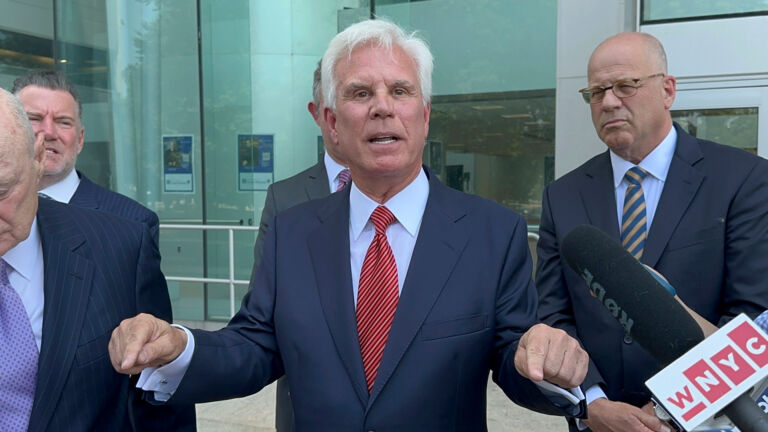
Cooper’s emergency medical response teams were part of a pilot program that enabled them to immediately provide medications to treat substance abuse in patients who had experienced an overdose and been revived with the opioid-reversal agent naloxone, commonly known as Narcan. Eventually, New Jersey became the first state to permit this work statewide and Dr. Kaitlan Baston, a leader in Cooper’s effort, was tapped by Murphy in the summer of 2023 to serve as state health commissioner, replacing Judy Persichilli who was retiring.
‘Our friends’
Monday’s indictment suggests Norcross was more interested in his own gains than helping Camden, however. Platkin alleges Norcross and his allies “conspired to, and did, extort and coerce” a local nonprofit to turn over development rights to a valuable waterfront building that it had purchased at a discount. “The entities that benefitted, including Cooper Health and [Norcross’s insurance firm, Connor, Strong & Buckelew], then occupied the properties they obtained interests in and sold the tax credits they obtained for millions of dollars,” it reads.
 Credit: (NJ Attorney General's Office)
Cooper Health was able to buy a 49% share of the building, known as the L3 Complex, which also houses the system’s main office, the indictment notes. Cooper eventually obtained more than $27 million in tax credits through a special state program designed to boost investment in Camden, based on a law Philip Norcross helped write, according to the allegations. The family even intervened as the state drafted regulations to implement the law to ensure that the hospital would be able to benefit financially from the credits, according to the charges.
“This is for our friends,” George Norcross told key allies during a phone call about the tax-credit legislation, according to the indictment.
The charges include first-degree crimes that carry a sentence of 10 to 20 years in state prison and a fine of up to $200,000, Platkin said. An arrangement is scheduled for July 9 in Mercer County Superior Court.
