
New Jersey’s revenue outlook has brightened slightly heading into the final weeks of the current fiscal year, according to new tax collection forecasts released by the administration of Gov. Phil Murphy.
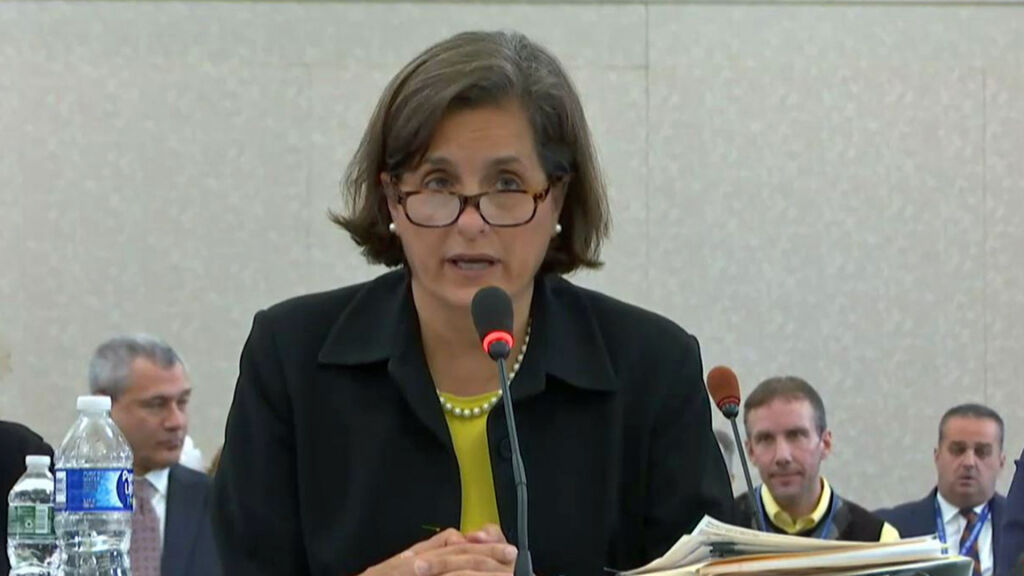
In all, forecasters added about $60 million to the revenue projection for the current fiscal year, which closes June 30, state Treasurer Elizabeth Maher Muoio told lawmakers during a public hearing Tuesday.
Looking ahead, the forecast for the fiscal year that begins July 1 has also been upgraded, with about $140 million added to the original revenue forecast released by the administration in late February.
While that’s not enough to make a significant dent in a wide structural gap to be carried over into the new fiscal year under Gov. Phil Murphy’s $56 billion proposed budget, it also means Murphy and lawmakers won’t have to make any drastic spending changes or program cuts over the next few weeks.
“After the revenue roller coaster ride during and after the pandemic, such stability is more than welcome,” Muoio told members of the Senate Budget and Appropriations Committee.
Items in flux
Still, even with a stable revenue outlook, several major items in the new budget remain in flux with a little over a month to go before Murphy and lawmakers will be up against a July 1 deadline for the adoption of a new annual spending plan — a deadline written into New Jersey’s Constitution.
Remaining up for discussion is a new tax on the most profitable corporations operating in New Jersey that Murphy, a second-term Democrat, is proposing as part of his proposed budget, which remains under review in the Legislature. This proposed tax alone accounts for an estimated $1 billion in new revenue, according to the updated tax collection forecasts.
Gov. Murphy is seeking to again spend more than the state is projecting to take in next year — a structural gap totaling about $1.8 billion.
Meanwhile, lawmakers have yet to announce their own spending priorities, which are likely to inflate the budget’s bottom line. Concerns about raiding the budget surplus and the status of a plan to enhance senior property-tax relief are also still hanging in the balance.
Under New Jersey’s Constitution, it’s up to lawmakers to draft an annual spending bill each year, and they can incorporate as little or as much of the governor’s budget proposals as they see fit.
In all, Murphy, a second-term Democrat, has proposed increasing spending by roughly 3% year over year as part of a budget that also calls for full funding of the state’s K-12 public-school aid formula, and of the state’s annual obligations to the public-worker pension fund.
Murphy’s budget also calls for increased spending on direct property-tax relief, with the popular Anchor program among the line items due to receive more funding. Counting supplemental spending items put forward since the start of the current fiscal year, including additional funding needed to cover increased demand for Anchor benefits, Murphy’s proposed spending increase for fiscal year 2025 measures roughly 1%.
Well-worn path
Around this time last year, Murphy and lawmakers were contending with a gap of more than $1 billion between what was originally forecast for the 2023 fiscal year and what was then projected to be collected.
Several weeks later, they agreed to adopt a budget with a wide structural gap, spending down surplus as a source of revenue to avoid the constitutionally barred practice of running at a deficit.
Earlier in the day, the spending down of surplus was flagged as a concern by Republicans when the committee received projections and heard testimony from Office of Legislative Services analysts.
Despite forecasting growth to occur during the fiscal year that begins July 1, Murphy is seeking to again spend more than the state is projecting to take in next year — a structural gap totaling about $1.8 billion, according to the updated forecasts released Tuesday.
And that gap will be in place even after accounting for the more than $1 billion that would be raised by taxing the income of corporations with more than $10 million in net annual profits, a group of about 600 companies, according to administration estimates.
Murphy’s new tax proposal — which calls for setting aside funding from that new tax for cash-strapped New Jersey Transit — has faced strong opposition from New Jersey’s business community in recent weeks, and it has yet to come up for consideration in either house of the Legislature.
Meanwhile, nonpartisan analysts from the Office of Legislative Services have also raised concerns that the proposed tax, if enacted, could leave NJ Transit with an unsteady source of revenue upon which to balance its own budget given New Jersey’s corporate-tax collections have a history of volatility.
Sales tax?
On Tuesday, committee Chair Paul Sarlo (D-Bergen) cited those concerns and asked Muoio if the administration would consider hiking the state sales tax as an alternative to its corporate-tax proposal.
“Nobody should read into any of this,” Sarlo asked, “but if the Legislature was to come back and to replace that with an increase on the sales tax, is that something the administration would be open to?”
“Chair, you have before you our proposal for the [fiscal year] 2025 budget. But, as always, we’re open to any discussions,” Muoio replied.
Meanwhile, also uncertain at this point is whether a proposed $6.3 billion ending surplus for fiscal year 2025 will remain unchanged by lawmakers, who in recent years have tacked on last-minute spending during the drafting of the final appropriations bill, without proposing any new taxes to pay for their added spending.
Even under current projections, that ending surplus would fall below the threshold of 12% of expenditures needed under state law to keep plans to significantly enhance senior property-tax relief on track.
Earlier in the day, the spending down of surplus was flagged as a concern by Republicans when the committee received projections and heard testimony from OLS analysts.
“You can do this one year, maybe for two years, and then you’re going to run into negative territory,” OLS budget and finance officer Thomas Koenig said in response to a question from Sen. Declan O’Scanlon (R-Monmouth).
“As you know, with the balanced budget requirement we have in New Jersey, we cannot sustain that kind of trajectory for long,” Koenig said.
