
 Credit: (AP Photo/Seth Wenig)
What happens inside the State House over the next several weeks will likely determine how much funding for direct property-tax relief is included in the state budget due to be enacted by the end of June.
For starters, officials from the Department of the Treasury are scheduled to soon provide an update to lawmakers on the latest tax-collection totals, including the always crucial April income-tax collections.
If the latest receipts have been bountiful, that bodes well for Gov. Phil Murphy’s plan to spend more than $3.5 billion on direct property-tax relief during the 2025 fiscal year, which begins July 1.
The income tax is the largest single source of revenue for the annual budget and each year’s collections help forecasters make predictions about what to expect going forward.
Revenue from the state income tax is also constitutionally dedicated to funding property-tax relief, which can include spending on direct property-tax relief programs, such as Anchor and Senior Freeze, as well as state aid to public schools.
New approach to easing property-tax burden
Meanwhile, by the end of this month, a task force that has been studying ways to further ease the property-tax burden faced by New Jersey seniors is due to issue a much-anticipated report to Murphy and lawmakers on the feasibility of establishing an altogether new relief program.
Money is already being set aside for the new program, which has been dubbed “Stay NJ,” and the report will, by law, contain recommendations to guide its establishment, which is currently planned for early 2026.
Property taxes are levied at the local level in New Jersey, but a sizable portion of the state’s annual budget goes toward offsetting local property taxes, including through programs like Anchor and Senior Freeze.
In all, Murphy, a second-term Democrat, has proposed spending a total of $3.58 billion on direct property-tax relief programs during the next fiscal year.
Property taxes, the biggest problem
That comes as residents continued to identify property taxes as their top concern in recent public opinion polls, and after the latest data released by the Murphy administration indicated the average New Jersey property-tax bill increased by more than $300 last year, reaching a record-high $9,803 statewide.
Under Murphy’s fiscal year 2025 budget proposal — which is still subject to review by the Legislature — total state spending on the direct-relief programs would be increased by nearly 5% year over year. That would push the total share of the annual budget devoted to such programs to 6.4% of the nearly $56 billion in proposed spending.
 This year, the largest share of spending on direct property-tax relief — nearly $2.3 billion — would be allocated to the Anchor program, which funds benefits distributed to more than 1 million homeowners and roughly 700,000 renters who meet certain income and eligibility requirements.
If lawmakers go along with Murphy’s proposed budget, the maximum benefit for eligible senior homeowners would remain $1,750, and the maximum benefit for eligible senior renters would remain $700.
For other homeowners and renters who meet the income and eligibility requirements, the maximum benefits would remain $1,500 and $450, respectively, under Murphy’s budget proposal, which assumes benefits will be distributed in the fall.
Meanwhile, spending on tax breaks offered to homeowners and tenants through their state income taxes would increase year over year to nearly $880 million under Murphy’s proposed budget.
Reduction via deduction
Under this program, listed as the Property Tax Deduction Act in budget documents, New Jersey homeowners can deduct from their state income taxes the full cost of their annual property tax bills, up to $15,000.
‘Gov. Murphy’s proposed budget picks winners and losers, while my plan only cuts property taxes, not schools.” — Assembly Republican Leader John DiMaio
Spending on the Senior Freeze program, which benefits homeowners ages 65 and older or disabled, is also set to go up year over year to nearly $190 million as the program begins operating under recently increased income limits that should lead to higher overall enrollment. The rule changes pushed the program’s income limit up to $150,000 for the 2022 tax year, and up to $163,050 for the 2023 tax year.
But the biggest proposed increase in year-over-year spending on property-tax relief is for the proposed Stay NJ program, which under current plans would seek to offer many senior homeowners with an up to 50% rebate on their annual property-tax bills, starting in calendar year 2026.
Finding room for tenants
The planned tax break has been widely praised by senior advocacy groups, but drawn criticism for leaving out tenants, including those in communities of color, who pay property taxes indirectly through monthly rent payments.
Last year, Murphy and lawmakers agreed to begin planning for the launch of the program, including by empaneling a Stay NJ task force. They also earmarked $100 million in the fiscal year 2024 budget to begin prefunding relief benefits that could eventually cost the state more than $2 billion annually, according to nonpartisan legislative analysts.
In his fiscal year 2025 budget proposal, Murphy is proposing to earmark another $200 million for Stay NJ benefits, doubling the amount set aside for the same purpose in the current budget.
In recent months, the task force has held a series of public meetings and has also been collecting information from state agencies and other interested stakeholders, according to a quarterly report published on Treasury’s website.
Invited guests have included AARP of New Jersey; the New Jersey Policy Perspective think tank; the Tax Collectors and Treasurers Association of New Jersey; and the New Jersey Chapter of the National Association of Tax Professionals, according to the report.
Meanwhile, Republicans, who currently hold minorities in both houses of the Legislature, have put forward their own plan to address concerns about property taxes. That plan calls for changing the way the state distributes aid to K-12 public school districts, recognizing such districts rely heavily on revenue from local property taxes to balance their own operating budgets.
Under a plan backed by Assembly Republican Leader John DiMaio (R-Warren), school districts that are seeing state aid cuts under the current K-12 school-aid formula and associated state law would receive additional state funding, which could be used “to rehire teachers and staff, implement programs and address learning loss and student mental health” — all without raising property taxes.
“Gov. Murphy’s proposed budget picks winners and losers, while my plan only cuts property taxes, not schools,” said DiMaio.
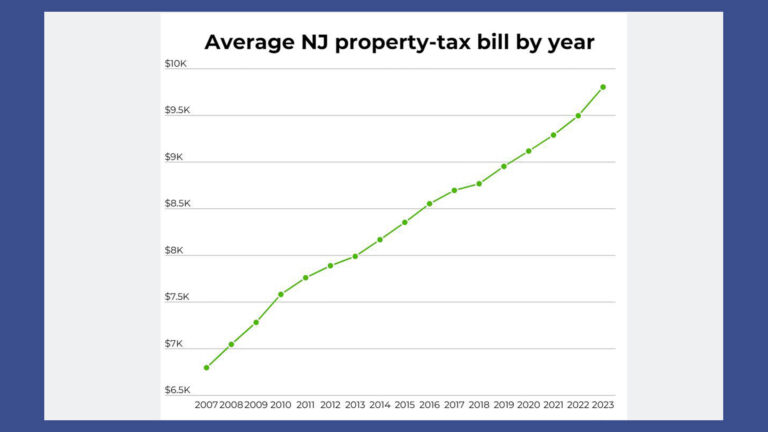
Analysis of latest DCA data reveals highest annual growth rate for property taxes in more than a decade
