
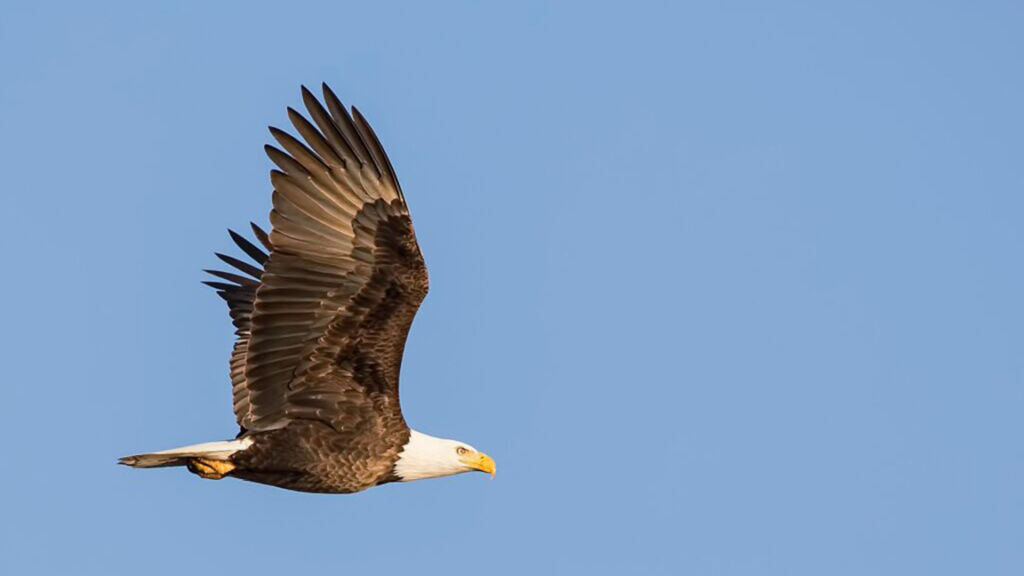
Last month, the state’s Division of Fish & Wildlife, in partnership with the nonprofit Conserve Wildlife Foundation of New Jersey, released its annual report for the Bald Eagle Project. For the sixth year in a row, the population has increased, highlighting what has been one of the state’s most successful conservation efforts — and foreshadowing future challenges for the iconic raptor species.
From the Wallkill River in northern Sussex County to the Higbee Wildlife Management Area in Cape May County, an army of about 150 volunteer nest monitors counted a record 286 territorial pairs throughout the state, an increase of 19 from last year. Of those pairs, 78% successfully produced 309 young. The nest count happens between January and July each year.
“It’s great,” said Kathleen Clark, who heads the state’s Endangered and Nongame Species Program. “And unexpectedly great to have the growing population that we have.”
Andrew S. Lewis discusses New Jersey’s bald eagle successes
It wasn’t that long ago that spotting a bald eagle in New Jersey, let alone a nesting pair with offspring, was virtually impossible. Prior to European colonization, an estimated 100,000 bald eagles lived throughout what today are the lower 48. But by the early 1960s, less than 1,000 remained. In New Jersey, the population was down to just one nesting pair by 1970 and remained that way for another decade.
While hunting was the primary cause of the bald eagle’s initial decline — they were perceived as a threat to other game and farm animals — it was the advent of the pesticide DDT that nearly wiped out the species.
Back from the brink
After DDT was banned in 1972, various restoration efforts across the country brought bald eagles and other raptors back from the brink. In New Jersey, a combination of egg incubation and the introduction of 60 fledglings from Canada set the state’s bald eagle population on a path toward recovery in the 1980s.
 Credit: (Dukes Farm Foundation)
By 2000, the state had 23 nesting pairs; by 2015, there were 150. Today, “eagle cams” in several locations throughout the state reliably stream footage of pairs and their fledglings during the late winter, early spring incubation period. The most popular cam, located at Duke Farms, in Somerset County, logs about a million views annually.
Krysten Schuler, of Cornell’s College of Veterinary Medicine likened lead’s impacts on bald eagles to ‘putting the brakes on recovery.’
Due to the success of the restoration programs across the country, the bald eagle was removed from the federal endangered species list in 2007. In New Jersey, however, it remains on the state endangered list during the winter, when fledglings have hatched and remain in their parents’ nests, and on the threatened list for the remainder of the year.
That could change as early as this year. The state hasn’t updated its list of endangered and nongame species since 2012, Clark said, and in that time, there have been “a couple” of bald eagle population-status reviews.
“The Department [of Environmental Protection] is considering delisting bald eagles,” Clark said. “There’s going to be a rule proposal — we don’t have a date on it yet, but it’ll be this calendar year.”
No longer endangered in NJ?
If the rule passes as proposed, New Jersey’s bald eagles’ status would move to a species of “special concern.” But, Clark added, “there are a lot of people in eagle world who want to balance recognizing the success of recovery against so many of the threats that just aren’t going away.”
 Credit: (Richard Lee on Unsplash)
While not nearly as lethal as DDT, lead poisoning has become a big concern for bald eagles in recent years.
In 2022, researchers from Cornell University conducted a study on the impact of lead poisoning on bald eagles in the Northeast over the last three decades. They found that deaths arising from the ingestion of lead ammunition was associated with between a 4% and 6% reduction in the growth rate of female (4.2%) and male (6.3%) bald eagles.
“Bald eagles are very susceptible to lead, because their stomachs are highly acidic,” said Krysten Schuler, a research professor at Cornell’s College of Veterinary Medicine and a co-author of the study. “Those little bullet fragments break down very quickly.”
A similar study, led by the U.S. Geological Survey, also found that the frequency of short-term exposure to lead was higher in winter, when bald eagles are breeding and thus foraging more heavily on dead animals that can have lead shot (from hunters) in them.
Lead poisoning
According to Conserve Wildlife’s Larissa Smith, Clark’s colleague and co-author on the Eagle Project Report, two bald eagles died from lead toxicosis last year. “There were other eagles that died from undetermined causes,” Smith said. “And lead exposure could have been involved.”
Schuler likened lead’s impacts on bald eagles to “putting the brakes on recovery.” Lead, like DDT, weakens bald eagles’ immune systems, thus their overall resiliency. “Most of the resilience they need to deal with additional stressors like climate change, other diseases, and land use changes, is being used up by lead,” Schuler said.
Despite the concerns of lead poisoning, High Pathogen Avian Influenza and forever chemicals, the biggest risk to bald eagles remains, as it always has, direct interactions with the human-built world.
And a depleted ability to fight off disease is particularly worrying right now, when bald eagle populations elsewhere in the country have been severely impacted by the most recent — and deadly — strand of High Pathogen Avian Influenza, H5N1.
In January 2023, the journal Scientific Reports published a study that found that 136 bald eagles across 24 states had died of H5N1 since the virus first appeared in wild North American bird populations in late 2021. In 2022, a bald eagle found at the Salem County Landfill tested positive for H5N1 and had to be euthanized. A month later, another bird that was already dead when it was discovered in Cumberland County by U.S. Fish & Wildlife Service officials also tested positive.
Luckily, Smith said, there were no cases of H5N1 in bald eagles last year in New Jersey, although Schuler said that, just in the last two months, “three or four” bald eagles tested positive for the virus in New York. Pennsylvania also recorded cases of H5N1 infection in bald eagles in 2022.
Avian flu and forever chemicals
Beyond lead poisoning and H5N1 infection, Schuler said that she and her colleagues are keeping a close eye on the so-called forever chemicals, PFOA and PFAS.
“We’re just starting to look at these things,” she said. “They’re forever, they’re everywhere, but we don’t really know what that means yet as far as their effect on animals or reproduction or anything, really.”
Despite the concerns of lead poisoning, H5N1 infection and forever chemicals, the biggest risk to bald eagles remains, as it always has, direct interactions with the human-built world. Because of both increased competition for optimal nesting habitat due to the increase in their numbers, as well as the expansion of human populations into previously wooded and rural areas, New Jersey’s bald eagles are increasingly choosing what Clark called “marginal habitat.”
“They’re choosing to nest closer and closer to people,” she said. “We know that’s dangerous.”
Clark pointed to some of the state’s most urban nesting pairs. One, in Bogota, a Bergen County borough jammed between the Hackensack River and Teaneck, had a fledgling jump prematurely from its nest — it spent the next two days wandering the neighborhood before Clark had it taken to the Raptor Trust, a bird rehabilitation center in Morris County. And, in Linden, a few years ago, a fledgling’s first attempt at flight landed it on the New Jersey Turnpike, where it miraculously ended up in the median and — after police stopped traffic — survived.
Others haven’t been so lucky. The leading cause of death in the state is electrocution and colliding with vehicles. Last year, 14 bald eagles died of electrocution and 10 of vehicle collisions. Collisions with utility lines are a problem especially for younger birds, who tend to be clumsier.
“As the eagle numbers increase,” said Smith, “we’re going to see an increase in deaths and injuries.”
More bald eagles also means more competition within the species. Last year, Eagle Project monitors documented three birds that died from injuries sustained from fights with other eagles. In one incident, in Gloucester County, an adult was found on the ground near a known nest, apparently injured. “It turns out that both adults were at the nest, so this bird was an intruder,” Smith said. “It had been banded in New Jersey five years ago, so it was just reaching maturity and looking for its own territory.”
“We never saw any signs of eagle in-fighting ten years ago,” Clark added. “There was not that kind of competition for nest sites that there is now, with this expanding population.”
Nevertheless, both Clark and Smith said in-fighting isn’t a concern for the population’s recovery at this point — certainly not up against far deadlier threats like lead poisoning and avian influenza. But, Smith said, “at some point, there will be a limiting factor as far as the population’s continued increase is concerned, whether that’s food availability, available habitat or territory.”
