
 Credit: (AP Photo/Charles Krupa)
In a step aimed at reviving what at times seemed a faltering offshore wind program, the New Jersey Board of Public Utilities is expected to announce awards for new projects off the Jersey coast this week.
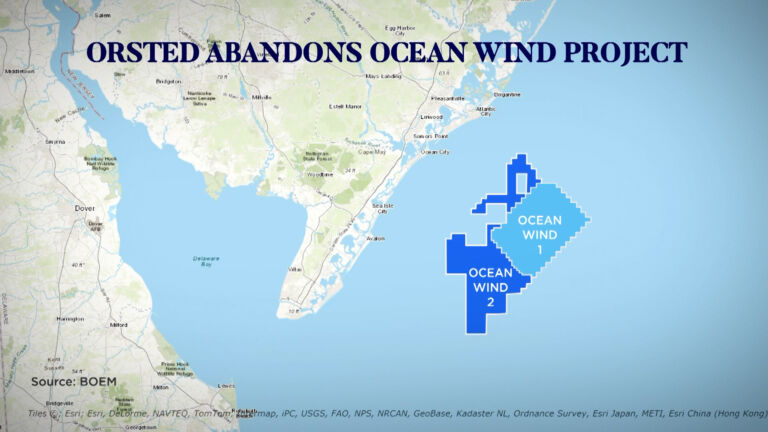
Four developers submitted bids to build wind farms last August, but that was before Ørsted, the world’s largest offshore wind operator, walked away from two projects in South Jersey saying they no longer made economic sense.
For the Murphy administration, the expected decision on new projects by the New Jersey Board of Public Utilities represents a crucial opportunity to get its offshore wind program back on track, a policy that seeks to be perhaps the key element in its drive to move away from fossil fuels and combat climate change.
Some Republicans accuse Murphy of pursuing wind agenda at any cost
By 2040, Gov. Phil Murphy wants to have more 11,000 megawatts of electricity generated from offshore wind farms, or roughly 27% of the power for New Jersey homes and businesses. After Ørsted’s withdrawal, Murphy ordered the state agency to hold a fourth solicitation sometime this year.
And then there was one
Ørsted’s departure left the state with only one viable offshore wind project, the Atlantic Shores initiative about 10 miles off the coast of Atlantic City. Atlantic Shores, along with its partners Shell Energies and EDF Renewables, is one of the developers seeking to be awarded a contract on Wednesday by the BPU. The Atlantic Shores approved project is intended to be 1,510 megawatts.
Besides Atlantic Shores, the other projects up for consideration include Attentive Energy, a joint venture between Total Energies and Corio Generation at a site about 42 miles east of Seaside Heights; Community Offshore Wind, an initiative from RWE and National Grid off Long Beach Island; and Leading Light Wind project by Invenergy and energyRE about 40 miles off the state’s southern coast.
Up to 4,000 megawatts of offshore wind capacity could be awarded by the BPU this week.
Clean-energy advocates are hoping at least two projects are awarded contracts to get the program back on track. “It’s an important step for New Jersey’s offshore wind program,’’ said Ed Potosnak, executive director of the League of Conservation Voters of New Jersey.
Why Ørsted bailed
In cancelling its two projects, Ørsted cited a variety of factors — higher borrowing costs, inflation and constraints in the supply chain, all of which boosted the expense of building the state’s first offshore wind farm.
Public support also has wavered in recent months, drawing protests from local communities who oppose having wind turbines because the height of the Washington Monument mar the view from beaches, fearing a tanking of the tourist economy. Critics also claim the projects will intensify the wave of whale and other marine mammal deaths occurring off the coast, something most scientists refute.
While interest rates have dropped, other economic factors remain difficult for offshore wind developers, not only in New Jersey, but also elsewhere along the Eastern Seaboard.
“We’ve seen cancellations. We’ve seen some projects go out for rebid. The industry is in a state of flux,’’ said Paul Patterson, an energy analyst at Glenrock Associates in New York. “It will be key to see what the prices come in at.’’
The rising cost of the projects also is fueling opposition. In New Jersey, the cost of getting offshore wind is going to be subsidized by a surcharge on consumer bills.
“If something changes in the economics of offshore wind and it fails to include a government subsidy of gargantuan size, then that would be headline news,’’ said Michael Makarksi, a spokesman for Affordable Energy for New Jersey.
Kris Ohleth, executive director of the Special Initiative for Offshore Wind, conceded prices are likely to rise in the new awards if they’re made by the New Jersey BPU. In part, that’s because developers have a better understanding of the economic climate than when the Ørsted projects were awarded, Ohleth said.
‘Right-sized and reliable’
“These bids will be right-sized and more reliable,’’ she said. It is likely there will be some cost escalation but they are likely to be more durable and sustainable. “This is an opportunity to recalibrate and get a realistic view of what this really costs.’’
Others, however, say it is irresponsible for state governments, like New Jersey, along with the federal government, to continue pushing forward new offshore wind projects.
“It is irresponsible development for little gain,’’ said David Shanker, a spokesperson for Green Oceans. “Whatever is built will have a negligible impact on climate change.’’ It should not move forward.
Offshore wind advocates note the latest applicants are proposing to build their projects much farther off the coast, ranging up to more than 40 miles. That could eliminate some opposition from those who do not want their ocean views to include wind turbines, Ohleth said.
“It takes the aesthetic argument off the table,’’ added Doug O’Malley, director of Environment New Jersey. “Ocean wind remains the best solution to meet our clean=energy needs.’’
