
 Credit: (NJ Spotlight News)
More than eight years after the New Jersey Supreme Court urged the Legislature to act, it began the process of revamping how municipal affordable-housing obligations are set, introducing a complex bill just before Christmas. But that effort is already on hold.
Lawmakers planned to approve A-4, a 70-page bill that seeks to replace the defunct Council on Affordable Housing (COAH) with a process similar to the one used by a superior court judge in 2018 to determine how many homes communities need to allow within their borders. But other measures were given greater priority during the lame-duck legislative session. Now, legislative sources said they hope to pass the measure early in the session that begins Tuesday.
Housing advocates say quick action is crucial, given the state’s housing need. According to the National Low Income Housing Coalition, the state needs close to 225,000 affordable rental homes to accommodate extremely low-income residents, more than half of whom are either senior citizens or people with disabilities.
But the potential legislative solution, as others before it, is likely to spark controversy, as officials and residents in some communities complain that they have been forced to accept high-density developments that are adding traffic, straining services and changing the character of their towns.
Lost in the shuffle
The Assembly Appropriations Committee had been set to take up the measure Thursday night, after it passed the Assembly Housing Committee on Dec. 20, two days after its introduction. It did not — voting instead on a number of other last-minute bills during a hearing that stretched into the night.
Assemblyman Brian Bergen (R-Morris) expressed outrage at the announcement after 9 p.m. that the housing bill was being held.
“People waited nine hours for A-4 … nine hours for a bill that’s being held,” he said as some left the hearing room. “That’s insulting to the people we represent. You should all be ashamed of yourselves.”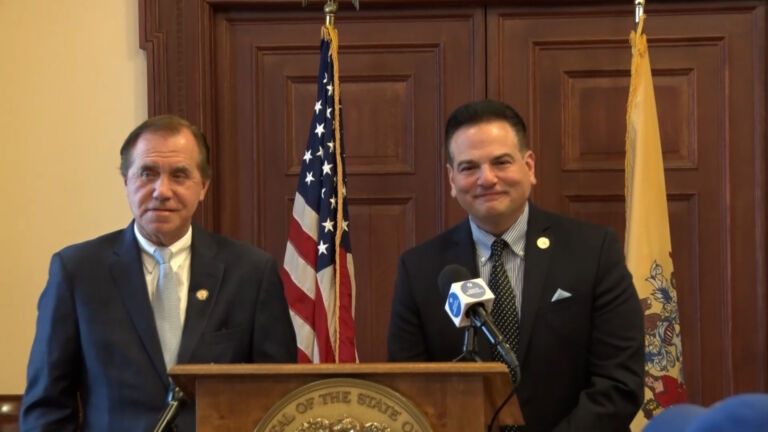
“I believe there are still issues and rather than put out an imperfect bill, they’re waiting to make sure that everything is done properly,” said Lisa Swain (D-Bergen), committee chair.
Housing advocates had hoped the bill would pass in the lame-duck session and were disappointed.
“With the fourth round quickly approaching, solidifying an effective enforcement process for affordable housing obligations as soon as possible is of utmost importance for all parties — most notably NJ’s low-income families and communities of color,” said Alex Staropoli of the Fair Share Housing Center that has been central to affordable housing creation. “While we are disappointed that it won’t happen during the lame-duck session, we are glad that we made progress on a strong piece of legislation that can hopefully be passed very early in the new session.”
More time to comment
But municipal officials, who had complained about the inability to provide meaningful comments on the bill during its first and only hearing, were happy to have more time to try to shape the legislation, given this is a process envisioned to govern affordable housing in the future.
‘While we are disappointed that it won’t happen during the lame-duck session, we are glad that we made progress on a strong piece of legislation that can hopefully be passed very early in the new session.’ — Alex Staropoli, Fair Share Housing Center
Assemblywoman Yvonne Lopez (D-Middlesex) introduced the bill on Dec. 18. That was 15 months after she held a hearing on potential changes to the current process that implements the Supreme Court’s mandate, spelled out in a number of decisions collectively known as the Mount Laurel doctrine, that all municipalities provide their “fair share” of the state’s affordable housing need. A judge set that need at 155,000 housing units through 2025. The bill, which Lopez’s committee advanced less than 24 hours after the text of the bill was made public, would set up the new process to guide the next “round” of housing obligations, which take effect in January 2026.
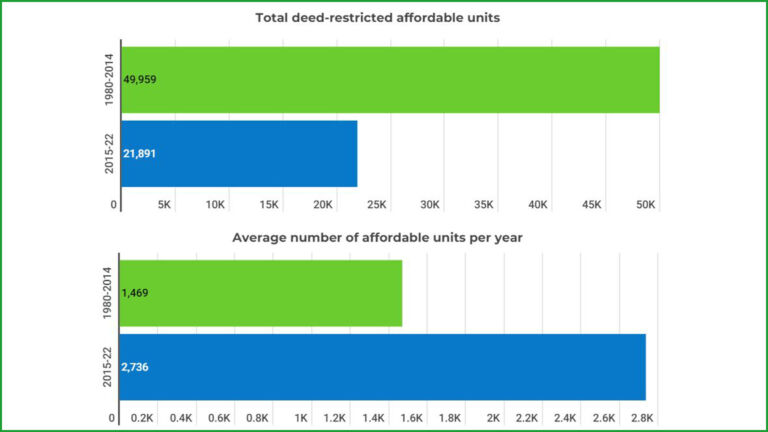
The law, unpopular with many municipal officials, has almost doubled the rate of construction since 2015
The courts had overseen the process of approving municipal housing plans, negotiated by local officials and the Cherry Hill-based Fair Share Housing Center. That work was previously done by COAH, the council created by the Legislature in the Fair Housing Act to carry out the Mount Laurel doctrine. But then-Gov. Chris Christie tried to abolish COAH in 2011 and Fair Share sued over the council’s third-round housing obligations. The Supreme Court declared the agency “moribund” and turned authority over the process to the courts, while at the same time urging the Legislature to act.
More than 21,000 affordable homes have been built since 2015 in the current round, according to Fair Share, which expects that number to exceed 30,000 by the end of the round. In 2022, Gov. Phil Murphy created a $305 million Affordable Housing Production Fund largely using federal COVID-19 recovery money that was expected to pay for 3,300 new housing units over several years. Staropoli said Fair Share hopes that “an improved process with limited delays” will yield as many as 50,000 affordable houses in the new round.
Moving ahead with new math
This first significant action by lawmakers would finally abolish the council, which exists in name only. The legislation would replace it with calculations made by three special masters appointed by Chief Justice Stuart Rabner for the north, central and southern regions of the state. Municipalities that agree would be able to implement their housing obligations without automatically having to engage with the court and pay costly legal bills. There would be an appeals process for officials who seek to dispute the number of homes allocated to their communities.

Under Gov. Murphy’s plan, COVID-19 recovery money will build 3,300 affordable housing units. Advocates say that’s a good start, not a goal
It’s unclear exactly what amendments lawmakers are planning to make when they reintroduce the legislation in the new session, which begins Tuesday at noon.
The bill introduced last month would have the special masters determine regional housing needs using a formula that includes U.S. Census Bureau estimates of the growth in the number of households, existing deficient housing for low- and moderate-income residents, the change in non-residential property values and the amount of municipal land suitable to accept development.
Other factors could help reduce a municipality’s housing obligation to a maximum of 1,000 units or 20% of existing housing stock, whichever number is lower.
Resolving disputes
Municipalities would have to submit their plans to a new Affordable Housing Dispute Resolution Program, which would post these online. Towns that approve their housing obligations by Jan. 31, 2025 would be exempt from potential builders’ remedy lawsuits, which could result in towns being forced to allow larger numbers of new houses. Should officials consider a housing obligation “unreasonable,” they could submit a housing plan that includes a smaller number of units. But the public or, likely, groups like Fair Share or developers could challenge the posted plans. The dispute resolution program would have between three and seven members, also appointed by the chief justice, who would hash out disagreements over the plans.
Should the program be unable to resolve disputes in a timely manner, each county or vicinage in the state would have a judge designated by Rabner and future chief justices to rule on those matters.
As in the past, municipalities could get additional credits for certain types of housing, such as transitional housing with access to support services for those recently homeless or who lack stable housing, homes for very low-income residents or people with disabilities, developments near public transit or in growth zones and age-restricted units for older residents.
The bill would allow a municipality to meet up to a third of its obligation through age-restricted housing but requires at least half of the designated affordable units be designed for families with children.
Costs for the new program are estimated at $16 million, with two-thirds of that going to operate the dispute resolution program and the rest to the courts.
