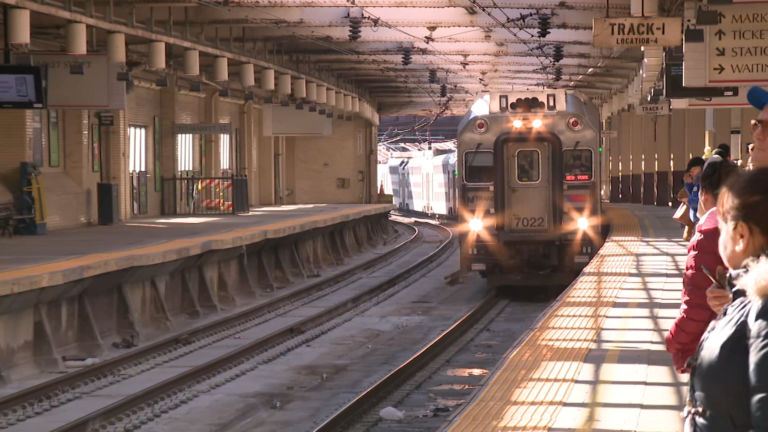
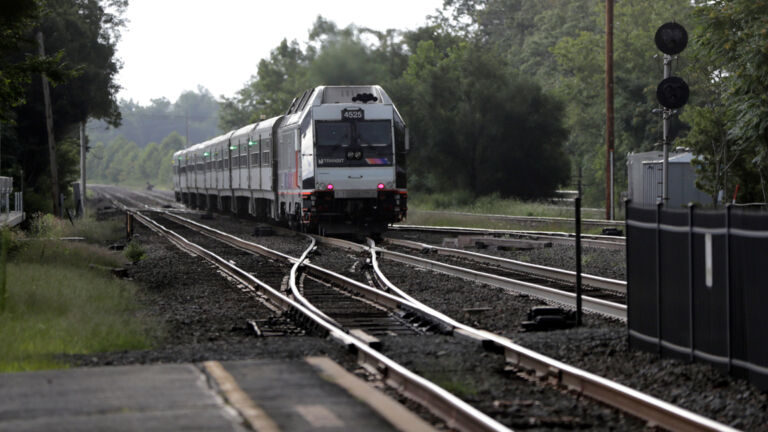
Credit: (John Reitmeyer/NJ Spotlight News)
 An election-year budget enacted by Gov. Phil Murphy and lawmakers several months ago increased spending in several key areas, including a big boost in state aid for New Jersey Transit.
But left largely unaddressed were longer-term budget challenges the statewide bus and rail agency is facing after it was dealt a significant financial blow by the COVID-19 pandemic.
Service cuts and fare hikes that could make bus and train trips in New Jersey less affordable are still an option as officials from the Murphy administration conduct an ongoing review of the agency and its operations and finances.
That’s a big concern for transportation advocates who have begun canvassing mass-transit stations throughout the state to bring more attention to the transit funding issue. As part of this effort, advocates are collecting signatures from anyone who wants to “Call on Governor Murphy to Fund NJ TRANSIT!” And they are using a life-size cutout of Murphy to call attention to their efforts and the need for funding.
“We need to take action now in order to sustain New Jersey Transit’s reliability, its safety and strengthen our mobility throughout the state,” said Renae Reynolds, executive director of the Tri-State Transportation Campaign, during an event held earlier this month at Newark Penn Station.
Onus on state lawmakers
The statewide advocacy campaign has been launched just weeks before an election that will see control of the state Legislature determined by voters across New Jersey. And it’s state lawmakers who would have a key role in the establishment of any source of dedicated state revenue for mass transit, under procedures set in the New Jersey Constitution. Asked whether candidates running for office this year are saying enough to ease the concerns of NJ Transit’s riders, Reynolds said, the “short answer is, we haven’t heard enough.”
“What we do need to see is candidates who value and understand mass transit, who take mass transit, and who have an intimate relationship, or an understanding, about the day-to-day impacts and the benefits that transit provides for riders,” she said.
Service cuts and fare hikes are still an option as officials from the Murphy administration conduct an ongoing review of the agency, its operations and finances.
NJ Transit’s $2.86 billion operating budget for the current fiscal year is both balanced and allows for fares to remain stable through at least June 30, 2024.
To help ensure that balanced spending, Murphy and lawmakers earlier this year added $40 million to a subsidy provided to NJ Transit out of the state budget each year in place of the types of dedicated revenues that support mass-transit agencies in many other states. That pushed the size of the fiscal year 2024 budget subsidy to $140 million, a year-over-year increase of 40%.
But looking ahead, NJ Transit budget documents indicate the agency will soon have to close a series of widening operating deficits as short-term, federal COVID-19 pandemic aid dries up even as the agency’s ridership has yet to rebound to pre-pandemic levels.
Bus services, more challenges
Policy experts also say the task of managing NJ Transit’s budget challenges has likely become more difficult in recent weeks after the agency was forced to compile an emergency bus-service stabilization plan to fill in for private carriers that abruptly stopped offering services in places like Jersey City and Newark due to their own financial challenges.
 Credit: (John Reitmeyer/NJ Spotlight News)
For its part, the Murphy administration has indicated the review of NJ Transit and its finances and operations remains ongoing.
Asked about the Tri-State Transportation Campaign’s ongoing outreach to riders, Murphy spokesman Bailey Lawrence said the administration will “continue to explore a broad range of funding options for the agency.”
“Governor Murphy remains committed to robust and forward-looking investments in our world-class public transportation system, which has become more accessible, more affordable, and more efficient since the outset of the Murphy Administration,” Lawrence said in an email.
‘It should be an issue of concern in the upcoming election.’ — former Senate Majority Leader Loretta Weinberg (D-Bergen)
While awaiting a formal decision on whether there will be any service cuts or fare hikes, a number of ideas for addressing NJ Transit’s financial problems have been put forward by groups and individuals outside state government.
Among them was a report issued last month by the Trenton-based New Jersey Policy Perspective think tank that urged Murphy and lawmakers to leave in place a state corporation-business tax surcharge that has been levied since 2018 in New Jersey on the incomes of businesses earning profits of $1 million or more annually.
Business tax
Under current law, the surcharge, which was initially put in place as a temporary tax add-on, will expire at the end of the calendar year. However, the think tank, citing Department of the Treasury forecasts, said $1 billion could be generated over a full fiscal year if the 2.5% surcharge were left in place. And if that revenue were dedicated to funding NJ Transit operations, it would fully offset the nearly $1 billion projected shortfall that’s looming for NJ Transit in fiscal year 2026.
“As corporations earn record-breaking profits and working families struggle with rising prices, taxing multinational corporations to support critical infrastructure that we all benefit from is a fair, responsible, and commonsense solution to fix NJ Transit in the short and long term,” the NJPP report said.
Former Senate Majority Leader Loretta Weinberg (D-Bergen) was among those to endorse the think tank’s findings during a recent virtual news conference. Weinberg, a longtime mass-transit advocate, also tied NJ Transit’s financial troubles to the upcoming legislative elections.
“I would urge voters out there, residents (and) advocates who are interested in this, to find out from the candidates in their own district how they feel about getting a reliable, dependable source of funding for New Jersey Transit,” Weinberg said.
“It should be an issue of concern in the upcoming election,” she said.
Meanwhile, Jersey City Mayor Steven Fulop has also come out in favor of keeping the surcharge in place to support NJ Transit. Fulop, a Democrat, is running for governor in 2025 to replace the term-limited Murphy.
But business-lobbying groups have pushed back strongly against such a remedy. They argue the extra surcharge has made the state a national outlier when it comes to business taxes, sending the wrong message to companies that could be considering moving to New Jersey.
Amid the ongoing policy debate, everyday bus riders say they are already starting to see cracks in the system.
“Every day, I use public transportation, and it has been increasingly difficult for me, and my family,” said Carla Cortes of Passaic during the event in Newark. “The buses come too late, and sometimes, they don’t come at all.”