
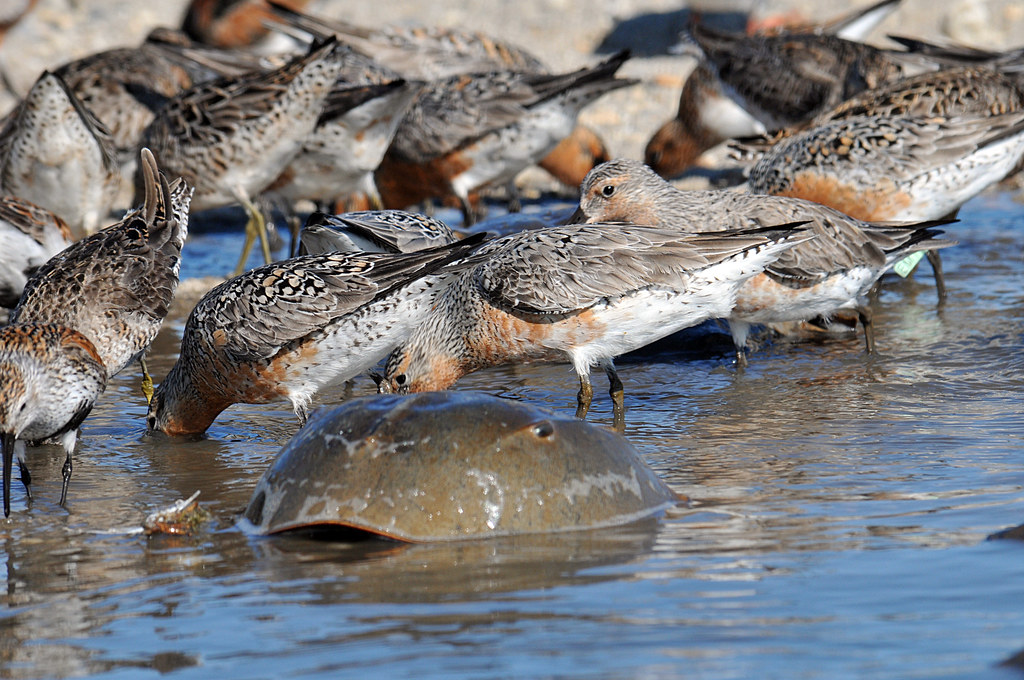
Federal regulators again rejected a plan to restart the harvest of female horseshoe crabs in the Delaware Bay for the first time in a decade, saying that public opposition to the proposal remains strong, and more time is needed before lifting the ban.
A board at the Atlantic States Marine Fisheries Commission voted to hold the harvest quota at zero for female crabs in the 2024 fishing season, rejecting a plan by commission staff that would have allowed 175,000 female crabs to be caught next year. At the same time, the board authorized a catch of 500,000 male crabs from the bay, the same as this year.
The planned restart of the female crab harvest was strongly opposed by conservationists on the grounds that it would have cut the amount of food available to migrating shorebirds, notably the federally protected red knot, as they stop off on Delaware Bay beaches during long-distance migrations every spring.
But the commission, a federal agency, argued that harvest levels have been set since 2013 to support the needs of migratory shorebirds, and that the number of female crabs in the bay has risen in response to the ban.
Still, some members of the board spoke out against the plan, saying it was too soon to make a change that could derail recent signs that the red knot and other shorebirds are beginning to recover, and that doing so would be at odds with public opinion.
No public appetite
“We’ve heard from the public that right now there’s not an appetite for female harvest,” said Shanna Madsen of the Virginia Marine Resources Commission, who proposed the successful motion.
Joe Cimino, a representative of the New Jersey Department of Environmental Protection who serves as the commission’s vice chair, said he’s encouraged by recent signs of an increase in both crab and bird populations but it’s too soon to be making policy that might disrupt the recovery.
“I think we need to get a few more years under our belt before we start considering this,” Cimino said. “I hope that other members of the board support that until we see this positive trend increasing for a fair amount of time.”
Although New Jersey banned the harvest of all crabs in its waters starting in 2008, the other three bay states — Delaware, Maryland and Virginia — implement horseshoe crab fishing quotas set by the commission. Conservation groups say the harvest should be halted until the crab population fully recovers from the over-harvest some 20 years ago.
Conservation groups say the density of crab eggs on bay beaches is only a fraction of what it was when the red knot’s population was much higher, and restarting the female harvest would further cut the food supply and raise new fears about the birds’ long-term survival.
A year ago, the commission unexpectedly rejected an earlier plan to restart the female harvest for the 2023 season, noting public concern about the status of the red knot population in the Delaware Bay.
Conservationists, too, welcomed the board’s decision, saying that overturning the ban would have been based on a model — called Adaptive Resource Management — that they say overcounts populations of both birds and crabs, and contains flawed assumptions.
Flawed assumptions impact shorebirds?
“We appreciate that the ASMFC was risk averse in their decision not to authorize a quota for harvesting female horseshoe crabs,” said David Mizrahi, vice president of research and monitoring at New Jersey Audubon. “Given the significant flaws, unsubstantiated assumptions and ambiguous results of the current Adaptive Resource Management modeling framework, any decision to include females in the 2024 horseshoe crab harvest would be irresponsible.”
The commission says the number of female horseshoe crabs in the bay rose to about 16 million in 2022 from a two-decade low of 3.7 million in 2006. It estimates the number of male horseshoe crabs at about 40 million, also a 20-year high. The agency’s modeling puts the population of red knots passing through the bay each spring at about 40,000. That’s about twice the number reported by naturalists from observation.
Since the over-harvest of horseshoe crabs prompted a crash in the red knot population in the early 2000s, New Jersey Audubon and other naturalist groups have been arguing for stronger protection of the crabs. They say that the density of crab eggs on bay beaches — a crucial indicator of the birds’ food source — is only a fraction of what it was when the knot’s population was much higher, and restarting the female harvest would further cut the food supply and raise new fears about the birds’ long-term survival.
Even though the board unanimously approved a continued ban on the female harvest, it also voted to uphold the controversial ARM model. That prompted critics to warn of an underlying threat to crabs and birds.
“We are pleased that the commission exercised caution in the face of uncertainty and the potential for serious harm,” said Ben Levitan, senior attorney for Earthjustice’s Biodiversity Defense Program, an environmental law firm that represents New Jersey Audubon and other critics. “However, the commission needs to end its annual practice of considering a female crab harvest based on a flawed computer model. The fate of red knots should not be put on the line year after year.”
