Credit: (Chris Engel from Pixabay)
Long preyed upon in their storied history, horseshoe crabs in the Delaware Bay are protected by rules that set quotas on how many can be caught for fish bait, a commercially popular and lucrative use.
New Jersey banned the horseshoe crab harvest altogether in its waters in 2008, but the other bay states — Delaware, Maryland and Virginia — still implement annual catch quotas set by the Atlantic States Marine Fisheries Commission (ASMFC), a federal agency.
For example, 475,000 male crabs are permitted to be caught this year, out of an estimated 40 million in the bay. The agency is scheduled to set next year’s quota next month.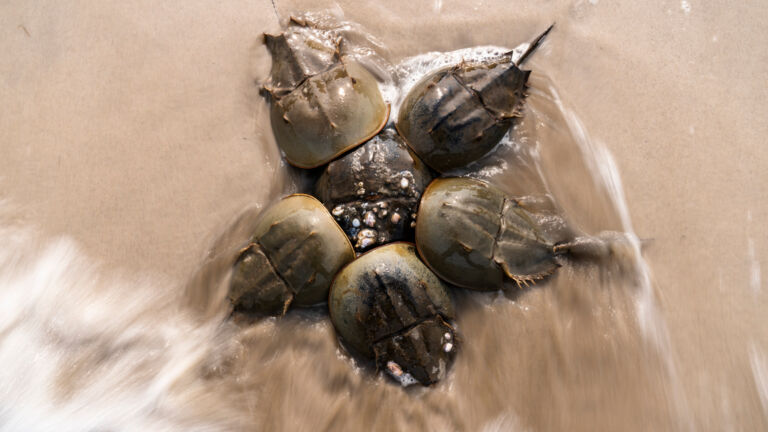
On the eve of that meeting, advocates for the protection of horseshoe crabs in Delaware Bay are now challenging the quota model — known as Adaptive Resource Management (ARM) — as not doing enough to protect the ancient species and other wildlife that depend on them.
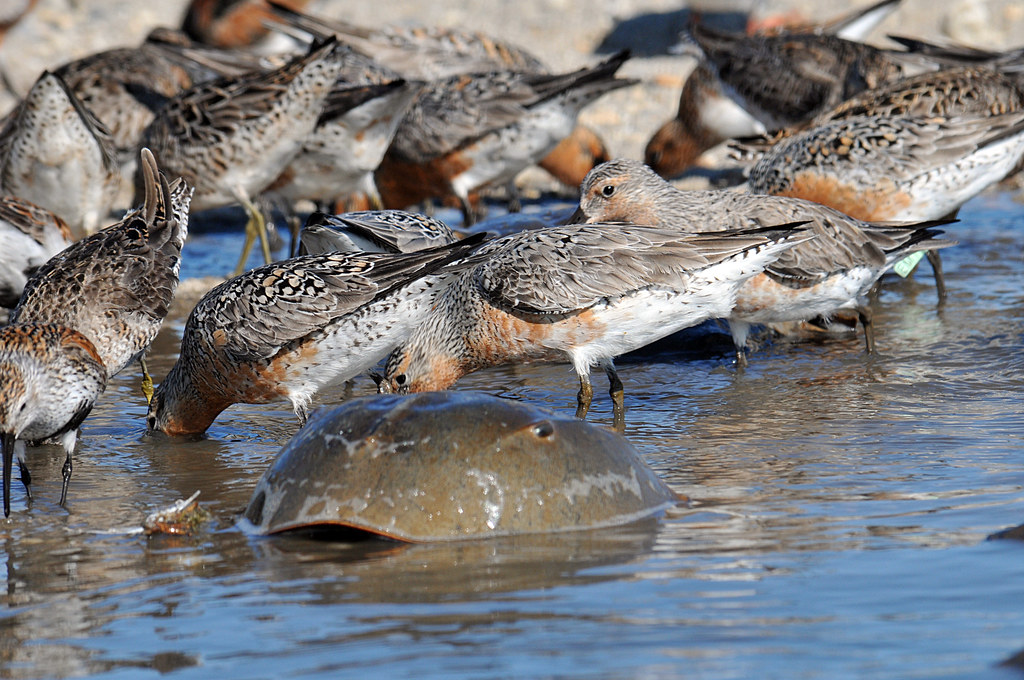
Conservationists say the quotas prevent the horseshoe crab from fully recovering after a drastic overharvest in the early 2000s, and the reduced number of crabs threatens the survival of other species that depend on the crabs, most notably the red knot, a federally protected shorebird that feeds on the crabs’ eggs in its annual migration via the Delaware Bay.
A new critique
An academic study says the model does not acknowledge a correlation between the number of crabs and the number of red knots and is “falsely optimistic” about the birds’ resilience.
The report said the model also does not account for the density of horseshoe crab eggs on bay beaches. Naturalists say that egg density is a crucial indicator of the amount of food available for the migrating birds.
“Despite the historical role of horseshoe crab overharvest in the decline of red knots, the model predicts red knot abundance will increase even if all horseshoe crabs vanish entirely from Delaware Bay,” said Earthjustice, a nonprofit law firm that represents New Jersey Audubon and Defenders of Wildlife, which are urging the commission to reform its model.
State and federal government measures for protecting horseshoe crabs in the Bay have been hotly contested for years.
They urged the commission, at a minimum, not to increase crab harvest quotas at its upcoming meeting, and to reconsider the model altogether in light of the new critique.
“I conclude that the … framework is not useful for managing risk to the red knot population due to the horseshoe crab harvest,” wrote Kevin Shoemaker, a professor of wildlife conservation at the University of Nevada at Reno and the report’s lead author.
Contentious measures
State and federal government measures for protecting horseshoe crabs in the Bay have been hotly contested for years.
Last November, the Atlantic States Marine Fisheries Commission unexpectedly dropped a plan to allow the resumed harvest of female crabs as well after a 10-year ban. Conservationists said allowing female crabs to be caught would have further restricted an important food source for the birds and represent another risk to the long-term survival of red knots and other species. In the face of public pressure, the commission dropped the plan, at least for now.
 Credit: (U. S. Fish and Wildlife Service - Northeast Region via Openverse under CC PDM 1.0)
But two other studies for federal agencies have concluded that the horseshoe crab population in the Delaware Bay is actually increasing, and that the population of red knots would not be harmed by any official resumption in the catch of female crabs.
One paper, published by the U.S. Geological Survey on Sept. 12, determined that the bay’s crab population was stable from 2003 to 2013 and then began to increase through 2017, consistent with harvest restrictions imposed by the commission’s model.
That followed a 2021 study by the U.S. Fish & Wildlife Service saying that the planned resumption of the female crab catch would have a “less than 1%” chance of reducing the red knot population.
Competing studies
Tina Berger, a spokeswoman for the Atlantic States Marine Fisheries Commission, declined to comment on the new study because the agency’s experts have not been asked to review it. Although the agency has set quotas for the harvest of horseshoe crabs for bait since 2000, it sets no limits on the number of crabs that can be taken for the biomedical industry, which uses their blood for bacterial testing in medical products.
In response to the Shoemaker study, the U.S. Fish and Wildlife Service defended its study and the commission’s model.
“We support our finding that the revised Adaptive Resource Management (ARM) framework represents an improvement over the previous approach because it incorporates the best available science — including a decade of new data on both red knot and horseshoe crabs specific to the Delaware Bay — and sound mechanisms for adapting to new information and reducing uncertainty over time,” it said.
‘This is the first time they are being meaningfully challenged on this incompetent management, so the impact could be substantial — I hope.’ — Larry Niles, wildlife biologist
The number of horseshoe crabs in the bay was estimated by the commission as about 40 million males and 16 million females in 2022, according to estimates used by the ARM. That represented a significant increase from 2003-12 when the population was about 10 million males and 6 million females. This year, the commission authorized a catch of 475,000 male horseshoe crabs.
With New Jersey’s continuing ban on the crab harvest, and the extended moratorium on the female catch throughout the bay, there are possible signs that the red knot population is edging up. About 22,000 were counted on the bay during their annual stopover this May, the highest since 2019 and well above a record-low 6,880 in 2021.
Implications for red knots
But the latest number remains much lower than the approximately 90,000 red knots that visited the bay beaches annually in the 1980s and early ‘90s. “This new analysis makes it abundantly clear that red knots remain at risk in Delaware Bay,” said Ben Levitan, senior attorney for Earthjustice’s Biodiversity Defense Program.
David Mizrahi, vice president for research and monitoring at New Jersey Audubon, said the Shoemaker paper shows that the ARM model must be reformed.“The premise put forward by the ARM model outputs suggesting that the relationship between horseshoe crab and red knot populations are weak is an outcome of using the wrong metric to measure the relationship,” Mizrahi said in a statement. “Clearly, horseshoe crab eggs, which have been ignored by the ASMFC since the inception of the ARM framework, have the greatest influence on the trajectory of red knot populations.”
Larry Niles, an independent wildlife biologist who has been monitoring shorebird migration on the New Jersey side of the Delaware Bay for more than a quarter century, said the new study validates his own research showing the importance of crab eggs for the birds’ survival. And he welcomed Shoemaker’s rejection of the model’s assertion that there is only a weak relationship between numbers of crabs and birds — an idea that he called “an absurdity.”
“This overturns the ARM model that no-one understood but a few people, and produced counterintuitive results,” Niles said. “This is the first time they are being meaningfully challenged on this incompetent management, so the impact could be substantial — I hope.”