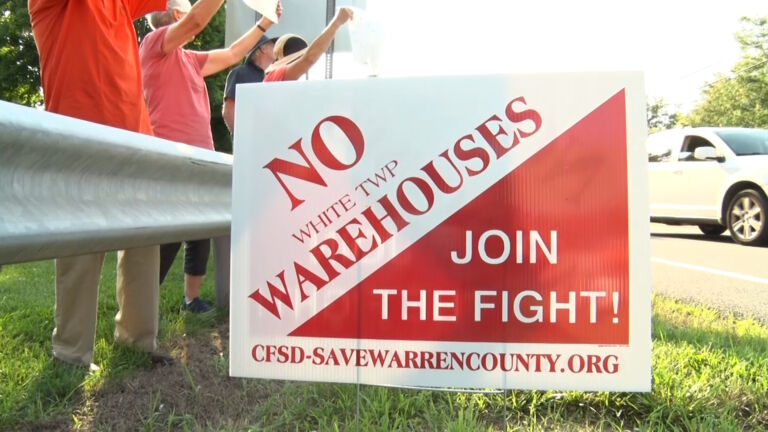
Credit: Jon Hurdle
A planning board overseeing one of New Jersey’s most contentious warehouse projects allowed the developer more time to finalize its plans, backing away from an earlier warning that it would deny the application if a complete new version of it was not received by Sept. 1.
The planning board of White Township in Warren County also refused to hear verbal objections to the latest warehouse application which complies with New Jersey’s new stormwater rules. The plan is opposed by Citizens for Sustainable Development, a residents’ group that has been fighting the plan by Jaindl Land Co., a Pennsylvania-based developer, to build two warehouses covering a total of 2.8 million square feet on what is now farmland.
At a public meeting last week, the board accepted an argument by Anthony Sposaro, an attorney for the developer, that it should allow more time for the company to take soil samples from the farmland. Sposaro said the developer had been unable to obtain the samples by the Sept. 1 deadline because sampling would have destroyed crops, and had been advised by the board to wait until the crops were harvested.
Missing piece
The panel’s deferral of a decision reversed its statement in August that, after a planning process that has so far taken more than four years, it would give Jaindl one more chance to submit a planning application that was fully compliant with new state rules on stormwater control. If the complete document was not received by Sept. 1, the board warned last month that it would deny the project, a potentially momentous action in the face of the developer’s threat to sue the town in the event of a denial.
The plan was delivered to the board by Sept. 1, as Sposaro promised, but without findings from soil sampling.
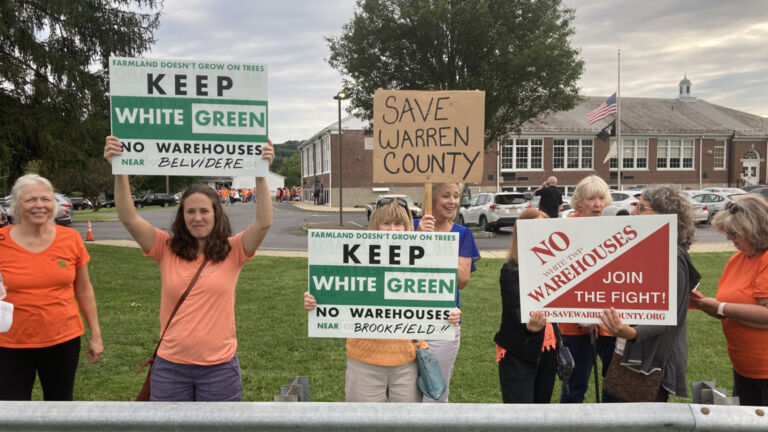
At the latest meeting, planning board chairman Tim Matthews said it didn’t have to vote on anything unless a board member made a motion to do so, and that had not happened. “I believe that we should give the applicant every opportunity to show that they can make this compliant,” he said at the meeting attended by about 175 people, many of them wearing orange T-shirts to signal their opposition to the warehouse plan.
Matthews also refused to hear a submission from Tom Bodolsky, a member of the residents’ group, who said he had identified 25 parts of the proposal that do not comply with relevant laws and rules. Those include New Jersey’s new Inland Flood Protection Rule which requires new buildings in flood-prone areas to be constructed 2 feet higher than under previous rules.
‘Troubling deficiencies’
“I have documented some glaring, and, I might add, troubling deficiencies in the submission,” Bodolsky wrote in a letter to the board on Sept. 11.
Critics’ hopes that the board would finally deny the project at the Sept. 12 meeting were raised by the board’s statements in August, and then by Bodolsky’s analysis of the revised warehouse plan. But they were dashed by the board’s deferral of a decision yet again.
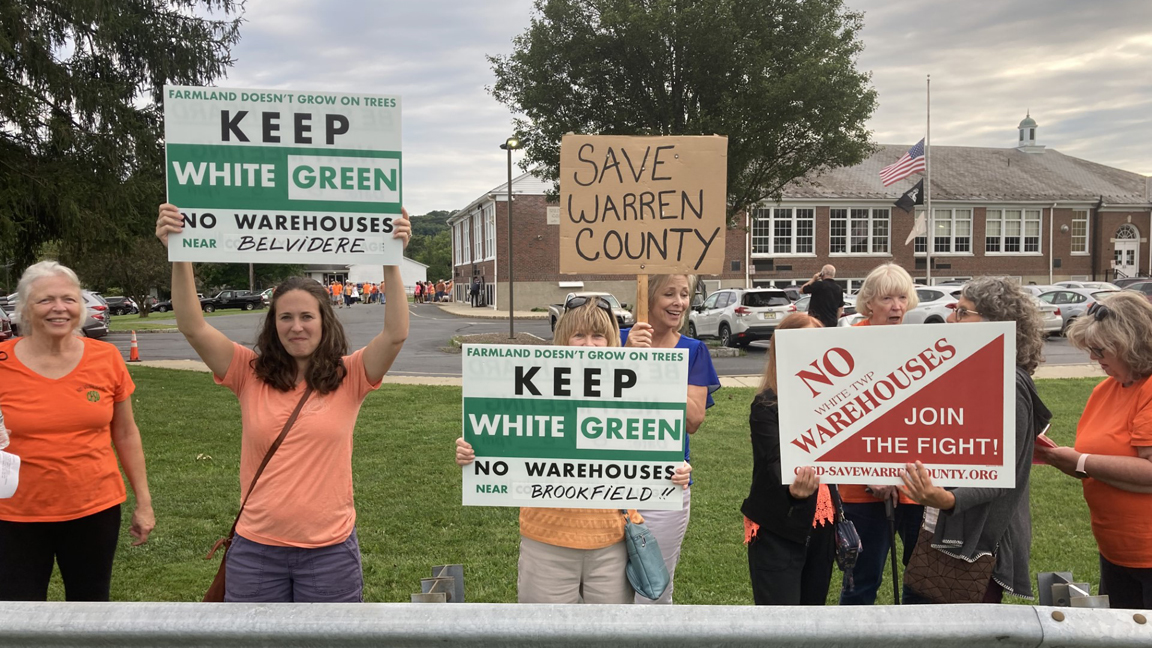 Credit: (Jon Hurdle)
“I question whether there isn’t some intent on the part of the board or the board members to diminish our numbers; to get people uninterested,” Bodolsky said, referring to why the board deferred a decision. Public involvement in the issue already seems to be dwindling, he said, noting that attendance at the latest meeting was down from about 200 in August and some 250 in July.
‘Jaindl’s failure to submit a fully compliant set of stormwater management plans and reports by the September 1 deadline requires dismissal of this matter without prejudice.’ — Mike Sinkevich, an attorney for Delaware Riverkeeper Network
Bodolsky accused Matthews of dishonestly changing his position.
“What the [August] directive to Jaindl was, versus his recollection of it, are two different things. They did not say that if it’s non-compliant, they will consider denying this application. No, they said they will deny it. Now they are doing a back-pedal.
“And on top of that, they don’t allow a person like me … to attempt to prove to them that the plans are not in compliance. For them to deny us the ability to present them, it’s absolutely outrageous.”
Matthews did not return a call seeking comment on Bodolsky’s claims.
Strong opposition
Matthews also refused to take questions from Mike Sinkevich, an attorney for the environmental group Delaware Riverkeeper Network, which opposes the White Township project. In a letter to the planning board, Sinkevich said an independent analysis by Princeton Hydro, an engineering company hired by DRN, found three major flaws in the Jaindl plan that showed it had not submitted a complete document by the Sept. 1 deadline.
“Jaindl’s failure to submit a fully compliant set of stormwater management plans and reports by the September 1 deadline requires dismissal of this matter without prejudice,” Sinkevich said in the Sept. 12 letter.
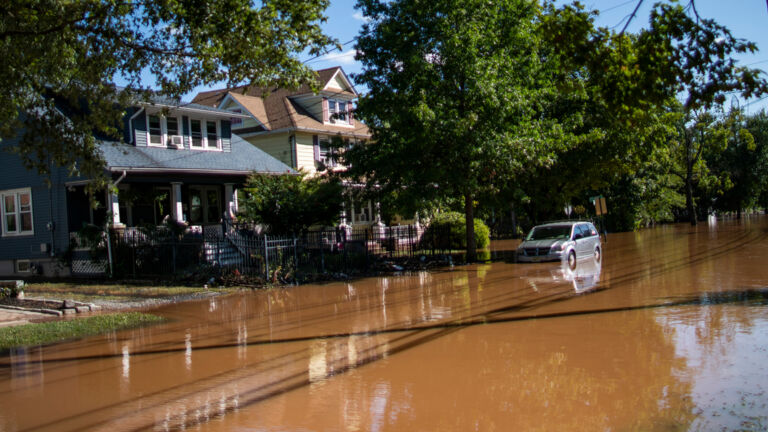
Critics of the warehouse plan say Warren County roads will be choked with new truck traffic because the site is about 10 miles from the nearest interstate. Echoing the concerns of communities faced with warehouse proposals in many other parts of New Jersey, many White Township residents predict the giant buildings will erode air and water quality and destroy a rural way of life that drew many residents to the area.
For his part, Sposaro said last week he did not know whether Bodolsky’s claims of non-compliance were accurate because he had not had time to examine the letter. But even if they were, such things were to be expected in a document of the size and complexity of the revised warehouse application, he said.
“It is inevitable that technical issues arise that can and will be addressed,” he said. “It would be truly remarkable if someone put a set of plans together and, when it was critiqued, there weren’t submissions that needed to be addressed.”
A misunderstanding?
He said the developer’s team would “drill down” to determine whether its stormwater plan needs to be revised.
Asked whether the board had reversed itself at the latest meeting, Sposaro said the panel’s August statement had been “misunderstood” as meaning that a new plan would be submitted by Sept. 1 without the need for any revisions.
When he discovered that his team would have to do as many as 60 soil borings to fully comply with the stormwater plan, Sposaro said he was advised by the committee staff and chairman not to do so when crops were in the ground. “They said, ‘Hold off on the additional soil borings’,” he said.
“Without those test results, it was impossible for us to give them chapter and verse on every aspect of the stormwater,” he said. “We could not provide them with all the empirical data that was necessary to do the complete analysis.”
The board is now due to consider the application in October or November.