
One of New Jersey’s most bitterly contested and long-running warehouse projects narrowly escaped a historic denial when planning officials in White Township, Warren County, gave the developer a little more time to modify its plan to conform with new state stormwater rules.
The local planning board teetered on the edge of denying the project, which would build two warehouses totaling 2.8 million square feet on farmland in the largely rural township. The plan has generated fierce opposition from residents since being proposed more than four years ago.
Cancelling the project would have been a major step for the township, which — like many others that have received warehouse applications — could be sued by the developer if it denies a plan that conforms with zoning rules in place at the time of application.
But after a rancorous meeting Tuesday lasting more than three hours, the board gave Jaindl Land Co. until Sept. 1 to submit a new plan that takes into account the Department of Environmental Protection’s Inland Flood Protection Rule, which requires new construction in flood-prone areas to be built 2 feet higher than under the rule it replaces.
Running out of time
The new rule became effective on July 17, giving the developer little time to adapt the warehouse plan to conform with the new requirements, argued Anthony Sposaro, an attorney for the developer. Submitting the amended plan by Sept. 1 is a “herculean task” but one that will be completed by that date, he told the panel.
Planning Board Chairman Tim Matthews repeatedly asked Sposaro why the board should allow yet more time for a final plan to be submitted, given the long history of delays that have characterized the project over more than four years.
‘We are not going away. We have too much of an investment here.’ — Anthony Sposaro, an attorney for the developer
In view of the delays, the board previously ordered Sposaro to present new and substantially different plans at Tuesday’s meeting or face the prospect that the project would be denied “without prejudice,” meaning that the developer would have to file a new application if it wanted to press on. But board members said the information presented on Tuesday was no different from what it had previously seen.
Sposaro repeated his earlier threat that a denial would prompt the developer to sue the planning board, an event that he predicted would not end well for the township.
Sposaro said the process has been delayed in part by lengthy statements from the public at the board’s meetings. He accused Matthews of failing to control opponents, about 200 of whom, dressed in orange T-shirts, packed a school cafeteria for the meeting.
Crowd control
“Look at how much time has been taken with testimony,” Sposaro told Matthews. “Repetitive statements; people getting more and more boisterous. You have allowed public comments on items not on the agenda. We’re not stupid. The amount of time that is eaten up is extraordinary. Our request to you is it’s time to reel the public in. If you can do that, we will move this matter along.”
He also pledged that his client will not back down in the face of opposition from the public or the board. “We are not going away. We have too much of an investment here,” he said.
 Credit: (Jon Hurdle)
Sposaro accused Matthews of being “intimidated” by the strong public opposition to the warehouse plan, a claim that the chairman quickly refuted. “Tony, you are talking to the wrong person if you think I am intimidated by anyone, including you,” he said.
As the board appeared to struggle with whether to deny the project, board member Richard Nieuwenhuis proposed that the board give the developer until Sept. 1 to produce “fully executed” plans that conform to the new stormwater rules, with a proviso that if it fails to do so, “we pull the plug,” he said.
‘I moved here seven years ago because I wanted a slower pace of life. I wanted to be in the country and enjoy the birds and the trees, and all of that would be destroyed.’ — Gayle Howard, Citizens for Sustainable Development
Matthews supported that plan, and warned Sposaro that the application would be denied if the board does not receive the updated plan by Sept. 1. “If we don’t get a fully compliant set of plans by September 1, we will deny it,” he said.
Sposaro said the application is complicated by Warren County’s refusal to sell land near the warehouse site to create a “deceleration lane” for traffic entering the site. The county requires the developer to build the lane but won’t sell the land that would allow it, a position that Sposaro called “illegal.” He added that the stalemate may lead the developer to sue.
No comment
Art Charlton, a spokesman for the county, said Sposaro’s statements are “inaccurate” and that the county would not comment “on active or potential litigation.” Charlton declined to say what about Sposaro’s comments was inaccurate.
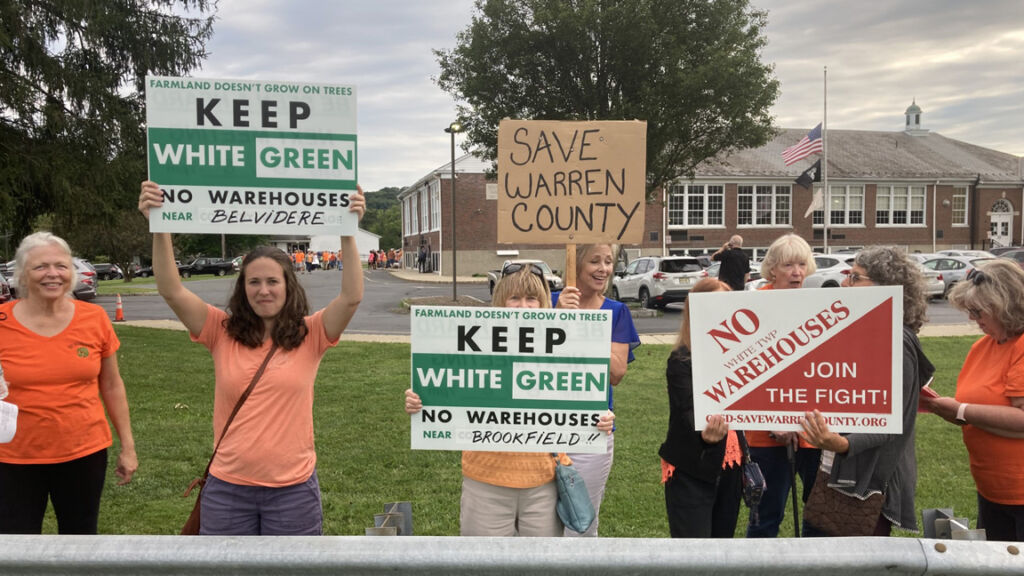
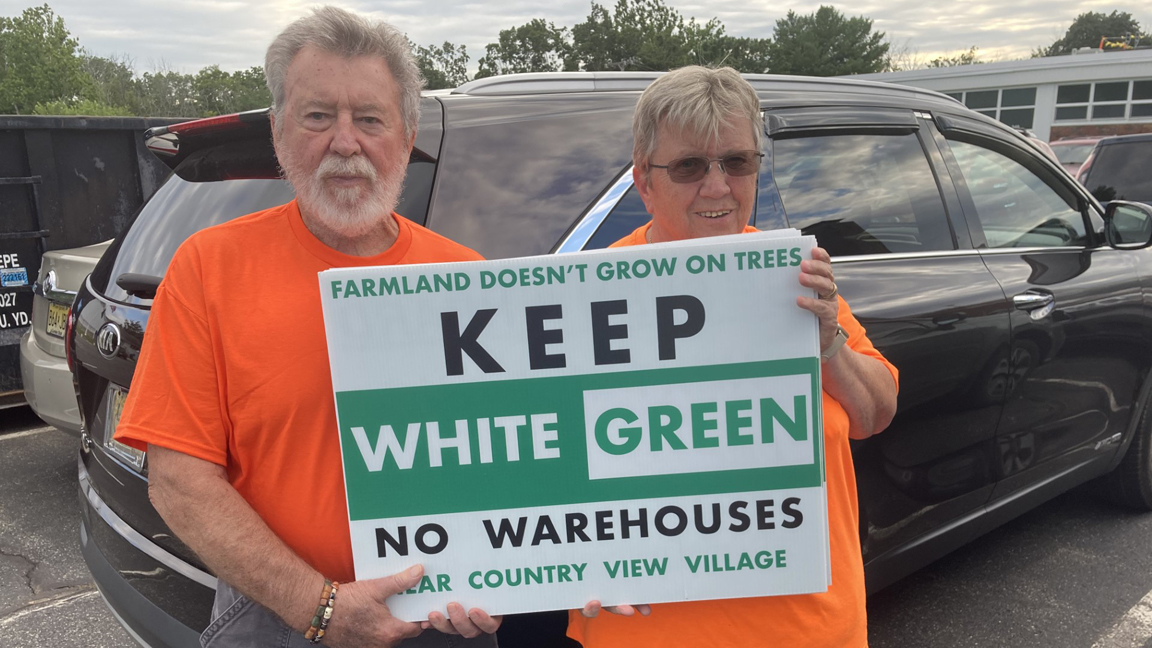
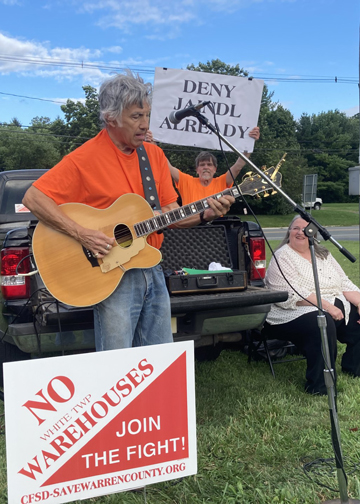
On Tuesday, the prospect that the board would finally deny the warehouse project brought out opponents who carried anti-warehouse signs, lined a nearby intersection and sang protest songs accompanied by a guitarist outside the meeting.
 Credit: (Jon Hurdle)
Gayle Howard, a member of Citizens for Sustainable Development, a community group that opposes the warehouse, said before the meeting that the project, like many others around the state in the current warehouse boom, would snarl traffic, worsen air pollution and destroy a rural way of life that attracted her and many other residents to the township.
“I moved here seven years ago because I wanted a slower pace of life,” Howard said. “I wanted to be in the country and enjoy the birds and the trees, and all of that would be destroyed.”
Howard said she was not opposed to warehouses but she argued that the current plan is in the wrong place because it is about nine miles from the nearest interstate; would be built on unstable karst geology (which is riddled by underground sinkholes); and would subject the nearby Delaware River to contaminated runoff from newly paved surface.
After the meeting, Sarah Hare, a spokeswoman for Citizens for Sustainable Development, said she was “very disappointed” by the board’s decision not to deny the project, at least for now.
“I think they have had more than enough time,” she said. “I still hope that the board will ultimately deny this. The big question is if it is denied without prejudice and (developer) Jaindl does come back with the application, will it then be grandfathered in under the original master plan or will he then have to comply with the new plan?”
For his part, Sposaro said Matthews was correct to allow time for the developer to submit a new plan without prompting litigation by the developer.
“Courts are inclined to give everyone the opportunity to reach the merits on their particular matter, and although there have been hiccups along the way, the chairman saw the bigger picture, and made the right decision,” he said.
