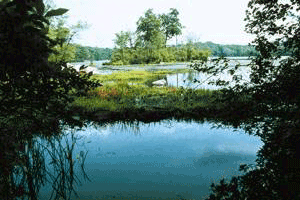
Credit: (Kristin Mylecraine)
One of New Jersey’s rarest birds might be saved by creating specialized habitat in a publicly owned tract of forest in Sussex County. But that involves felling part of the forest, a policy that’s strongly opposed by some conservationists.
New Jersey’s population of the golden-winged warbler, a tiny bird that migrates to the northeastern United States from South America for a few months each summer, dropped to only 13 pairs in 2022, down from around 100 pairs in 2000, according to state records. The bird, only 5 inches long and weighing less than a third of an ounce, is already listed as endangered by the state and is under consideration for federal listing under the Endangered Species Act.
The best hope for pulling the bird back from the brink of state extinction, says the naturalist group New Jersey Audubon, is to create a type of woodland called “early-successional habitat.” That involves first clearing an area. About six years after that the forest should start to grow back with a mixture of shrubs and small trees, creating an environment that naturalists say is favored by the notoriously picky birds. Throughout the state, all of the nesting birds in 2022 were found in early-successional habitat.
Where did the warblers go?
Some of that habitat has been created since 2017 at the 3,400-acre Sparta Mountain Wildlife Management Area, and a few pairs of the birds nested there in 2020 and 2021, raising up to five young each year and generating excitement among birders and biologists. But it’s unclear whether the existence of the warbler-friendly habitat proves that’s how to prevent the disappearance of the species from New Jersey, especially since the bird has not been seen on that preserve since 2021.
The best hope for pulling the bird back from the brink of state extinction, says the naturalist group New Jersey Audubon, is to create a type of woodland called ‘early-successional habitat.’ That involves first clearing an area.
The bird’s absence this year and last is probably because the young forest where it previously nested is no longer an ideal age, showing the importance of creating successive swathes of young forest that will host new generations of the birds, said Kristen Meistrell, vice president of stewardship at New Jersey Audubon, which manages the Sparta Mountain preserve in the Highlands region along with New Jersey Fish & Wildlife, a division of the state Department of Environmental Protection.
The current stewardship program is opposed by the nonprofit Highlands Coalition and its allies. They argue that the golden-winged warbler has effectively already left New Jersey for more northern states such as Minnesota and New Hampshire, driven by a warming climate. Thus, any amount of early-successional habitat won’t boost the breeding population in New Jersey.
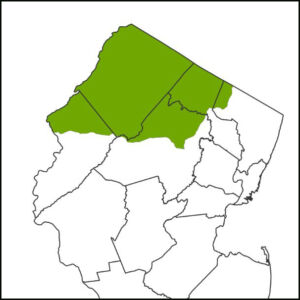 Credit: (NJDEP)
“We are not comfortable with what NJ Audubon continues to do at Sparta Mountain WMA with the cooperation of the Division of Fish & Wildlife,” said Elliott Ruga, head of policy and communications at the Highlands Coalition. “Their creation of early-successional habitat for a bird species that likely has already migrated north out of New Jersey has impacts to forest interior species that are also declining.”
Ruga said the forest’s ecology is damaged by access roads through it to allow lumber to be cut and extracted. He adds that Audubon and its state partner have never done an analysis of those impacts.
Rather, New Jersey’s forests should be kept intact so that they can play a vital role in sequestering carbon, helping to curb climate change, according to the Highlands Coalition and other critics of the tree cutting at Sparta Mountain. The Sparta Mountain preserve is almost all upland forest or forested wetlands.
“To avoid worsening the climate crisis and to improve climate resilience, our public forest policies must: stop cutting mature native trees; stop clearing the canopy and stop removing logs; and most importantly, stop clearing old forests to grow young forests,” the Highlands Coalition and its allies said in a presentation to a joint meeting of the state Senate and Assembly environment committees in March. “The scientific proof for larger, mature trees sequestering the most carbon is unequivocal.”
Defending the logging
New Jersey Fish & Wildlife defended the logging of some areas of Sparta Mountain Wildlife Management Area, and argued that the creation of young forest habitat has not happened on a large enough scale to stop or reverse declining numbers of the golden-winged warbler, but has at least slowed the decline.
The agency blamed the bird’s decline since 2000 mainly on new regulations that prevented the growth of shrubs, saplings and grasses — conditions that attracted golden-winged warblers — along power-line corridors, in a response to a widescale electric blackout in 2003. As a result, the bird’s numbers in northwestern New Jersey plunged by about 75% between 2000 and 2008, it said.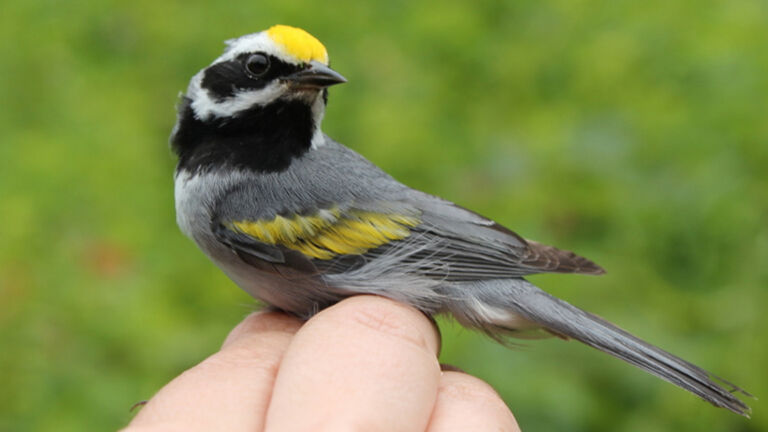
More recently, opening up the forest canopy at Sparta Mountain more than doubled the number of bird species, including rare and declining birds, compared with the number that existed there before the trees were cut, the agency said in a statement. It has also worked with PSEG to maintain warbler-friendly habitat along some power corridors.
And it questioned assertions that most of the breeding birds have already moved north of New Jersey because of climate change. It cited predictions by the U.S. Department of Agriculture that the bird’s southern Appalachian population will move north into New Jersey and New England as climate change creates the kind of forest that the bird favors.
‘When the golden-winged warbler declined so sharply, it was an indication that something was off-balance in our forests and that other species will likely become affected.’ — Kristen Meistrell, New Jersey Audubon
“They will move north only if the habitat is still suitable, and will not move into a boreal forest under any circumstance, even if increasing temperatures make them uncomfortable,” the agency said.
Human intervention
Meistrell of New Jersey Audubon said the decline of the golden-winged warbler signaled that human intervention was needed.
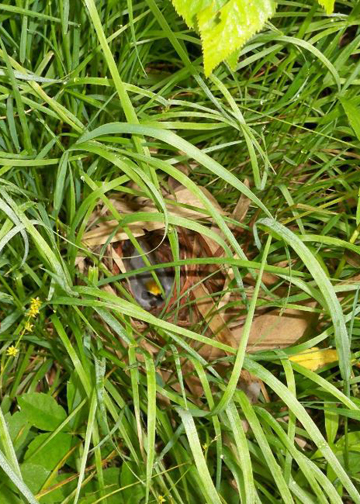 Credit: (Sharon Petzinger; NJ Fish & Wildlife)
“When the golden-winged warbler declined so sharply, it was an indication that something was off-balance in our forests and that other species will likely become affected,” she said. “If it is showing up to that forest site, that means that the site is probably diverse and healthy and functioning as it should. When we see the decline of the golden-winged warbler and other early-successional habitat species, that’s an indicator to us that our forest needs some help.”
Other species that may benefit from the creation of young forest include the red-headed woodpecker, already a state-threatened species, and the prairie warbler, both of which are so-called tipping point species, meaning they have lost half of their population in the past 50 years, Meistrell said.
“If they continue to decline, they are going to make it to the threatened or endangered species list, but if we can reverse some of the habitat-loss trends, we might be able to reverse that,” she said.
Although total forest acreage in New Jersey has remained broadly stable since the 1970s, thanks in part to laws like the Highlands Act of 2004, the amount of young forest that attracts the warblers and other species such as fledgling wood thrushes has dropped sharply as the forest has matured, Meistrell said. Earlier laws that preserved forests include the Pinelands Protection Act of 1979 and the Freshwater Wetlands Protection Act of 1987.
A resolution to the long-running standoff might be reached through new forestry guidelines from the Highlands Council, which is working on a document and expects to publish it early in 2024.
About 80% of New Jersey’s forests are 80 to 100 years old, and that signals that most of the area is not attractive to birds like the golden-winged warbler, Meistrell said. “Because 80% of our forests are roughly the same age, there’s not enough diversity across the landscape.”
She also defended the cutting of trees in the state-owned land, saying that sustainable commercial harvesting of lumber helps to pay for the maintenance of a healthy forest while creating suitable habitat for rare species like the golden-winged warbler.
And she argued that relying on forests to help curb climate change is “asking them to do more than they are capable of,” given that all kinds of natural lands offset only 8% of New Jersey’s total global-warming emissions, according to the state’s 80×50 Report, which aims to reduce carbon emissions from all sources by 80% by 2050. “The best way to combat climate change in New Jersey is to reduce our emissions and invest in clean energy,” she said.
Banning logging
After years of arguing against logging at Sparta Mountain, the coalition is now hoping that legislation — planned by Sen. Bob Smith (D-Middlesex) — will result in a state law ending the practice. Smith said he plans to file a “comprehensive forestry management bill” before the end of the current legislative session but said the bill’s details are “not yet ready for prime time.”
Opposition to logging at Sparta Mountain has persisted despite a significant reduction in 2021 in the area subject to the current forest stewardship plan to 4% from 18% of the total, after protests from environmental groups. The amount logged is now down to 10 acres a year, or about half of the original plan, Meistrell said.
Meanwhile, a resolution to the long-running standoff might be reached through new forestry guidelines from the Highlands Council, which is working on a document and expects to publish it early in 2024.
The council, a state agency charged with regulating development and safeguarding water quality in the Highlands region, has not taken a position on whether Sparta Mountain should be logged, and is now aiming to broker an agreement between the two sides, said Ben Spinelli, the agency’s executive director.
“We are actively engaged now in a much bigger effort that would encompass what’s going on at Sparta Mountain to put out guidelines for how forest management and forest stewardship would take place into the future,” Spinelli said. “We are going to take a position on these things going forward. Whether you agree with it or not, there will be standards by which these projects will be measured.”
Forestry is exempt from the Highlands Act but only if there is an approved forest management plan in effect, Spinelli said. “What we want to be able to do is put appropriate guidelines in place so that in order to enjoy that exemption, they will have to conform to the guidelines.”
— Editor’s note: This story was updated to correct a reference to the location of Sparta Mountain Wildlife Management Area and a photograph of the golden-winged warbler.