

Too little, too late for the golden-winged warbler?
It’s on borrowed time due to a lack of older forest in the Highlands and insufficient gaps in the canopy
If someone glimpses the bright yellow head and wing stripe or hears the soft buzzy chirp of the golden-winged warbler in the New Jersey Highlands, they’re fortunate — the small bird is on the verge of vanishing from the state.
“We’re trying to do restoration for that particular species … it might be that old thing where it’s too little, too late,” said John Parke, former stewardship project director of the New Jersey Audubon Society.
≋ Play to hear the golden-winged warbler’s call. Credit: Andrew Eppedio for the Macaulay Library at the Cornell Lab of Ornithology.
Sharon Petzinger, a senior zoologist with the state Division of Fish and Wildlife, said 10 breeding pairs were observed in New Jersey in 2021, down from 14 in 2020 and about 100 in 2000. The population decline is among the greatest of all the songbirds, according to the American Bird Conservancy, which says it has plummeted by two-thirds since 1966.
According to Petzinger’s modeling, there is an 88% chance there will be no golden-winged warblers in New Jersey within a decade.
“The golden-winged warbler is an indicator. If we’re losing that species, there are going to be other species on the decline if we don’t do something now to stop this,” Petzinger said. “If we lose the golden-winged warbler, next it will be the prairie warbler. After that, it’ll be something else.”
Habitat problems
As with many birds in trouble, the greatest problem for this species is a lack of habitat. But the problem is not simply one of trees where the bird would nest being cut down for development. Instead, there’s not enough diverse forest for it in the Highlands, the only area in the state through which the warbler migrates.
The golden-winged warbler winters in South and Central America. Its breeding range stretches from eastern Tennessee through Pennsylvania, northwest New Jersey and New York, across Minnesota and into Canada. The warbler breeds in fields that are grown over with tall grass and brush and in gaps in forestland that includes shrubs and young trees. It also needs nearby mature forest — with 75% or more of forest coverage — where it can feed on caterpillars and other insects. In the Highlands, nearly all the remaining forests are the same age, said Parke.

“They’re all middle-aged,” he said, meaning 70 to 100 years old. “There’s no old growth, there’s hardly any young growth … So it’s completely whacked out of balance.”
“They nest in forest canopy gaps,” Petzinger said of the golden-winged warbler. “They need large tracts of forest; they’re area-sensitive, and … a ten-acre forest gap may provide nesting habitat for one or two breeding pairs, depending on the quality of the habitat, and is the recommended minimum acreage when restoring nesting habitat for this species,” she said.
Most forests in the Northeastern U.S. were cut in the 1900s for charcoal and industrial use. Many of the remaining forests have not been managed in decades, “so now we really don’t have a lot of breeding or nesting habitat” for the warbler, she added.
Controversial restoration project
To try to help the species, the state began a 10-acre forest restoration project about a decade ago on Sparta Mountain in Sussex County, but that drew significant opposition from residents and environmentalists who objected to the cutting of trees on state-preserved land. The group Save Sparta Mountain undertook a campaign to try to “STOP the CHOP!” The group, which now goes by the name NJ Forest Watch, contended that the trees cut for the project were on average older than the state had characterized, that the machinery used to cut them created severe rutting and major soil disturbances and that the fragile ecosystem was disturbed, impacting other species that need intact contiguous forest canopy.
But Parke and Petzinger say the state’s plan is backed by science.
There is an 88% chance there will be no golden-winged warblers in New Jersey within a decade.
According to Sharon Petzinger, a senior zoologist with the state Division of Fish and Wildlife
“The hard part in all this is there’s a lot of opposition, because a lot of folks just don’t understand the science or it sounds counterintuitive to cut a tree in order to get a tree back,” Parke said. “You literally have to open up the forest canopy to allow sunlight to get down to stimulate the growth of a lot of these species … that literally have their seeds in the ground but they haven’t seen any sunlight in years. So when you open up the canopy, you get this huge influx of vegetation that comes in and that’s what the species were looking for.”
Petzinger said the effort to save the spotted owl in the Pacific Northwest helped spawn a nationwide movement.
“Don’t cut trees, save the birds, and so that was a big movement. I was part of that,” she said. “It wasn’t until I started to realize what kind of forest habitat the birds really need, especially the declining birds, and I started actually managing forests myself, that I went from ‘don’t cut anything’ to ‘OK, we need to manage our forests for birds.’”
No success yet
Some forest management is happening on privately owned land in addition to the 10 acres in the Sparta Mountain Wildlife Management Area, Petzinger said.
While the efforts to create more habitat for the species so far have failed to attract more golden-winged warblers to nest and breed, the birds are using the managed land for migration. And the managed tract on Sparta Mountain has brought an increase in other declining bird species, from about 11 species before the tree-cutting to about two dozen a few years later, with some sites adding more than 30 species, according to Petzinger.
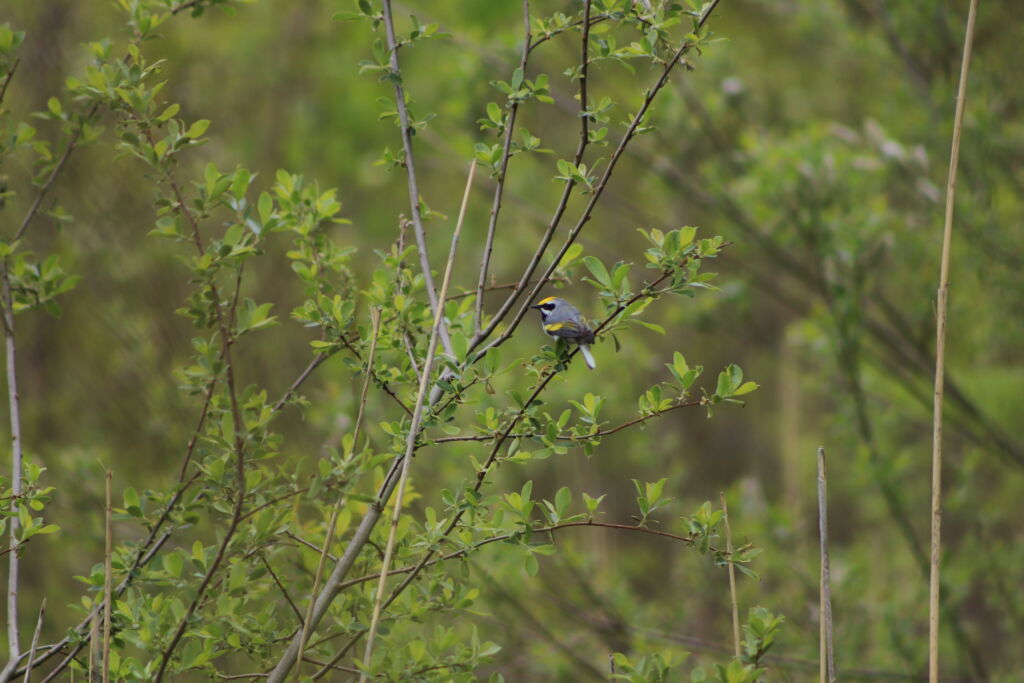
“The total number of bird species using the site more than doubled,” she said. “When you’re looking at the birds that are declining, it more than tripled.”
Although the forest management hasn’t yet drawn more golden-winged warblers, “the reality is that the work you do for that covers a whole suite of species that are also declining that have not made it onto the T and E (threatened and endangered) list but need the help,” Parke added.
This article is part of a special series by NJ Spotlight News and funded by the William Penn Foundation. Go to njspotlightnews.org/Delaware-Watershed to visit the project homepage. Send us your stories and photos about the Delaware River region.
— More in this series —
