
 Credit: (Bobby Brier; NJ Spotlight News)
Several dozen teenagers impacted by gun violence in Paterson — many from neighborhoods that have been in conflict with one another — recently graduated from a new program designed to help them navigate conflict, trauma, grief and the impacts of violence in their neighborhoods.
The Paterson Healing Collective, a hospital-based violence intervention group, created the program — the Safe Summer Teen Club — after two people were killed in shootings and several were injured during the July 4 holiday. In its first year, the club brought together 30 teens between the ages of 14 and 18 to teach them strategies to better manage their mental health and, hopefully, reduce community violence.
“The real purpose of this program was to teach young people the importance of understanding themselves, so that they understand how powerful they are in stopping the cycle of violence,” said Liza Chowdhury, the executive director of the Paterson Healing Collective.
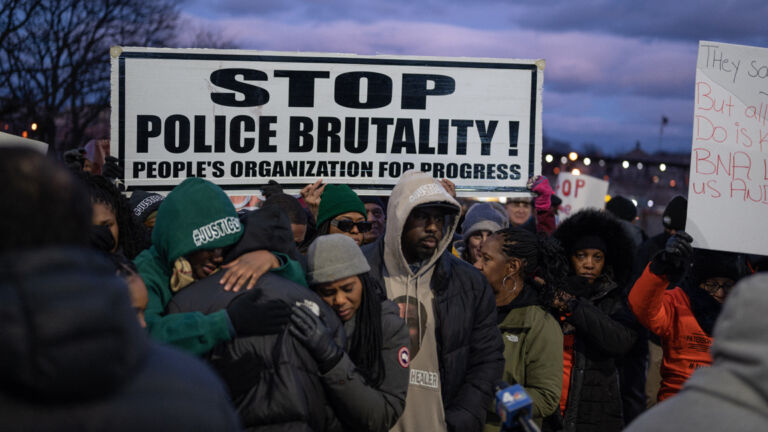
The graduation came nearly six months after Najee Seabrooks, a 31-year-old anti-violence activist who worked for the Healing Collective, was shot and killed by Paterson police while he was experiencing a mental health crisis. Chowdhury said the Safe Summer Teen Club continues Seabrooks’ legacy because he wanted the Collective to intervene with young people in the city to prevent shootings.
Liza Chowdhury, executive director of Paterson Healing Collective, talks to the program’s graduates
“Najee always would tell us, ‘Hey, we need to create programming for these young folks,” Chowdhury said. “Because, prior to this Safe Summer Teen Academy, we were doing a lot of hospital-based intervention work. So that means that we have to wait until somebody gets shot,” she said. The Healing Collective pairs medical staff at St. Joseph’s Hospital in Paterson with community members who have built trusting relationships with their peers to mentor victims of gun violence — many of whom are boys and men of color — and limit retaliation among them.
Avoiding crisis
“What mental health specialists frequently do is intervene at the time of crisis. What a program like this does is build support and capacity so they have resilience to avoid crisis if possible and endure it with a sense of self-pride and capacity when it comes,” said Dr. James Pruden, the medical director for the Healing Collective who has been an emergency physician at St. Joseph’s Hospital for over 40 years.
“Instead of looking at it from the back end of, ‘You’ve got a mental health issue, let’s try to fix it,’ this [the club] is building resilience so hopefully it will decrease the need and the trauma that eventually will come in all of our lives,” Pruden added.

Throughout the six-week Safe Summer Teen Club program, teenagers participated in workshops that included conflict mediation and restorative circles, in which they discussed the harm that was done to them by their peers in their neighborhoods through gun violence, the impact that had on them and actions that must be taken to address the harm. Every teenager was given the opportunity to speak and be heard.
Paterson has a high rate of concentrated violence in the neighborhoods where some of the young people in the program are from, said Chowdhury, and it was “very important” for members of the Healing Collective to explain to them what trauma is and how it shows up in their bodies, she said.
Chowdhury said the Healing Collective also rented out music studios to teach young people about using hip-hop to express the trauma that they have lived through rather than rapping about violence, which included writing songs and recording music. They were also taught CPR, financial literacy skills and took a trip to New York City to visit Times Square and Madam Tussauds wax museum. Many of the teenagers had never been outside New Jersey before, Chowdhury said.
After school
And the program has continued into the school year, serving as a “safe space” for teenagers after school while operating out of the Healing Collective’s headquarters, according to Chowdhury. So far, 15 kids have showed up and the Collective is planning to recruit more students to the program. Due to funding limits, the program now only operates two days a week, said Chowdhury.
“Unfortunately, it’s just the livelihood of the majority of the young men that kind of frequent the streets. They have no place to go. If they’re not in school, the streets is it,” said Barbara Martinez, the Healing Collective’s operations director. “I do see … them returning and … that contributing to the decline in violence in the city. It’s just a reality,” she said.
That was the reality for Teddie Martinez, Barbara’s husband and the hospital violence intervention coordinator and a human resources supervisor with the Healing Collective. “When I was younger, we didn’t have an outlet like this,” he said “Our outlets was the streets. Back then, I know that’s how I dealt with my mental health issues. I took it out on the opposition,” Martinez said. “So having programs like this is a great thing especially when you got people who have lived experience who can share those experiences with those individuals.”
