Credit: (AP Photo/Brennan Linsley, File)
A New Jersey Senate committee is set to consider three new Superior Court judges Thursday. But that’s only half the number of new vacancies that have arisen in the month since the director of the state judiciary pleaded with lawmakers to add new judges as quickly as possible.
More nominees could still be added to the Senate Judiciary Committee agenda before its 10 a.m. meeting but it’s unclear how many more, given no new judges were listed when the agenda was released Monday. A total of 20 nominees are awaiting Senate confirmation and Gov. Phil Murphy announced his intention to nominate another nine this month. But even if all of those were approved, those new judges would account for less than half of the current 64 judicial vacancies. And more openings will come as more judges are expected to retire before the end of the year.
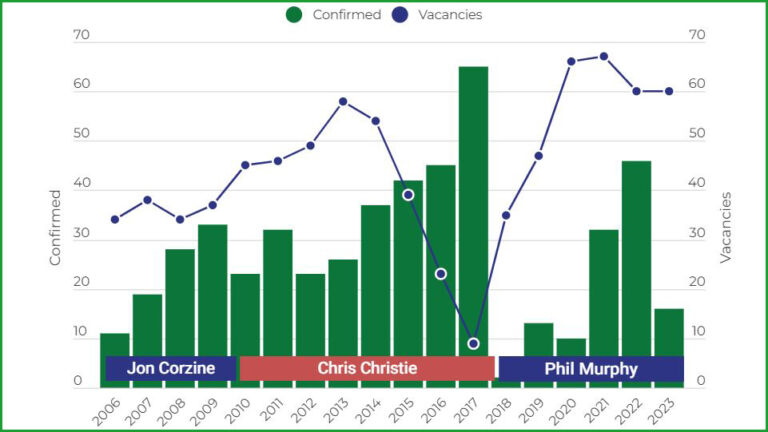
Glenn Grant, the administrator of the state court system, appeared at back-to-back meetings of the Assembly and Senate budget committees and called this high number of vacancies a crisis. Grant reiterated comments he made over the prior two years, saying the courts cannot operate effectively with more than 25 or 30 judicial openings. The last time the state ended a year with fewer than 30 vacancies was 2017, the last full year of former Gov. Chris Christie’s tenure. A year later, at the end of Gov. Phil Murphy’s first year in office, that number had grown to 35 openings.
The lack of judges is impacting some counties more than others. While six counties have a full slate of judges, Bergen and Union counties each have nine openings and Essex has eight vacancies. Supreme Court Chief Justice Stuart Rabner decided three months ago to put nearly all civil trials, including divorces, on hold indefinitely in the vicinages that include Cumberland, Gloucester and Salem counties and Hunterdon, Somerset and Warren counties due to the lack of judges. Grant warned lawmakers that civil matters could wind up being put on hold in other areas, as well, without an infusion of new judges.
All three of the nominees on Thursday’s committee agenda would fill vacancies in the Gloucester vicinage, though it’s unclear if that number would be enough to resume civil trials there if all three are ultimately confirmed. The Senate has scheduled a voting session for next Monday when any nominees advanced by the committee could be considered.
The sustained large number of vacancies is impacting people and businesses of all kinds. Couples looking to divorce are stuck in limbo in those six counties and facing long waits elsewhere, often with children impacted. Businesses can’t settle contract disputes. Criminal matters in which individuals are being detained without bail or on some court-ordered monitoring are receiving priority treatment, but those are taking longer than the court had envisioned when the state’s bail reform system took effect six years ago.
Couples looking to divorce are stuck in limbo in those six counties and facing long waits elsewhere, often with children impacted. Businesses can’t settle contract disputes.
Grant and the head of the state bar association have also said that the added workload on judges is exacerbating the vacancy problem by prompting some judges to choose to retire early because they feel burned out; judges must retire at age 70 in New Jersey.
Unlike other states where voters elect judges, New Jersey’s system requires the governor to nominate candidates, who then receive a hearing in the Senate Judiciary Committee and finally must be approved by a majority of the 40-member Senate. Those who advance from committee are all but guaranteed confirmation. But there is an unwritten rule known as senatorial courtesy which allows a senator from a nominee’s home county to block the person from even getting a hearing without having to state a reason. This has led to a number of nominations by Murphy, and by previous governors, from moving forward.
The Senate Democratic office declined to comment on the number of nominations being considered this week. Once the governor’s office submits nominees to the Senate, the Senate conducts its own vetting process, which includes interviewing the prospective judges and seeking approval from the members representing the county where the nominee lives.
While lawyers have been complaining about the vacancies, both Murphy’s office and Senate Democrats have defended their efforts. Last month, Sen. Paul Sarlo (D-Bergen), who chairs the budget committee in the upper house, said the Senate has approved 53 new judges so far this session, which began in January 2022, even as he urged Murphy to expedite nominations. A Murphy spokeswoman said he has nominated nearly 140 people of judgeships since he took office, with 116 of them confirmed so far.
On Monday, Murphy nominated attorney Michael Noriega to fill the last vacancy on the state Supreme Court, which has been without a full complement of justices since December 2021. In a statement praising the pick, Jeralyn Lawrence, president of the New Jersey State Bar Association, also used the opportunity to express continued concern over the vacancy problem.
“We hope that efforts will remain focused on addressing those vacancies that have had a deep and lasting negative impact on the people and businesses that call our state home,” she said.