Credit: (AP Photo/Brennan Linsley, File)
The director of New Jersey’s judiciary made the same plea to a legislative budget committee Monday that he has been making every year: We need more judges.
This time, administrator Glenn Grant added more urgency, calling the current situation with 58 judicial vacancies statewide “dire.”
Assemblyman Raj Mukherji (D-Hudson) pointed out what everyone at the hearing already knew, that the Assembly has no power to put more judges on the bench. The governor nominates judges, and it is up to the Senate to confirm them. Grant will get the chance to make his plea directly to senators on Tuesday when the Senate’s budget committee is scheduled to review the judiciary’s budget.
While the number of open seats in the state Superior Court is smaller than the historic high of 73 from a year ago or the 67 openings in the spring of 2021, Grant said the cumulative effect of operating with so few judges for years has had a great impact. The most recent came two months ago, when Supreme Court Chief Justice Stuart Rabner halted indefinitely all civil trials, including divorces, in six counties due to the lack of judges.
‘It seems like “Groundhog Day.”’ — Assemblyman Harold Wirths (R-Sussex)
“A year ago, we warned of the need to reduce that number to a manageable level of between 25 and 30. We are no longer headed toward a crisis. We are in the middle of one,” Grant told the Assembly Budget Committee. “As of today, our courts are operating with 58 judicial vacancies, while confronting a massive backlog of cases created by the combined effects of years of high vacancy numbers and the COVID-19 pandemic. And while new judges are being nominated and confirmed, another 22 judges are expected to retire between now and the end of the calendar year. Merely keeping pace with retirements does not help us dig out of the hole.”
Another year, another plea
Grant’s plea to end the judicial vacancies once again came as lawmakers are reviewing budget proposals for each of the state departments and agencies. That’s part of their work on Gov. Phil Murphy’s proposed 2024 fiscal year budget that seeks to increase spending to $53.1 billion. A new budget must be approved before July 1.
 Credit: NJTV News
The repeated annual requests by Grant to fill judicial vacancies prompted Assemblyman Harold Wirths (R-Sussex), the Republican budget officer to quip, “It seems like ‘Groundhog Day,’” referring to the movie in which actor Bill Murray relives the same day over and over.
“What’s the answer to getting these vacancies filled?” Wirths continued. “It seems like we’re not making any progress.”
There may be small progress in the fact that the number of vacancies this year at budget time is the smallest it has been in three years. But Grant said the court system cannot continue to function with more than 30 vacancies and still effectively perform its work.
‘…the backlog of cases throughout our justice system — in our civil, general equity, family, and criminal divisions — continues to rise.’ — Judge Glenn Grant, NJ court administrator
“Throughout the state, the continued high number of vacancies causes real harm to the individuals seeking to address their matters with the courts,” Grant said. “Victims seeking financial compensation are left in limbo. Married couples with children who are seeking to work out divorce agreements have their lives put on hold. Businesses are unable to settle contract disputes. And the backlog of cases throughout our justice system — in our civil, general equity, family, and criminal divisions — continues to rise.”
He repeated Rabner’s warning that without additional judges, the courts may need to suspend civil and matrimonial trials in additional counties.
Current process isn’t working
Grant cited Bergen County as an example of how the current system of filling a few vacancies here and there is not working. He said that four new judges recently joined the bench in Bergen County, but there are still seven existing vacancies and seven more judges will be retiring by Aug. 5.
With the Legislature in a virtual hiatus except for budget hearings through mid-May, it’s unclear when the pending nominations may be vetted by the Senate Judiciary Committee and brought before the full Senate for a vote. By May 1, the number of vacancies will rise to 61 unless the Senate confirms more judges.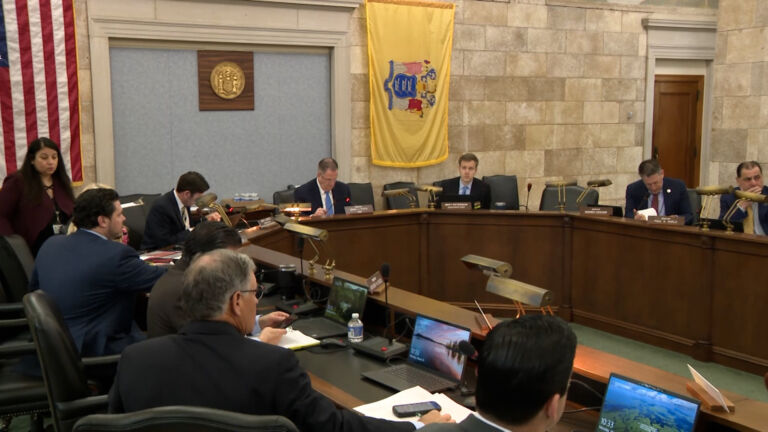
One suggestion by lawmakers that Grant said is worth pursuing is increasing the mandatory retirement age for judges, which is currently 70. That age was written into the 1947 state Constitution, when the average person did not live as long, noted Assemblyman John McKeon (D-Essex).
“For us not to change that mandatory age to me is just a degradation of all our duties,” McKeon said, adding that wisdom and experience are considered hallmarks of a good judge.
Raise retirement age?
McKeon and Mukherji are co-sponsors of a resolution (ACR-130) that would amend the state Constitution to increase the mandatory retirement age for judges to 72. And last December, Sens. Shirley Turner (D-Mercer) and Patrick Diegnan (D-Middlesex) introduced a bill that would raise the mandatory retirement age for judges to 75. Neither measure has had a hearing and it’s unclear whether either of these will gain traction. McKeon has been pushing his constitutional amendment for the last nine years. Some lawyers say asking judges to work for more years before they can retire and collect a pension is not the solution, but that Murphy and legislators need to work together and compromise to fill all the vacancies.
Grant said the court needs to get to the point of having fewer than 30 vacancies “to have a realistic chance to dig ourselves out of this hole” and even then, “it’s going to take at least three years for us to do that.”
In the meantime, Grant asked the committee for an additional $6 million in staffing for pretrial detention monitoring, saying that the longer trial delays have led to an increase of more than 50% in the number of people who are not being held in jail while awaiting trial over the last three years. With bail all but eliminated in the state due to the criminal justice reform of 2017, all but those accused of the most serious crimes and repeat offenders are released on some level of monitoring until their cases go to trial. The closing of the courts due to the COVID-19 pandemic and the judicial vacancies have ballooned the case backlog so that today some 46,000 people are on pretrial release. Grant said the budget of the pretrial release office needs to rise to $30 million “so that we can properly monitor these defendants.”