 Credit: (U. S. Fish and Wildlife Service - Northeast Region via Openverse under CC PDM 1.0)
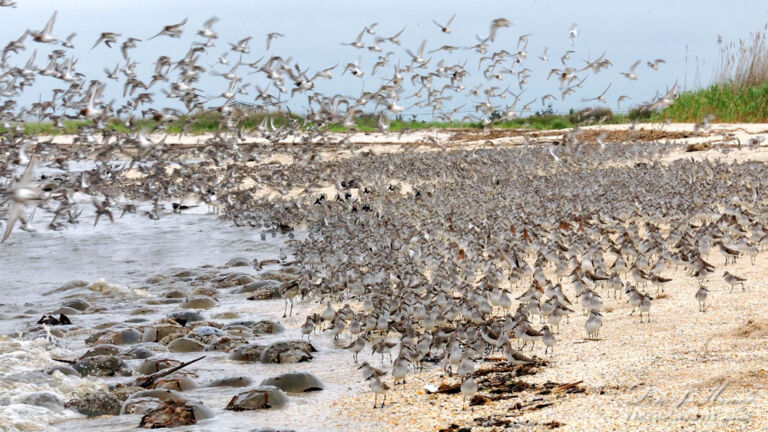
Just in time for the annual visit of red knots to South Jersey’s Delaware Bay beaches, two new conservation plans offer the prospect that the imperiled shorebird may avoid extinction in the long run.
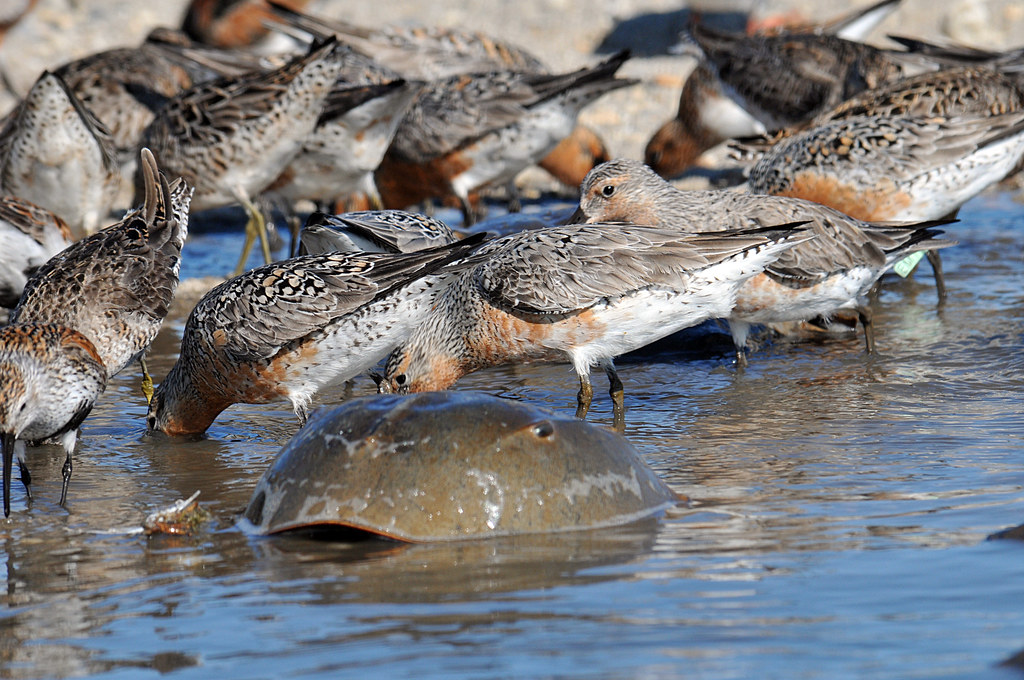
A federal judge in South Carolina in early April banned the harvest of horseshoe crabs –– the birds feed on its eggs — on about 30 beaches in the state where the birds stop briefly during a long-distance migration every spring. The ban, effective between March 15 and June 15, is designed to protect a crucial food source that enables the bird’s rufa subspecies to complete its migration and breed successfully.
Two weeks later, the U.S. Fish & Wildlife Service published a long-awaited recovery plan for the red knot that followed the agency’s designation in 2015 that the bird is “threatened” under the federal Endangered Species Act.
The plan includes protecting habitat, limiting mortality from factors such as oil spills or harmful algal blooms and addressing emerging threats, especially sea-level rise which is expected to increasingly flood beaches where the birds rest and feed on their migration. The agency also aims to ensure “ample” food supplies but does not specify horseshoe crab eggs in its list of recovery actions.
The agency said its plan “provides a road map for helping the red knot flourish to the point that it no longer needs federal protection.” But it does not expect to delist the bird until 2080, after implementation of a plan that would involve 40 U.S. states and 27 other countries where the bird breeds, migrates or winters, and could cost $880 million.
‘Huge victory’
In South Carolina, a court-brokered consent order — which is not appealable — is a “huge victory” for red knots, said Catherine Wannamaker, an attorney with the Southern Environmental Law Clinic, which argued the case before U.S. District Judge Richard Mark Gergel. “This is the largest protection of red knot feeding habitat we’ve ever had in South Carolina,” she said.
The order was agreed by Charles River Laboratories and two other defendants that harvest horseshoe crabs for bleeding by the biomedical industry which uses an extract from crab blood for testing medical products, including vaccines for toxins. Although the operation takes only some of the crabs’ blood, and the animals are then returned to the ocean, naturalists estimate as many as 30% die because of the bleeding and others are unable to breed afterward.
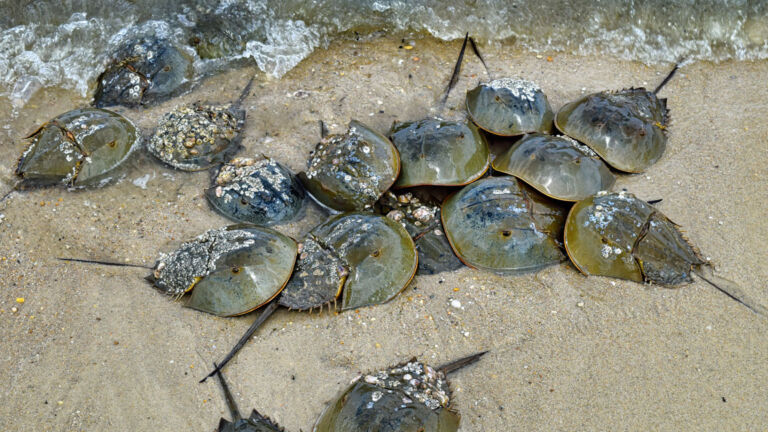
By ruling the specified beaches off-limits for horseshoe crab harvesting this season at least, the judge went further than a ban on placing female crabs in holding ponds that the plaintiffs sought.
The red knot is not the only species found on New Jersey beaches to have declined in the last two decades.
Since an estimated two-thirds of migrating knots in the Atlantic Coast population pass through coastal South Carolina en route from South America to breeding grounds in Arctic Canada, the benefits of the crab-harvest ban for the population, including those that stop on the Delaware Bay beaches in late May, could be soon and significant, Wannamaker told NJ Spotlight News.
“This is the first time that they are going to have significant spawning horseshoe crab populations left on the beach for their feeding ever,” she said.
Immediate impact?
Larry Niles, a veteran biologist who has monitored the red knot migration on New Jersey’s Delaware Bay Shore for more than a quarter-century, predicted that the effect of the South Carolina ruling could be felt as soon as this year’s migration, and throughout the bird’s Atlantic Coast route. “I bet we see it this year,” he said.
If the crabs are allowed to spawn on the beaches, they will attract migrating birds, said Niles. He has found that the density of crab eggs on Delaware Bay beaches is only about a fifth of what it was before the over-harvest of crabs in the late 1990s and early 2000s, when populations of both crabs and knots plunged.
Although the red knot has become a poster child for imperiled shorebirds on the East Coast, it is not the only species found on New Jersey beaches to have declined in the last two decades. Others include the ruddy turnstone and the semipalmated sandpiper.
The crab harvest has been banned in New Jersey waters since 2008, thanks to a state law. But Niles and other naturalists continue to campaign for a bay-wide moratorium to allow the crab population to recover and for the bird’s numbers to build to the point where it is no longer nearing extinction. In 2021, a migration-season count on both sides of the Delaware Bay found a record-low 6,880 birds, less than a tenth of the number commonly seen in the 1980s and early 1990s.
This year’s tally is likely to be known in June after the northbound birds have left sites like Reeds Beach in Cape May County.
Recovery costs and plans
Meanwhile, the Fish & Wildlife Service plan to rebuild the bird’s national population relies heavily on the protection and restoration of habitat. It advocates land acquisition, aiding coastal management and avoiding degradation and loss of areas where the birds winter, migrate and breed. It estimates that such measures would cost $180 million between 2023 and 2040.
 Credit: (U.S. Fish & Wildlife Service/Public domain)
While naturalists have for years stressed the importance of horseshoe crabs in explaining the bird’s decline, the federal plan highlights the threats of climate change.
The birds would return to the depleted beaches if the crabs were allowed to survive and breed there in greater numbers, said biologist Larry Niles who has monitored the red knot migration on New Jersey’s Delaware Bay Shore for more than a quarter-century.
“Coastal areas that constitute the vast majority of rufa red knot non-breeding habitats are virtually certain to experience erosion/inundation from accelerating sea-level rise; warming temperatures including marine heat waves; increasing ocean acidity, and increasingly intense and/or unseasonal storm activity,” the 22-page recovery plan said.
The bird’s Arctic breeding grounds are likely to become warmer and more vegetated, bringing changes to patterns of predators and prey, and raising questions about the knot’s ability to adapt. “It is unknown if the rufa red knot’s limited inherent adaptive capacity is sufficient for the subspecies to persist over the long term,” the report said.
Next steps
While noting that the overharvest of horseshoe crabs on the Delaware Bay was the likely cause of a red knot population crash starting in the early 2000s, the agency’s report did not specify the crabs as part of its recovery plan.
Bridget Macdonald, a spokeswoman for the service, said officials are now working on an implementation plan, some parts of which will relate to horseshoe crab management. The details are expected by the middle of this year, she said.
Last year, naturalists criticized the service for endorsing a plan by the Atlantic States Marine Fisheries Commission, an interstate regulator, to restart the harvest of female horseshoe crabs in Delaware Bay after a 10-year moratorium. The commission unexpectedly shelved that plan last November but adopted a model that could allow it in future.
Niles, who testified for the plaintiffs in the South Carolina case, accused the commission and the Fish & Wildlife Service of being influenced by the fishing industry. He said the judge’s order is important because it was an independent decision that he said was the first judicial ruling in the long-running red knot saga.
He said there are many places along the red knot migration route where horseshoe crabs are being killed so that the numbers never rise to the point where there are enough eggs to feed migrating birds.
But he predicted that the birds would return to the depleted beaches if the crabs were allowed to survive and breed there in greater numbers.
“As soon as the eggs appear, the birds are there, and I think that would happen all along the East Coast if we were allowed to increase the numbers so that we could get significant egg densities,” he said. “Shorebirds, instead of being a basket case, could actually go up if we had all these stopovers.”