
 Credit: (Chris Engel from Pixabay)
Fisheries regulators are poised this week to take another step toward allowing the harvest of female horseshoe crabs in the Delaware Bay, a move that naturalists say would make it even harder for migrating shorebirds to find food on the bay’s beaches.
The Atlantic States Marine Fisheries Commission is set Wednesday to consider a change to fisheries rules that have banned the harvest of female crabs since 2013 in an effort to rebuild low populations of the shorebirds, particularly the local population of the federally threatened red knot, which depend on crab eggs.
The commission wants to use new sources of data and modeling software to more accurately count the number of crabs and birds in the bay, and to estimate the size of the crab population needed for the birds to thrive. The number of female crabs has been increasing in the last five years, the commission says, and so it is now considering if the commercial fishing industry could restart harvesting the female crabs for bait.
The commission is weighing a revision of its Adaptive Resource Management framework to allow the harvest of 140,000 or 210,000 females, and twice as many males in each case, starting next year. If the proposed revision had been in effect in 2019, it would have allowed the harvest of about 145,000 female crabs, a catch that’s consistent with a red knot population of about 45,000, according to the commission’s calculations.
The original framework used software that is “antiquated, not supported, does not run on current computer operating systems, and is limited in its capacity to incorporate uncertainty when determining optimum harvest strategies,” the commission said in its agenda for the meeting.
Disagreement about consequences, numbers
The proposed change would still allow the red knot’s population to rebuild, and would continue to recognize a link between populations of crabs and birds, the commission says.
David Mizrahi: ‘The ASMFC’s intent to implement a plan that would allow for the harvest of female horseshoe crabs is reckless, given that their eggs are a critical resource for red knots.’
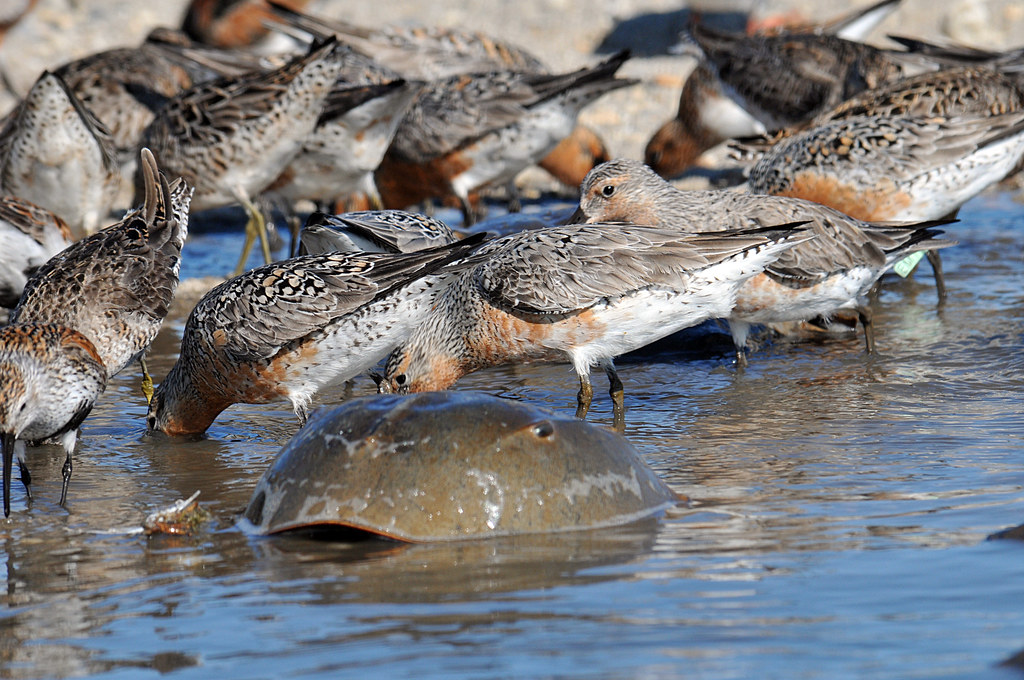
But naturalists say it’s exactly the wrong time to be making a change that would reduce the number of crab eggs for the birds. The density of crab eggs on the bay beaches is already less than a fifth of what it was before the red knot’s population plunged in response to an over-harvest of horseshoe crabs in the early 2000s, and a drop in the number of female crabs would make their eggs even scarcer, the advocates say.
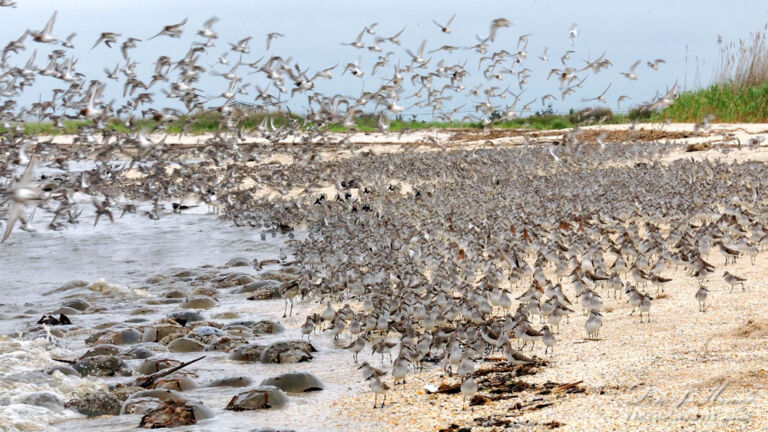
“Recent evidence indicates the red knot population using Delaware Bay during spring migration is declining,” said David Mizrahi, vice president of research and monitoring for New Jersey Audubon. “The ASMFC’s intent to implement a plan that would allow for the harvest of female horseshoe crabs is reckless, given that their eggs are a critical resource for red knots.”In 2021, the number of knots visiting and feeding on the bay during their northbound migration from South America dropped to a record-low 6,880, according to a count on land, sea and air. Although the number edged up this year to about 12,000, that was still just a fraction of the 90,000 or so that regularly visited during the 1980s and early ’90s and gave the migration in May each year a reputation as one of the world’s great natural spectacles.
 Credit: (U. S. Fish and Wildlife Service - Northeast Region via Openverse under CC PDM 1.0)
By contrast, the commission estimates the red knot population is fairly stable at around 45,000, based on its own count using a computer model. Larry Niles, a biologist who has been monitoring the birds on New Jersey’s bay beaches for the last 26 years, rejects that number. Niles argues that his method of counting, based on observation, is accurate at the much lower level.
Beaches such as Reeds Beach in Cape May County that were once packed with red knots and other migrating shorebirds for a couple of weeks each May are now mostly empty, a reminder of a sharply diminished population that may be headed for extinction.
Vulnerable red knots
Naturalists are particularly concerned about a portion of the red knot population that migrates some 9,000 miles from southern South America to breeding grounds in Arctic Canada. Those birds, arriving depleted after one of the longest migrations in the avian world, are especially dependent on food supplies at the Delaware Bay beaches, and so are highly vulnerable to any further decline in crab eggs.
Campaigners are urging the commission to halt its discussions on the new rules. They argue that the public won’t be able to consider a model by the U.S. Geological Survey that underlies the commission’s plan — because the USGS last week denied a request to release the model to the public.
Ben Levitan: ‘It is fundamentally unfair to ask the public to comment on a controversial management change when government officials won’t release key information about it.’
USGS said it was withholding the model under a “deliberative process” privilege. “Public dissemination of this information would have a chilling effect on the agency’s deliberative processes, expose the agency’s decision-making process in such a way as to discourage candid discussion within the agency, and thereby undermine its ability to perform its mandated functions,” it said.
Earthjustice, an environmental law nonprofit, said Friday that it had requested the model under the Freedom of Information Act, and because of the denial, the public will now be unable to evaluate the commission’s rule when the public-comment period opens.
Information void
“It is fundamentally unfair to ask the public to comment on a controversial management change when government officials won’t release key information about it,” said Ben Levitan, an attorney for Earthjustice’s Biodiversity Defense Program. “ASMFC must allow for meaningful review of the new model before rushing the proposal toward final approval.”
The bay states of New Jersey, Delaware, Maryland and Virginia still have the authority to restrict female harvest within their respective states.
The nonprofit, representing New Jersey Audubon and Defenders of Wildlife, has also filed a Freedom of Information Act request for a report by the U.S. Fish & Wildlife Service that reportedly said there was only a 1% chance that the red knot population would be hurt by the proposed changes.
If approved, the new rule would be put out for public comment in August and would then go before the Horseshoe Crab Management Board for final approval in November, said Tina Berger, a spokeswoman for the commission.Berger said the number of female crabs in the bay has been increasing over the last five years, and that the last version of the resource management framework allowed a harvest of females but only if a certain threshold was met — which it was not in previous years.
If the commission allows the female harvest to resume, it still has the right to reverse that decision later, she said.
“While female harvest may be allowed under the framework, the board still has the prerogative to prohibit the harvest of female horseshoe crabs in the Delaware Bay region during the annual specification process,” she said.
And even if the board does allow the harvest of females, the bay states of New Jersey, Delaware, Maryland and Virginia still have the authority to restrict female harvest within their respective states, Berger said.
