
 Credit: (OIT/NJ Governor’s Office).
A top Republican lawmaker is urging Gov. Phil Murphy’s administration to take a fresh look at a bipartisan proposal to increase the share of rent payments that can be deducted from a tenant’s state income taxes.
The push to get more tax relief to New Jersey renters comes as affordability remains a key issue heading into this fall’s legislative elections, and after Murphy and lawmakers last year made tenants eligible to receive state-funded, direct property-tax relief benefits for the first time in more than a decade.
Under the newly established “Anchor” relief program, nearly 442,000 New Jersey tenants received direct payments totaling $450 earlier this year, according to the latest figures released by the Department of Treasury.
However, Treasury has also indicated many of the renters who were initially thought to be eligible for Anchor benefits — a group of more than 900,000 New Jersey residents, according to administration estimates — did not apply for them in the program’s first year.
How to get more tax relief to more residents who rent in New Jersey has emerged as one of the key topics of discussion during recent hearings on the budget for the fiscal year that begins July 1.
As part of an overall $53.1 billion budget put forward by Murphy, $2 billion has been earmarked for the Anchor program, whose formal title is Affordable New Jersey Communities for Homeowners and Renters.
Trying to increase participation
To increase Anchor participation among renters, Treasury officials have indicated they plan to, among other measures, ramp up direct outreach to community groups and put a bigger emphasis on distributing foreign-language materials.
But Assemblyman Harold Wirths (R-Sussex) suggested during a recent meeting attended by state Treasurer Elizabeth Maher Muoio that if the administration’s goal is helping more tenants contend with soaring rents, it would be more effective to provide them with an increased credit on their state income taxes, rather than “going through all the promotion and rigmarole of giving people their own money back.”
“To me, it just looks like something that is a lot easier [to administer],” said Wirths, who serves as budget officer for the Assembly Republicans.
The proposal to increase the state income-tax deduction for renters would cost the state as much as $135.5 million in annual tax revenue, according to a fiscal estimate drafted by the nonpartisan Office of Legislative Services.
For years, New Jersey has offered tenants a state income-tax deduction as a form of property-tax relief to recognize the way rents indirectly fund a share of the property-tax bills owed by landlords.
Under current law, New Jersey renters can generally take a state income-tax deduction worth 18% of their annual rent payments as a form of state-subsidized property-tax relief.
Likewise, homeowners are also able to deduct from their state taxable income the amount paid annually in local property taxes, up to $15,000.
A measure that easily cleared the Democratic-controlled Senate with bipartisan support last year called for increasing the amount of annual rent payments that can be deducted from state income taxes, from 18% to 30%.
That legislation — which featured Senate President Nicholas Scutari (D-Union) as a primary sponsor — advanced prior to the establishment of Anchor, and it has since stalled in the Democratic-controlled Assembly.
Homeowners were keen
Under Anchor, New Jersey homeowners are eligible to collect relief payments as large as $1,500, as long as they meet the program’s income and residency provisions. And the latest figures from Treasury indicate there was a much higher participation rate among homeowners than renters in the program’s first year.
Nearly all of the more than 1 million New Jersey homeowners who were estimated to be eligible for Anchor benefits applied for and received them during the program’s first year, according to Treasury data.
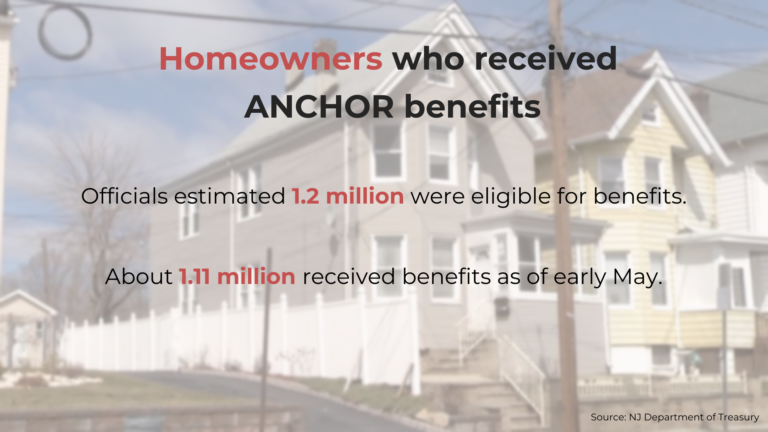
Still, budget documents released by the Murphy administration last week have indicated the state is saving nearly $170 million through a “lapse” during the fiscal year that ends July 1 by not having to fund as many Anchor benefits as were initially estimated by Treasury.
The proposal to increase the state income-tax deduction for New Jersey renters would cost the state as much as $135.5 million in annual tax revenue, according to a fiscal estimate drafted by the nonpartisan Office of Legislative Services.
But Wirths suggested during last week’s hearing that the OLS analysis also means increasing the income-tax deduction for renters would result in the same amount of annual savings for beleaguered New Jersey taxpayers.
More to be done
Muoio told lawmakers during the meeting last week that Treasury “made good headway” with Anchor in the first year, including by reaching many of the renters who had been locked out of prior relief efforts like the Homestead program, which was Anchor’s direct predecessor.
“There’s obviously more to be done,” said Muoio, who added the best advertisement for Anchor going forward could be “knowing somebody who did get a check” this year.

Meanwhile, in the Assembly, where the legislative agenda is controlled by Speaker Craig Coughlin (D-Middlesex), it appears doubtful the bill that calls for increasing the income-tax deduction for renters will come up for a vote anytime soon.
Asked about the status of the bill, Maggie Garbarino, a spokeswoman for the Assembly Majority Office, said Coughlin “remains committed to focusing on affordability for New Jersey residents” and then pointed to the Anchor program.
‘At this point, the best way to get money back to renters for high property taxes is to expand the benefit amount of the ANCHOR program for renters, who on average have lower incomes than homeowners and shouldn’t be treated unfairly even though they don’t own a home.’ — Peter Chen, New Jersey Policy Perspective
“Since the Homestead Rebate for renters was eliminated over a decade ago, many renters did not realize they were eligible for the ANCHOR program,” Garbarino said. “The Speaker is optimistic that year two of the program will have stronger participation, coupled with an upfront budgetary commitment to fund additional publicity for the ANCHOR program.”
Anchor or alternative?
Despite passing the Senate in a 39-0-1 vote, not everyone is in favor of the legislation that calls for increasing the income-tax deduction for renters.
Last year, the New Jersey Policy Perspective think tank called for amendments to the measure to address concerns about offering a deduction with a flat percentage and no income limits — something that would allow the largest tax benefits to go to the renters with the highest incomes instead of those whose rent bills make up a larger share of their annual incomes.
By contrast, Anchor provides more targeted relief to renters by making those with annual incomes over $150,000 ineligible to receive any benefits at all.
Without amendments, the income-tax deduction bill as currently written would “yield the most benefits to high-income individuals with substantial tax obligations who pay high rents,” NJPP senior policy analyst Peter Chen told NJ Spotlight News last week.
“At this point, the best way to get money back to renters for high property taxes is to expand the benefit amount of the ANCHOR program for renters, who on average have lower incomes than homeowners and shouldn’t be treated unfairly even though they don’t own a home,” Chen said.
— Graphic by Genesis Obando

