
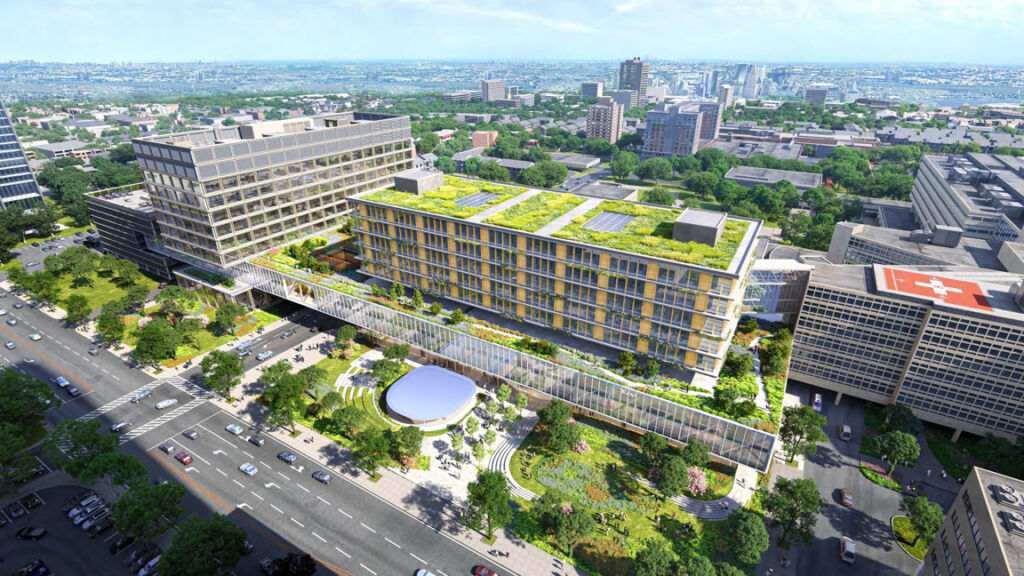
The only public hospital in the state, University Hospital has an ambitious draft plan for redeveloping its Newark campus, but funding for the $1.8 billion project remains a work in progress.
Ed Jimenez, president and CEO of University, said the hospital continues to solicit community input on the project, which will evolve in two large phases with multiple “sub-phases.” And he said it has raised $200 million — about one-third of the funding needed for the first part of the work.
“To proceed with the initial phase, we expect to need an additional $410 million,” Jimenez told NJ Spotlight News. “So far, the New Jersey legislature and the Governor have been receptive to the explanations and justification of our requests. We are optimistic that this positive response will result in the necessary funding.”
The 43-year-old hospital — the region’s only Level 1 trauma center — treats nearly 100,000 patients a year in an emergency room built to handle half that number and endures fairly regular floods and power failures.
With state budget deliberations underway, some advocates for University Hospital argue the state should be doing more to support the facility financially, both long- and short-term. They want Gov. Phil Murphy’s administration to commit some of the $1.4 billion the state has in leftover federal pandemic aid to the reconstruction project and increase line items in Murphy’s $53.1 billion budget proposal for the coming year to boost the facility’s operating funds.
“The state has failed its responsibility to University Hospital,” said Debbie White, president of Health Professionals and Allied Employees, the state’s largest health care union, which represents more than 1,000 workers at the Newark facility. “It is such an outdated, crumbling structure and every year the governor and the Legislature fail to fund University Hospital.”
White raised these concerns in written testimony to the Assembly Budget Committee in advance of its meeting Monday to review Murphy’s spending plans for the Department of Health, which licenses hospitals and provides some of their operating funds. The hearing is part of a lengthy review process before lawmakers vote on the budget in advance of the 2024 fiscal year, which begins July 1.
Murphy’s budget proposal offers $79.7 million in operating funds for University Hospital, including $35 million in new funding for capital work and technology. It also provides $13 million — a $5 million increase — to support the hospital’s role as a teaching facility for Rutgers University’s medical, dental and other clinical health schools in Newark. Both these line items are within the Department of State budget, which funds colleges.
Another source of funding
University’s role as a teaching hospital also enables it to collect millions in graduate medical education dollars, federal and state funding allocated through the health department’s budget. Murphy’s proposal includes two new categories of graduate medical aid specifically for trauma centers — a total of $77 million — targeted at facilities that serve low-income populations. The Newark public hospital is expected to get $22.2 million from this fund, state officials said.
University Hospital is also eligible for charity care reimbursements through the health department budget, a mix of state and federal money that’s allocated based on how much facilities spend providing unpaid care. Murphy’s new budget shrinks the pool for this work slightly, suggesting University will receive around $63 million, the same as last year and one-third more than any other facility in New Jersey.
‘You’re not doing enough if I may say so. That number is not adequate for the needs of University Hospital.’ — Assemblywoman Nancy Munoz (R-Union)
Language in Murphy’s budget highlights University Hospital’s unique public role in the region and state. University runs the emergency medical system in Newark and has played a critical public health role during the COVID-19 pandemic, testing medical treatments and operating public vaccination clinics. It also has a historic responsibility — codified in the Newark Accords, a community agreement drafted in the wake of the 1967 Newark uprising — to care for the city’s residents, the majority of whom are people of color with limited incomes.
“The Administration values University Hospital and the critical services it provides to the broader community,” said Murphy spokesperson Christi Peace, pointing out the increases in funding for the hospital in this year’s budget proposal.
“In addition to the other revenue sources the hospital relies on to operate, this State funding will help support the crucial work of University Hospital — which will include cost-effective efforts to expand access to care in historically underserved communities via the [graduate medical education] funding.”
Falling short
But this effort still falls short for some hospital supporters, including Assemblywoman Nancy Munoz (R-Union), a nurse with a strong family connection to University Hospital. The trauma center there is named after her late husband, Dr. Eric Munoz, who spent his career at University and also served in the state Assembly; her two sons trained there as residents.
“We’ve heard over and over again that our budget reflects our values. And if we value health care, then our budget needs to reflect the needs of our public hospital and our commitment to University Hospital,” Munoz told Treasury officials during a budget hearing earlier this month. “You’re not doing enough if I may say so. That number is not adequate for the needs of University Hospital.”
‘Since this process will take some time, there is time to discuss funding alternatives.’ — Ed Jimenez, president and CEO, University Hospital
In an interview with NJ Spotlight News, Munoz ticked off a multitude of physical problems at the Newark facility: a heating and cooling system so fragile it doesn’t function below 17 degrees or above 88 degrees; an incomplete sprinkler system; a lack of critical equipment, like CT scanners, leaving patients to wait days for imaging. While emergency rooms in most hospitals are forced to occasionally care for patients in the halls when crowded, she said University Hospital created numbered spots for hall beds to extend its ER capacity, depriving these patients of quiet or privacy.
“Residents are suturing patients in the hallway,” Munoz said, while traffic circulates around them.
University’s status as the region’s top trauma center means it is the go-to site for victims of bad accidents on north Jersey’s tangled highways or at the port system in Newark and Elizabeth, Munoz explained. “If the president of the United States lands at Newark airport, University Hospital is on call,” she said. “We have historically under-funded this hospital.”
State officials directed additional money to University Hospital in the past two budget cycles, thanks in part to $450 million in federal COVID-19 funds that were allocated to the state’s four Level 1 trauma centers, based on their work as regional patient-triage and capacity coordinators during the height of the pandemic. University has pledged to use its $150 million share of this money — and an additional $50 million provided last year through the New Jersey Economic Development Authority — to pay for planning and pre-construction work related to the reconstruction.
A $1.6B gap
But that leaves a gap of $1.6 billion for the rebuilding project, which the draft plan describes as a mix of renovations to modernize existing buildings and construction of new structures, intertwined with public green space throughout the 60-acre campus. The project was announced in 2021 by the former president and CEO Dr. Shereef Elnahal, who previously served as state health commissioner, who stood surrounded by powerful state and county lawmakers. The estimated price tag was $1 billion, at that time.
Jimenez, the new president, said hospital leaders continue to gather input from the Newark community on the redesign plan. “Since this process will take some time, there is time to discuss funding alternatives,” he said.
Many of University’s supporters remain in positions of power, including Assemblywoman Eliana Pintor Marin (D-Essex), who chairs the budget committee, and Sen. M. Teresa Ruiz (D-Essex), the Senate majority leader.
But it lost a longtime advocate when former Sen. Ron Rice (D-Essex), a former Newark police officer and champion of the city’s residents, died earlier this year.
“From his fierce protection of the core principles of the Newark Accords to his tireless advocacy for the City of Newark and this Hospital, Senator Rice was a staunch supporter of the health and well-being of the community and of the help and healing we offer to our patients each and every day,” University Hospital officials said in a statement following his death.
Reconstruction is not the only concern for hospital advocates, however, given University Hospital’s day-to-day needs. HPAE’s White wants the state to boost operational funding for University Hospital and insists that, as a public facility, it should be prioritized over private hospital systems when taxpayer dollars are being allocated. Line-item funding for University Hospital has remained the same since 2014, she said, when the state overhauled its system of medical education.
“It is unrealistic to expect UH to continue to perform miracles in times of crises, while not providing the funding necessary to live up to the expectations of the State,” White wrote in her testimony, a copy of which was obtained by NJ Spotlight News. “The State must make FY2024 the year New Jersey makes significant investments into University Hospital.”
