
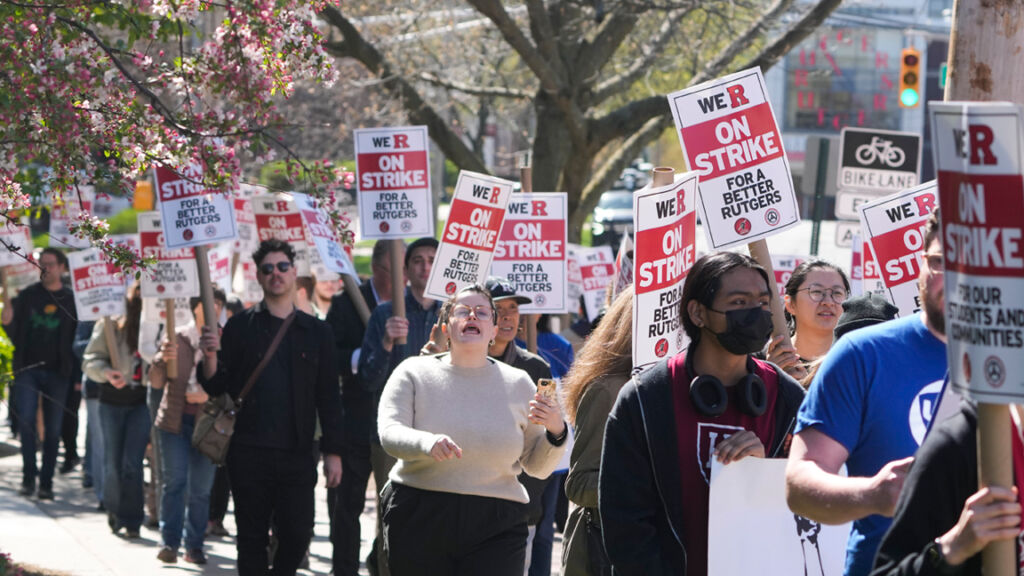
The unprecedented strike at Rutgers University disrupted classes and other events on campus, but officials said health care providers associated with New Jersey’s state university continue to serve patients on campus and at community facilities stretching from Passaic to Galloway.
A trio of labor unions representing roughly 9,000 educators, researchers and clinicians launched the job action Monday following 10 months of negotiations with Rutgers University leadership over pay, job security, scheduling and other issues, including access to health care. The walkout led Gov. Phil Murphy to call together the parties in Trenton; negotiations were expected to continue into Tuesday.
One of the unions now on strike, the American Association of University Professors-Biomedical and Health Sciences of New Jersey, represents 1,300 faculty in health-related schools, some of whom also serve in clinical roles at hospitals or outpatient practices around the state. Patient care continues as usual, according to a spokesperson and others involved with the job action. Some of those involved with the health care union who spoke to NJ Spotlight News on Monday said it was important that patients know their care will continue uninterrupted.
Critical research
“The medical faculty of the AAUP-BHSNJ union will continue to perform patient care duties and critical research, while curbing voluntary duties,” said Alan Maass, who handles communications for the union.
Rutgers University officials declined to comment on the health care situation Monday. On a webpage dedicated to the strike, the university said it has held more than 100 bargaining sessions with the unions and continues to engage in “intense negotiations.” The action impacts some 67,000 students at all three campuses in New Brunswick, Newark and Camden.
“We are working hard to reach fair and reasonable agreements with our unions, but no matter the outcome of the labor negotiations, the wellbeing of all Rutgers students will remain our top priority,” Rutgers officials said on the page.
Much of the care provided by university faculty is through Rutgers Health, a nonprofit entity founded by the university’s board in 2016 to integrate and improve academics, research and patient care statewide. According to its website, the system now involves 1,300 clinicians, although it is not clear how many are represented by a union.
2.8M patient visits
These professionals — doctors, dentists, pharmacists, nurses and behavioral health providers — staff student health centers on campus and community clinics in New Brunswick and Newark, the Rutgers cancer institutes, University Hospital and outpatient offices throughout much of the state. Together they offer more than 200 specialties, from primary care to neurology, and have worked with patients on some 450 clinical trials. Statewide, Rutgers Health providers conduct 2.8 million patient visits annually, the website notes.
‘The medical faculty of the AAUP-BHSNJ union will continue to perform patient care duties and critical research, while curbing voluntary duties.’ — Alan Maass, AAUP-BHSNJ
The RWJBarnabas Health system, one of the state’s largest hospital networks, also has a stake in Rutgers Health. A partnership agreement signed in 2017 by RWJBarnabas and Rutgers Biomedical and Health Sciences — which includes its two medical schools and other health-related colleges and specialty programs — calls for the hospital system to provide clinical guidance for the university program. RWJBarnabas was also required to invest $100 million up front and $50 million a year to expand academic, research and clinical capacity at Rutgers Health in the deal, which extends through 2038 and can be renewed for another decade. In return, the hospital system will handle all the billing and can keep much of any revenue generated through providing this patient care.
This partnership with a private hospital system has sparked concern among some public health advocates, including elected officials and labor leaders focused on Newark. The state’s largest city — with a long history of poverty and poor health outcomes — depends heavily on health services delivered through or in partnership with Rutgers, including at University Hospital. The state’s only public hospital and the region’s Level 1 Trauma Center, University is also a teaching hospital for Rutgers New Jersey Medical School in Newark and depends largely on Rutgers faculty and staff for daily operations.
