Credit: (AP Photo/Patrick Semansky, File)
Tax Day may be a little later than usual this year, but for last-minute filers, there’s now less than a week left to submit state and federal tax returns and pay any owed taxes.
This year, Tax Day is Tuesday, April 18, for both state and federal tax returns, instead of the typical April 15 deadline.
That’s due, in part, to April 15 falling on a Saturday this year, as well as the federal Internal Revenue Service observing Washington, D.C.’s Emancipation Day holiday on Monday, April 17.
In the run-up to this year’s deadline, the IRS has been encouraging eligible taxpayers to take advantage of the federal government’s “Free File” service. That electronic service is offered to taxpayers who made $73,000 or less in 2022.
The electronic way in NJ
Meanwhile, New Jersey’s Division of Taxation is also reminding residents they have the option of filing state income tax returns for free electronically.
A recent post on social media highlighted the state’s online income-tax filing portal, which allows residents who filled out a return for the prior year to complete and submit their 2022 tax forms electronically this year.
The state’s online portal also has a “save” feature that allows residents to start a return, but complete it later without losing their work, according to the Division of Taxation. The portal also provides a way to pay any balances that are due online, via e-check or credit card, with immediate confirmation that a tax return and payment have been received by the state.
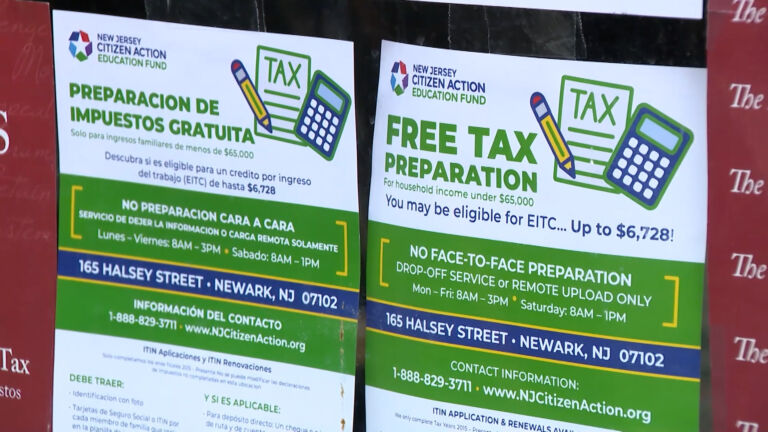
As of the end of March, the IRS reported it had received roughly 90 million individual income tax returns, indicating many of this year’s estimated 168 million expected filers had yet to submit a completed return.
The IRS has been urging taxpayers to be on the lookout for scams that target individuals, businesses and tax professionals during the tax season.
For those who have already submitted their tax returns, the IRS indicated it had issued nearly 63 million refunds as of the end of March, with the average refund totaling just over $2,900.
For those who file returns electronically, the IRS has indicated most who are owed refunds will receive them within 21 days of filing, if they choose direct deposit and if there are no issues with their tax return. By contrast, it can take four weeks or longer to receive a refund after filing a paper return, according to the IRS.
Check the status of your refund
Anyone seeking to check the status of their refund can do so by visiting the “Where’s My Refund?” page on the IRS website.
At the state level, the Division of Taxation has indicated it will take four weeks or more after you file tax returns electronically to receive a refund this year. Those who file returns by mail should expect to wait at least 12 weeks, and it will take 15 weeks or longer for those who send in paper returns via certified mail, according to the division.

New Jersey residents can check the status of a state tax refund online or by calling 1-800-323-4400 or 609-826-4400.
For those receiving refunds, paper checks are issued from the state’s “Property Tax Relief Fund,” according to the division. Those receiving refunds via direct deposit will see them appear from “State of N.J. NJSTTAXRFD.”
The tax-refund payments are issued separately from the “Anchor” property-tax relief benefits that many New Jersey homeowners and renters began receiving late last month, via check or direct deposit. Anchor benefits total $1,500, $1000 or $450, depending on income and whether a recipient is a homeowner or renter.
Avoid hidden fees
This year’s tax-filing season is the first since the state’s tax law was rewritten to help protect consumers against hidden fees that were sometimes charged by tax preparers offering what are known as refund-anticipation checks.
A law enacted by Gov. Phil Murphy last year made it illegal in New Jersey for a tax preparer to “provide, offer, or advertise” to consumers a refund anticipation check or loan as being “free,” “no cost” or “no fee,” if that service is “predicated upon, the assessment of higher or additional fees for other tax preparation or other services than are charged to clients who do not receive refund anticipation loan or refund anticipation check services.”
For its part, the IRS has been urging taxpayers to be on the lookout for scams that target individuals, businesses and tax professionals during the tax season.
Among the agency’s “Dirty Dozen” list of scams are those aggressively promoting refunds related to the Employee Retention Credit, or ERC, and “phishing” and “spearphishing” scams that come via email or text message and are designed to get users to provide personal information.
The IRS is also cautioning taxpayers to be on the lookout for unscrupulous tax preparers, including so-called ghost preparers who refuse to sign a return or include their IRS Preparer Tax Identification Number as required by law. Taxpayers should never sign a blank or incomplete return, according to the IRS.