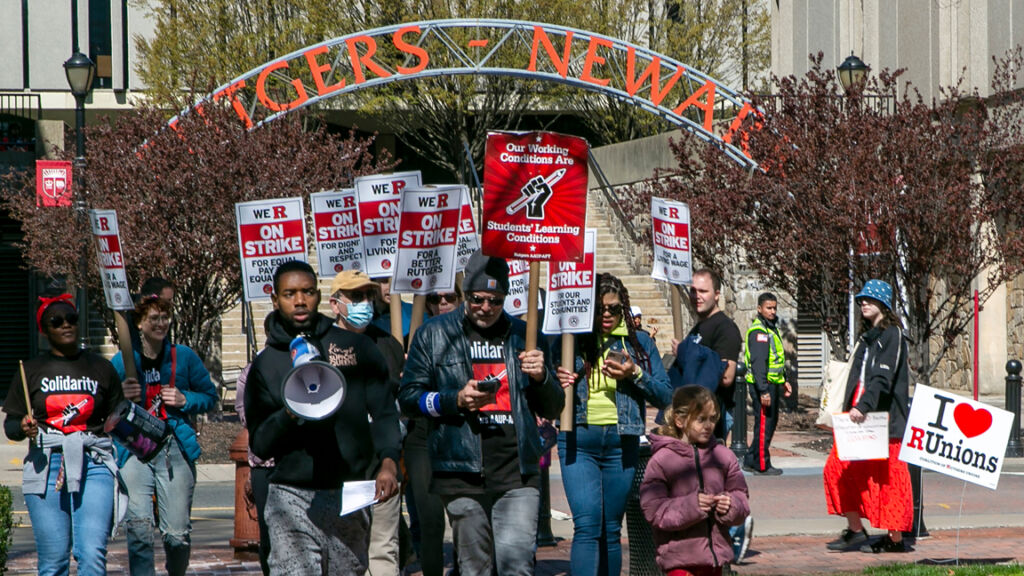
Fighting for pay equity and livable wages is a matter of racial justice, say Rutgers union members now part of the historic strike at the state’s flagship university system.
Black, Indigenous and people of color often experience financial barriers to entering academia, those union members say, because they simply cannot afford to. The result is that nationwide, the majority of professors are white and male, who are also more likely, according to U.S. government statistics, to hold higher job titles as professors, whereas people of color are more likely to be associate or assistant professors.
“The disparity in wealth of Black to white, of individual families, is literally 10 to one. Your average white family has 10 times the wealth of your average Black family,” said Donna Murch, associate professor of African American and U.S. history at Rutgers University. “So to be able to attend graduate school, where parents are often still subsidizing their children, if they have the wealth to do it, this is a structural disparity.”
In Rutgers’ case, adjunct faculty are not paid the same amount for teaching classes as full-time professors. Graduate student workers make anywhere between $20,000 and $30,000 a year for 15-hour work weeks but are often prevented from taking on other jobs by their departments. As part of their demands, striking full-time faculty are asking for wages that keep up with inflation, as well as job security and competitive benefits.
Priced out of graduate school
“There are people that can’t afford to come to graduate school on such low wages, and they’ll go where they can get enough money,” said Murch, who is also the president of the New Brunswick chapter of Rutgers AAUP-AFT, one of the unions striking.
On top of financial strains, Murch said faculty of color are also unpaid for doing extra diversity, equity and inclusion (DEI) work, another reason why it’s hard to retain faculty of color because they have to do “double duty” between their professor roles and DEI work. Jason Williams, associate professor of justice studies at Montclair State University, said it’s not uncommon for professors of color to be tapped to serve on various DEI committees, which can be “emotional labor.”
Rutgers University needs better job conditions and wages for its academic employees, say union members, to create a pipeline for more Black, Indigenous and people of color to enter academia and reflect New Jersey’s diverse population.
It’s “demoralizing for our students who don’t see faculty who look like them. It limits their own ambitions for themselves. It says that people like them can’t advance to these kinds of roles,” said Deepa Kumar, professor of media studies at Rutgers-New Brunswick and former Rutgers AAUP-AFT president.
It’s hard to know racial and ethnic breakdowns of professors at Rutgers, said Kumar, because that information became “non-mandatory” in 2012. But that doesn’t stop the unions fight to create a better working environment for people of color at Rutgers.
Diversity fellowships
Rutgers AAUP-AFT and Rutgers Adjunct Faculty unions are fighting for 100 diversity fellowships to financially support graduate student workers to finish their dissertations, said Kumar and Murch.
On Tuesday, Murch said the unions have “yet to win (the) fellowships at the bargaining table.” In an update emailed Wednesday, the Rutgers unions said there has been “significant” progress on their economic demands and Murch said she hopes that DEI fellowships will be funded.
The issue of fellowships is particularly troubling to Murch, who said it’s hard to recruit students to the African American history department without fellowship packages, even though the program is nationally recognized. Murch said fellowships were essential to her becoming a professor.
“It’s really disheartening to have the first Black president of Rutgers take a hardline stance against graduate student demands because it hurts the individual graduate students and their families,” Murch said. “But its long-term effect is going to damage our graduate programs, especially those who are African Americans, Indigenous and other (students of color).”
The unions are also fighting for more money for the University Committee on Diversity, Race and Gender, which was formed by current co-chair Kumar. Kumar said the committee has been able to work with the Faculty Diversity Collaborative, a university initiative, to provide funds for a “modest” program to help faculty of color. These faculty are often “stuck in rank” at the associate professor level, and the program would offer mentors and sponsors for them to “establish themselves as scholars with standing,” Kumar said.
But when the unions proposed more funding for diversity, equity and inclusion initiatives such as the sponsor program, Kumar said university management “rejected everything.”
Deliver on the rhetoric
“On the one hand, we have all the rhetoric about diversity, equity and inclusion, but when the union actually proposes concrete programs, after polling our faculty, after polling our (faculty of color) — and we present them and we asked for funding for this, we hear a deafening silence,” Kumar said.
When asked to comment on the Rutgers response to diversity fellowships and program proposals, university spokesperson Dory Devlin said, “We are all working as hard as we possibly can, in partnership with the Governor, to negotiate fair contracts for all of our employees.”
If these DEI programs are not funded, or if professors are unable to get what they consider livable and fair wages, the university could lose current or potential educators of color, said union members. It’s not just a Rutgers-specific issue. Williams said he knows of many faculty who “job hop” and that it creates a “ripple effect.”
“Because now (students of color) don’t have advisers or mentors with whom they can relate. And so then the students ultimately end up suffering as well,” he said.