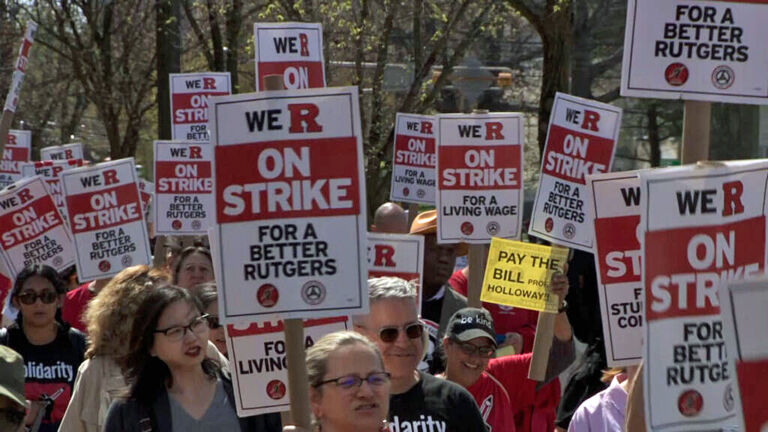
Credit: (AP Photo/Ted Shaffrey)
For many students and faculty at Rutgers University, the strike by three unions is interrupting the semester and could possibly derail their coursework for some time.
“I am crestfallen for my students that I’m not in the classroom with them, helping them get ready to graduate,” said Dr. Anna Haley, an associate professor at the Rutgers School of Social Work and a member of the Rutgers AAUP-AFT union.
The strike, the first in the school’s 257-year history, comes after nearly a year of unsuccessful negotiations between union representatives and university leadership, impacting 67,000 students across three state campuses.
The unions represent 8,800 graduate students, professors, adjunct professors and health professionals. Earlier this week, Gov. Phil Murphy called for negotiators from both the university and the three faculty unions to meet in Trenton to come to a resolution. No deal has been reached as the negotiations continue.
The three unions are calling for pay equity, a living wage for graduate workers, longer contracts for faculty without tenure and a $15 hourly campus minimum wage, among many other demands. The strike comes in the wake of similar walkouts on college campuses around the country this year where workers are also calling for increased wages, better health benefits and more job security.

“We would directly benefit from the pay raise and the increase in benefits,” said Ethan Block, a 21-year-old undergraduate political science major at Rutgers University in New Brunswick. “And I think it really helps our professors devote more of their time to teaching us and preparing us for careers and for the outside world in a sense,” said Block, a junior.
But with final exams scheduled to begin in a few weeks at the university, the breakdown in negotiations and lack of resolution have proven to be a disturbance for faculty and students.
“It has been … a disruption just in the sense that it’s hard to plan your lessons when you don’t know for sure whether or not you’re going to go on strike, like what do you cover and what do you prioritize,” said Rachel Barber, an adjunct professor and first-year writing instructor at Rutgers-Camden.
A necessary interruption
On the other hand, Barber noted, the strike is “really, really necessary.”
“It’s really difficult, especially in a writing-intensive course, to give your students appropriate feedback when you’re really struggling to balance all of your various work responsibilities just because you’re not paid enough to do it,” she added.
Barber teaches two courses per semester at Rutgers-Camden while also working another job on the side because she said she is not paid enough as a teacher. She also does not have health insurance.
The walkout has caused anxiety and uncertainty for students and faculty during a critical time in the semester as regular classes are scheduled to end on May 1.
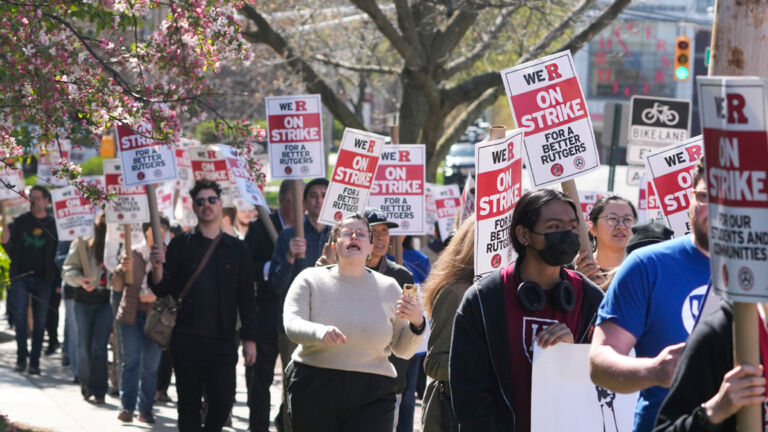
David Marchino, who arrived at the Camden campus last summer when the contract for university faculty was still in dispute, said the situation is “very scary.” Marchino has kids at home and with the current amount of money he is making as a graduate instructor and graduate student in the Master of Fine Arts creative writing program, he cannot afford regular grocery shopping.
But Marchino added that the students in the class that he teaches have said that they are stressed out and worried as well.
Student support
“They’ve given me their support. They say we want you to win this contract. But at the same time, none of us want to be here on strike [and] not together in the classroom. So, I think we’re all a little worked up and worried about that,” he said.
If there is no movement towards an agreement, there will be “no choice” but to take legal action to assure the continued academic progress for students and to prevent “irreparable harm,” Jonathan Holloway, Rutgers University president, said in a letter earlier this week.
Haley, a professor in the school of social work, said she hopes that there is no injunction, that management stays actively engaged at the negotiating table and that the parties can arrive at a mutually satisfactory set of agreements.
“It would be what Rutgers is supposed to be as an inspiring, inclusive, diverse university community where it is trying to meet all of its different members’ goals and senses of well-being,” Haley said.