
 Credit: (AP Photo/Wayne Parry)
In the days following the Sept. 11 attacks, Dan Trolaro was on his laptop constantly. The Union County native and then-Goldman Sachs employee had held a clear view of the planes hitting the World Trade Center towers from his office building in Battery Park City.
On Sept. 12, an ad for an online gambling site popped up on the screen, and he ended up playing blackjack for 45 minutes.
“I felt better. Like I just didn’t feel sad. My mind was preoccupied. I had other things to focus on,” said Trolaro, 47 years old. “And so I did it that day, and then I woke up the next day and I did it again. And the next day and the next day. And I gambled on something pretty much every day for the next eight and a half years.”
Trolaro’s addiction escalated, and to fuel it, he started to take clients’ money after leaving Goldman Sachs and becoming a financial planner with Prudential in New Jersey. He was caught in 2010 and sentenced in 2011 to six years in New Jersey state prison for the illegal retention of assets and misappropriating more than $2 million.
Trolaro, now out of jail and trying to help others, is one of over 3 million people nationwide who have struggled with gambling addiction. Programs abound to help them — and New Jersey is seen as a national leader in providing those programs.
The latest effort is a proposal by state lawmakers to create for New Jersey a gambling treatment diversion court as an alternative to incarceration, similar to the “drug courts” for substance addictions. Another bill would require school districts to provide instruction on the risk of compulsive gambling as early as ninth grade.
Widespread gambling
The push by lawmakers comes in the wake of a May 2018 U.S. Supreme Court decision that ruled in favor of the state of New Jersey and allowed for the legalization of sports betting both in the state and across the country. Between 60% and 70% of New Jersey residents place bets in some form, from lottery tickets to online gambling, according to Dr. Lia Nower, a professor and director of the Center for Gambling Studies at Rutgers University.
Under the legislation for the diversion court, a pilot program would treat people diagnosed with a gambling addiction who have committed a crime because of their disorder. The pilot program would be established in one northern, one central and one southern court district. As part of the treatment, the program would require the person seeking treatment to pay restitution, and it would be managed by a mental health professional, such as a problem-gambling counselor or a licensed psychologist.
The program would include resources on how people can stop their gambling problem through educational, counseling and support sessions. It would also include referrals to community, health, substance abuse, religious and social service agencies for additional resources, according to the bill.
If the person adequately completes the treatment, the conviction would be overturned, and the person could file a petition to expunge his or her records related to the conviction. However, if the treatment is not completed, the court would apply the original sentence.
The bill is modeled after a similar program in Nevada, where diversion courts for gambling addictions have been deemed a “win-win” for society as well as for those who are facing legal troubles because of their addiction, according to state Assemblyman Daniel Benson, a primary sponsor of the bill. The bill has been referred to the Assembly Appropriations Committee.
“Oftentimes much like other addictions that we see, folks are running into legal troubles as they’re trying to cover up their addiction or trying to cover losses and still maintain their quality of life,” said Benson (D-Mercer). “That then leads to more folks in the judicial system.”
‘An element of escape’
Problem gambling is a mental health disorder, according to the National Council on Problem Gambling. Up to half of people in treatment for a gambling disorder have suicidal ideation, and about 17% have attempted suicide, according to the Nevada Council on Problem Gambling. However, most problem gamblers who have had thoughts of suicide have recovered and gone on to lead healthy lives, the council noted.
Just like substances, gambling can be an element of escape, said Dr. Emily Einstein, the chief of science policy at the National Institute on Drug Abuse. There is also a large dopamine release associated with it. If people seek out a stimulus, such as gambling or drugs over and over, that will change the circuitry in the brain and keep people coming back in a compulsive way that they can no longer control, according to Einstein.
 Credit: (AP Photo/Jeff Chiu, File)
Gambling is also often a hidden addiction that is not evident with any known physical traits or characteristics, according to Trolaro.
This was the case for Trolaro, who left Goldman Sachs and the city in in September 2003.
He joined Prudential in New Jersey as a financial planner also in September 2003, when he had been gambling steadily for two years, he said. The time and money he spent gambling started to increase. In his new role, he was in charge not only of giving people financial advice but in some cases of their money as well.
“That’s not a good combination for a person with a gambling problem,” he said.
In June 2008, Trolaro had a client write a check to him rather than to Prudential, and he deposited the check in his personal bank account. This was the first time he had done something illegal, he said. He gambled with the money, thinking he would win and pay the client back. Instead, he lost and owed the client $10,000. From June 2008 until Feb. 11, 2010, he stole dozens of checks from clients for over $2 million to support his gambling addiction.
On the morning of Feb. 11, 2010, Trolaro received a phone call from his managing director at Prudential.
Trolaro’s ‘journey of recovery’
A months-long investigation into his misappropriation of clients’ funds had taken place, involving the FBI and local authorities in New Jersey. That day, he admitted to everything he had done and was fired from his job.
“That was the day that started the journey of recovery for me,” he said.
On Aug. 19, 2011, Trolaro was sentenced to six years in state prison for the illegal retention of assets.
“I remember the night before I went away, on August 18th, I had to sit my twins down on the couch. And they’re … six years old,” he said. “I had to tell them that dad had to go on a business trip and I didn’t know how long I would be away for … I didn’t know how long it would be until I saw them.”
He was in the criminal justice system for 4 1/2 of the six years. While incarcerated, Trolaro got back into his faith and spirituality, which he had drifted away from because of shame, he said.
“I just knew I wanted to help people,” he said.
Most callers to 1-800 Gambler are seeking help for gambling problems associated with online and sportsbook gambling.
After prison, he began volunteering to share his story with 800-Gambler, a 24-hour, seven-days-a-week confidential helpline run by the Council on Compulsive Gambling of New Jersey. The council is a private nonprofit organization that provides information, education and referral services for people affected by a gambling problem.
Eventually, he was hired by the council as a full-time employee, working with the organization for 5 1/2 years and becoming the assistant executive director.
In August 2021, Trolaro left the organization and joined Epic Risk Management as its vice president of prevention in the U.S. The company, founded in the U.K., aims to help people, businesses and organizations avoid the effects of gambling-related harm. In the U.S., the company works with athletes and sports organizations, including the NCAA, the NFL Players Association and Major League Soccer.
More calls for help
Excessive gambling is a problem that continues to do damage throughout the state and beyond.
The number of calls to 1-800 Gambler for those seeking help increased by 10% from 2021 to 2022, according to Felicia Grondin, the executive director for the Council on Compulsive Gambling of New Jersey. Most callers are seeking help for gambling problems associated with online and sportsbook gambling, according to Grondin. She added that 1-800-Gambler may refer them to a mental health counselor in their area, to a Gamblers Anonymous group in their area or provide a “compassionate ear” to listen to them.
Overall, about 25% of calls deal with sportsbook gambling problems, Grondin noted.
New Jersey is one of the national leaders when it comes to providing help for problem gamblers, according to Alan Feldman, a distinguished fellow at the International Gaming Institute at the University of Nevada, Las Vegas.
The state’s Division of Gaming Enforcement has set specific parameters for what warning signs operators should be looking for, including players whose gambling time increases from week to week.
New Jersey was among the first states, along with Massachusetts, to require that online gaming operators provide player data to be researched, studied and better understood, according to Feldman. “That’s a relatively new development in the history of this topic, and it’s an unbelievably welcome development,” Feldman said.
Gaming operators already collect player data, but under the new state program the data is being used to uncover potential problem gambling patterns, according to the attorney general’s office. The state’s Division of Gaming Enforcement has set specific parameters for what warning signs operators should be looking for, including players whose gambling time increases from week to week, bettors who repeatedly self-impose “cool-off” periods from gambling and gamblers who wager until they have less than $1 in their accounts.
Self-exclusion
Additional efforts to curb gambling addiction in New Jersey have included the state’s self-exclusion program which was created in 2001. This program allows people with a gambling problem to voluntarily exclude themselves from gambling in all Atlantic City casinos. In 2013, the program expanded to include self-exclusion for internet gaming as well.
One of the latest approaches is to get at the problem early. And state lawmakers have filed a bill that would require high schools to incorporate instruction on the potential risks of compulsive gambling, including the dangers of gambling addiction and taking risks with personal finances or personal assets. The bill has been referred to the Assembly Education Committee.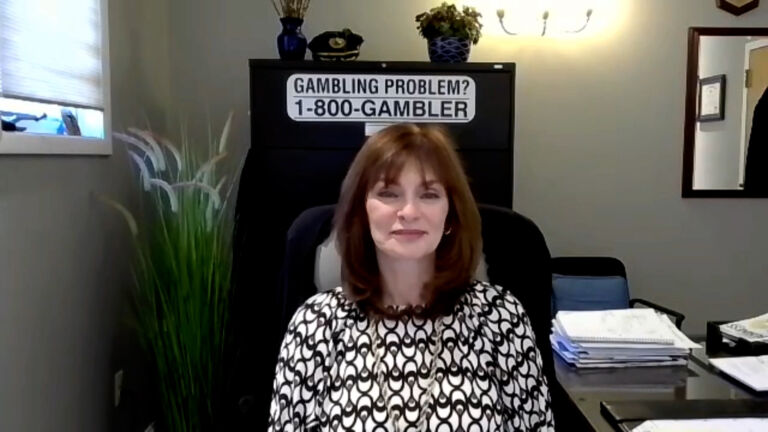
“Typically, we see kids that start in childhood or middle school end up with more problems than people that start later in life,” said Nower of the Center for Gambling Studies at Rutgers University.
For Trolaro, gambling was normal in the house and among friends when he was growing up. He is an advocate for more education for young people and for more “balanced messaging” about gambling that shows “the good, the bad (and) the ugly,” he said.
‘Even the worst day in recovery is better than the best day in active addiction.’ — Dan Trolaro
Still, New Jersey is an outlier. On the national level, there is no federal agency tasked to address problem gambling, according to the National Council on Problem Gambling.
“This is the only major disease or disorder that has no federal support, which means that states like New Jersey are left to try and address the negative consequences of gambling addiction on their own,” said Keith Whyte, the council’s executive director.
Whyte added that “the Number One legislative priority” for the organization is to remedy this “glaring gap” at the national level.
As for Trolaro, he continues to share his story around the country and raise awareness about the dangers of problem gambling.
“Even the worst day in recovery is better than the best day in active addiction,” he said.
