Credit: (AP Photo/Seth Wenig)
Advocates for water infrastructure improvements welcomed the latest federal funding to upgrade drinking-water systems, especially for replacement of lead service lines, but warned that the money still does little to close a multibillion-dollar funding gap.
The Environmental Protection Agency said Tuesday it will allocate $142.7 million to New Jersey in the current budget year as part of its annual payments to states to help them make low-interest loans to improve drinking-water systems. Nationally, the agency handed out $6.5 billion, a sum significantly increased by funding from the Bipartisan Infrastructure Law of 2021.
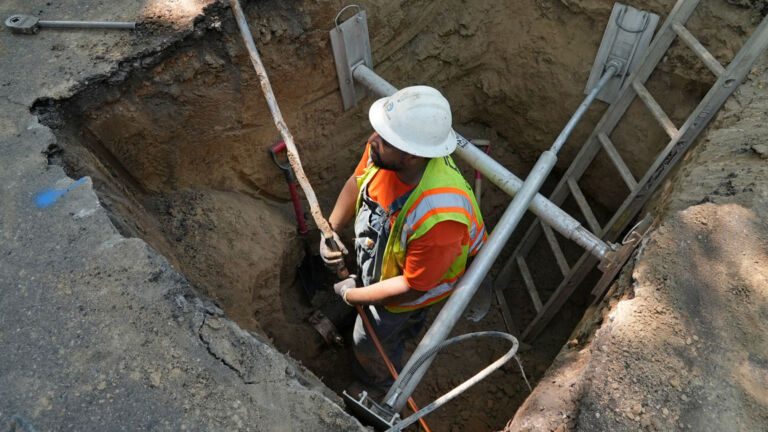
New Jersey’s share included almost $83 million for replacement of lead service lines, which state law requires by July 2031. The money is about $35 million more than expected, said Diane Schrauth, director of policy for water at the nonprofit New Jersey Future, but remains far short of at least $2.1 billion that the Department of Environmental Protection has estimated as the total cost for the massive statewide project.
“It’s going to help but it’s not going to solve the problem,” said Schrauth, who is leading an effort to use $700 million in New Jersey’s share of pandemic relief money for upgrading water infrastructure. She said the higher-than-expected amount for lead service lines reflects a recalculation by EPA for states like New Jersey that have an especially high number of the lines.
“It will get additional funding out to communities for lead service line replacement but it is not going to fully address the need,” she said. “Drinking water systems are likely going to have to raise their rates in order to replace their lead service lines.”
Still billions short
New Jersey is $8.5 billion short of the money it needs to renew neglected water pipes and wastewater systems over the next five years, according to the EPA. The funding gap rises to $26 billion over the next 20 years.
In the new funding, New Jersey’s allocation also includes $13.6 million for the removal of ”emerging contaminants” such as toxic PFAS chemicals in drinking water systems. Most utilities are expected to face higher costs to remove the chemicals in order to meet strict new federal standards likely to be finalized by the end of 2023. In many cases, water suppliers may have to raise rates for customers to pay for filtration technology that would enable them to comply, experts say.
The funding also includes $1 million for disadvantaged communities, as required under the federal infrastructure law.
The federal money will be paid into state revolving funds which provide low-interest loans to utilities to help pay for measures like installing filters to remove PFAS, or “forever chemicals,” from public water supplies.
New Jersey’s State Revolving Fund has, through the state’s Infrastructure Bank, so far provided $114 million in loans to the City of Newark for its state-leading program to replace lead service lines. Of the total loans, $56 million in principal will be forgiven, the EPA said. In 2017, the city discovered that some 20% of residential water lines tested exceeded the federal action level for lead, and by the end of 2022, it had replaced more than 23,000 of them.
Historic level of investment
Andy Kricun, a former head of the Camden County Municipal Utilities Authority, said the new funding reflects a historic level of federal investment in water infrastructure, but does not suggest that the job is done.
“This is an absolutely unprecedented investment in water infrastructure in New Jersey and around the country. But never think that it’s mission accomplished because of years of disinvestment or insufficient investment. We are already behind, then we have the new issues of emerging contaminants, lead service lines, and climate challenges,” he said.
Kricun, co-chair of Jersey Water Works, a statewide collaborative that advocates for water infrastructure upgrades, called the new funding “incremental” in the context of the overall need.
“It’s a cause for celebration but we must continue to work to make sure these funds are spent as well and as wisely as possible, and advocate for still more funding,” he said.
New Jersey’s federal lawmakers welcomed the new money.
“It should be a given that the water New Jersey families are drinking is safe and free of dangerous chemicals. These funds awarded through the Bipartisan Infrastructure Law will modernize our aging drinking water infrastructure, and help ensure that it is free of lead, PFAS, and other contaminants,” said U.S. Sen. Bob Menendez. “Not only will these funds improve access to safe drinking water, but also create good paying jobs to support the rebuilding of our vital water systems.”