Credit: (Madeline Ference; NJ Spotlight News)
When American Whiskey opened its doors in downtown Newark a few years ago, the bar’s owners grappled with an ongoing pandemic and an underperforming New Jersey Devils team that wasn’t exactly great for business.
Pandemic restrictions eased the year after American Whiskey opened, but the team’s performance stayed stagnant.
This season, however, the Devils have put the hockey world on notice, advancing to the National Hockey League’s Stanley Cup playoffs for the first time since 2018 after a stellar regular season.
The second game of a first-round series against the rival New York Rangers is set for Thursday at Newark’s Prudential Center.
For area businesses, the team’s improvement has been welcomed with open arms. The Devils organization has worked to build partnerships with New Jersey businesses, and experts say a playoff run can drive additional economic activity, both in Newark and the region at large.
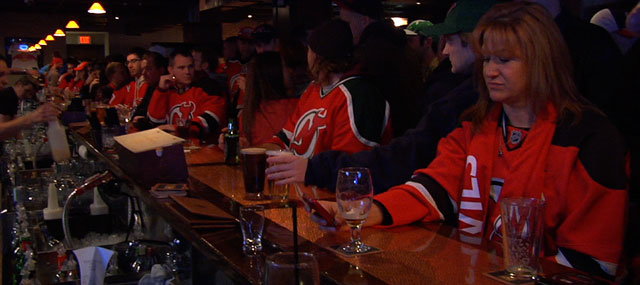
On any given game night this season, the area around the Prudential Center has been flooded with hockey fans. American Whiskey and Redd’s Biergarten, two bars just outside the nearly 20,000-seat arena, are hubs for pre- and post-game activity.
‘A symbiotic relationship’
For American Whiskey owner Kevin Hooshangi, the team’s turnaround couldn’t have come at a better time.
“It’s a symbiotic relationship; the paths don’t always cross or hit at the same time,” he said. “We’re very fortunate that it’s happened this way.”
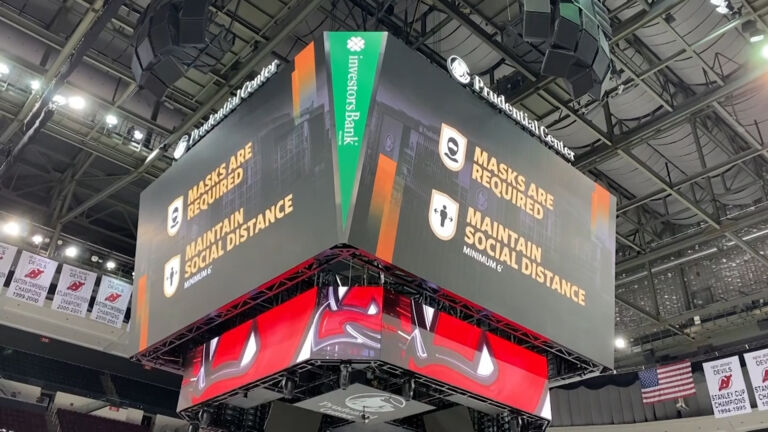
When the 2022-2023 regular season began, the Devils lost their first two games. But the team would go on to post a franchise record 13-game win streak by mid-November and eventually rise to the top of the league standings.
“It’s unique that we get to support the Devils in an environment that is fairly urban,” Hooshangi said. “There’s no tailgating experience; we are kind of the custodians of tailgating and the pregame. We’re all looking to help each other and we’re all looking to help Newark grow.”
The last time the Devils played in the Stanley Cup finals was more than a decade ago, when they lost a best-of-seven series to the Los Angeles Kings in six games.
Since then, they’d only made the playoffs one other time, in 2018, and promptly lost in the first round to the Tampa Bay Lightning.
A big turnaround
There are 32 teams in the National Hockey League, and only four teams finished the 2021-2022 season with a worse record than the Devils. But this season, the team closed out the regular season with the third-best record and the best single-season turnaround in league history.
 Credit: (AP Photo/Seth Wenig)
“While the fan base is very loyal and they came out last season to the very end, there’s been a very different feel this year,” Hooshangi said.
“There were maybe three nights in December where we didn’t have every table full in the place,” he said. “So, the difference is night and day between last season.”
‘This is a team that is going to compete for the Stanley Cup for a decade and I think that’s the most exciting part.’ — Jake Reynolds, president, New Jersey Devils
Team officials say they have long prioritized partnerships with both the local community and the state itself. And the economic benefits that can come from the team’s activities also aren’t exclusive to Newark-based businesses.
Partnerships with New Jersey-based businesses, such as Toms River Brewing, LeGrand Coffee House and Calandra’s Bakery, continue into the playoffs.
Representing New Jersey
“We put a tremendous amount of emphasis as an organization on making that a top tier priority of being able to partner with the city and the state who have been incredible partners of ours, not just this year, but during our entire tenure here” said Jake Reynolds, the team’s president. “We are incredibly proud to be the only team that represents New Jersey across their crest, and we take a tremendous amount of pride in that in terms of representing the state and look to continue to build and look for new ways to continue to impact the city and state around us.”
Just how much a successful team can boost the local and regional economies can be difficult to measure, and estimates vary.
But the playoffs bring additional home games after the allotted 41 that are played during each regular season — at least for the 16 teams that make the playoffs each year.
When the Nashville Predators advanced to the Stanley Cup finals in 2017, the team estimated that its playoff run generated roughly $50 million in overall economic activity after adding 11 more home games through the postseason.
Josh Lupinek, an associate professor of sports marketing at Montclair State University’s Feliciano School of Business, said such estimates usually run on the high side and should be viewed conservatively.
He added that if the Devils end up going on a deep playoff run, it does have the potential to “translate into economic activity for the surrounding area and, especially, Newark.”
“There’s just no question about it,” Lupinek said.
For the team itself, merchandise sales and sponsorship revenue pick up during the playoffs. The city and its businesses can also gain more revenue as more and more home games get added to the schedule.
Long-term investment
“The economic activity, in the short term, really comes from increased spending at local hotels, restaurants and bars,” Lupinek said.
This season, the Devils organization reported one of the league’s biggest single-game ticket businesses in terms of gross dollars, according to a team spokesperson, who added that the Devils set an organizational record in ticket sales revenue this year, growing business 32% compared to last season.
Lupinek credited the team’s current ownership for being well-prepared to seize the opportunities that can be generated by a well-performing team that progresses deep into the playoffs.
The Devils have one of the youngest rosters in the league, with an average age of 26.1 years old.
“They’re ready for this moment. They’re ready to capitalize,” he said.
While the first game in the series against the Rangers Tuesday night didn’t end with the outcome Devils fans would have liked, they can take solace knowing that the team’s success this season isn’t out of luck, but a yearslong strategy toward sustainability.
“We had a vision in terms of what we wanted to build here and, and [general manager] Tom Fitzgerald and his team have done an incredible job of executing that vision to bring it to life,” Reynolds said. “A lot of the focus was how do we build this sustainably? So, this is a team that is going to compete for the Stanley Cup for a decade and I think that’s the most exciting part. This is Year One and Step One in that process.”
The Devils have one of the youngest rosters in the league, with an average age of 26.1 years old.
That suggests the excitement about the team — and the opportunity for a bigger economic impact from its success — can stretch beyond whatever happens during this year’s playoffs.
“If you’re a local business, and you’re not ready for this, you have maybe a solid, three-year window coming your way that you have a chance to capitalize on,” Lupinek said.