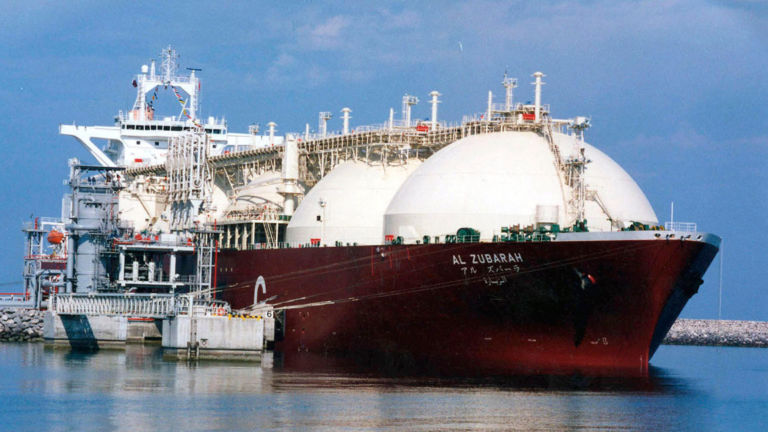
Credit: (AP Photo/Martha Irvine, File)
Plans to ship liquefied natural gas by rail to a proposed export terminal at Gibbstown in Gloucester County suffered a significant setback when the federal government denied renewal of a permit that would have allowed the cargoes.
The Pipeline and Hazardous Materials Safety Administration published its denial in the Federal Register Monday, some four years after a “special permit” was issued by the Trump administration to allow the shipments to be carried on an approximately 200-mile route from Wyalusing, Pa. to Gibbstown on the Delaware River in South Jersey. The agency gave no reason for its decision.
The plan by New Fortress Energy to ship the super-cooled natural gas to Gibbstown ignited a storm of protest from environmental and civic groups who argued that the trains would pose a grave risk to public safety because of the highly explosive nature of their cargo, especially in the densely populated areas such as Camden and Philadelphia where the trains would pass.
Critics also said state and federal governments should not be encouraging the production of fossil fuels while they are seeking big cuts in carbon emissions and aggressively promoting clean-energy technologies such as offshore wind and electric vehicles.
New Fortress Energy did not respond to a request for comment.
Activists welcomed the permit withdrawal but warned that New Fortress Energy and its affiliates could still use trains to ship the gas if the Department of Transportation does not also drop a rule that for the first time allowed the transport of LNG by rail throughout the U.S. That rule, also from the Trump administration, followed the special permit, which applied only to the Wyalusing to Gibbstown route.
Big blow to developers
“It does not necessarily doom the Gibbstown project but it was a necessary step to doom it,” said Kimberley Ong, a senior attorney at the Natural Resources Defense Council. The group opposes what would be New Jersey’s first LNG export terminal, planned for a new dock on the site of a former DuPont explosives factory.
If trains are no longer allowed to ship the fuel, the developer could in theory still carry it by truck, although Ong argued that shipment of all the LNG by road would require so many trucks that it would be “economically infeasible and logistically impracticable.”
The federal agency was under no legal obligation to issue its denial, and the fact that it did has fueled speculation that it will soon also issue a decision on the national rule regulating rail transport of the gas, Ong said.
The agency did not respond to a request for comment.
When first proposed as a truck-only operation, the project was expected to require about 360 truck trips a day, operating around the clock, to deliver LNG to ocean-going tankers at the planned export terminal, according to an environmental assessment by the U.S. Army Corps of Engineers in 2020.
Replacement by trucks of two daily “unit trains,” each of 100 cars, would result in a huge increase in trucks, and would probably provoke more protests by communities along the route, advocates said. According to the National Resources Defense Council, 18 New Jersey municipalities have joined others in Pennsylvania and Delaware in passing resolutions opposing LNG by rail.
In December 2020, Gov. Phil Murphy voted as part of the Delaware River Basin Commission to approve construction of the Gibbstown dock where the LNG would be exported. But later that month, he confused opponents by saying his administration would “explore all avenues within its authority to prevent the use of this dock for LNG transport.”
On Tuesday, Murphy’s office welcomed the federal denial of the special permit. “The PHMSA’s decision will help protect New Jersey children and families against the safety risks posed by the transportation of liquified natural gas (LNG),” Murphy’s spokesman, Bailey Lawrence, said in a statement.
Work has not begun
Despite the basin commission’s greenlight more than two years ago, work has not begun on the dock. This year, it cannot take place between March 15 and September 15 because of a ban on construction during that period by the Army Corps in an effort to protect the critically endangered Atlantic sturgeon which breeds in the river at that time.
Neither has any progress been made on a planned liquefaction plant at Wyalusing where natural gas from Pennsylvania’s abundant Marcellus Shale would be cooled to a liquid to be transported for export. An affiliate of New Fortress Energy allowed a Pennsylvania air permit for the plant to expire, and has not sought to renew it, advocates said.
The Biden administration is shipping more LNG to Europe to make up for decreased natural gas from Russia during the war in Ukraine.
Tracy Carluccio, deputy director of Delaware Riverkeeper Network, an environmental group that opposes the Gibbstown project, called the denial a “nail in its coffin” but said the national LNG-by-rail rule could still be used to ship the fuel to New Jersey — if the rule survives its current federal review.
But activation of the national rule “couldn’t happen overnight,” she said, because it would require rail cars built to a higher standard than those specified in the special permit for the Wyalusing-Gibbstown route, and those cars have yet to be built.
“The LNG-by-Rail federal rulemaking is still a big threat,” she said.