

New Jersey’s largest utility is seeking state approval to continue a major overhaul of its gas infrastructure, replacing aging cast-iron and steel pipelines prone to leaking methane, a potent greenhouse gas.
The three-year $2.54 billion proposed project, filed with the state Board of Public Utilities Wednesday, also would allow PSE&G for the first time to use renewable natural gas and hydrogen in its gas distribution system, which serves nearly 2 million customers.
If approved by the regulatory agency, the project would offer insight into how gas utilities are adapting to a state intent on transitioning from fossil fuels, a goal the Murphy administration now aims to achieve with a 100% clean-energy economy by 2035, 15 years sooner than its previous target.
This third phase of PSE&G’s gas modernization program aligns with recent executive orders by Gov. Phil Murphy and the state’s Energy Master Plan, as well as a state law mandating reductions in greenhouse gas emissions, according to Wade Miller, senior director of gas transmission, distribution and engineering for PSE&G.
Cast-iron and steel pipes
PSE&G has more than 3,000 miles of cast-iron gas mains, with an average age of 91 years — more than any other utility in the nation. In its proposal, the company would replace about 860 miles of cast-iron pipes and approximately 200 miles of unprotected steel pipes, with much of the replacement targeted for overburdened communities.
By PSE&G’s estimate, the utility’s ongoing replacement program has reduced methane emissions by 250,000 metric tons of carbon dioxide equivalent emissions. The new program is expected to reduce emissions by another 145,000 metric tons, the utility said.
If implemented as proposed, the latest program is forecast to increase the typical residential customer bill by about 3%, or $3 per month for each year of the three-year program. Lower natural gas prices have led to rate decreases in the past two months.
“PSE&G supports a balanced approach to decarbonization while meeting today’s energy demand — an approach that recognizes natural gas as a fuel to maintain affordability and reliability, as we continue to assess options including lower-carbon fuels and electrification,’’ said Kim Hanemann, president and chief operating officer of the utility.
In addition to the replacement of old pipeline, PSE&G is proposing to insert both renewable natural gas, or RNG, and hydrogen into its gas distribution system. The state’s gas utilities view both fuels as non-fossil alternatives and a lower-carbon alternative in the transition to cleaner fuels.
Environmental groups dispute that claim.
RNG, a ‘false’ solution
“We shouldn’t be subsidizing false climate solutions like RNG, which is costly and has environmental impacts,’’ said Doug O’Malley, director of Environment New Jersey.
But Miller argued RNG has a lower carbon content than natural gas, a fact that reduces harmful greenhouse gas emissions. The company is planning to build a $123 million facility to collect landfill gas at an old garbage dump in East Brunswick, convert it into RNG and inject it into its distribution system.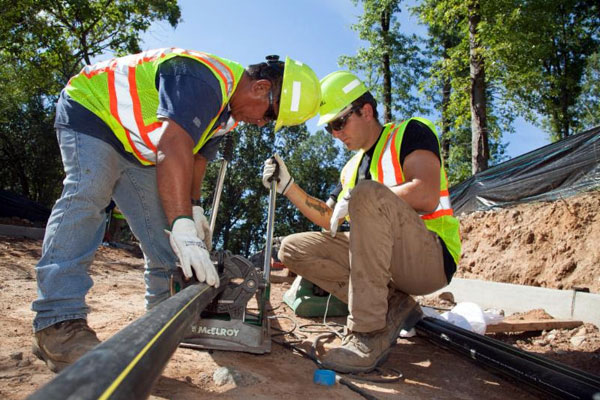
In Edison at a PSE&G metering and regulating station, the company is seeking approval to build a power-to-gas facility to inject 2% hydrogen into its gas system. At the facility, electricity and water are converted into hydrogen and then blended into the natural gas system as a low-carbon fuel.
“It’s an effort to address the concerns with the use of natural gas,’’ said Paul Patterson, an energy analyst with Glenrock Associates, who added it remains to be seen whether RNG or hydrogen are economically feasible on a large scale.
Miller disagreed. “What we are seeing across the nation, both RNG and hydrogen are economically feasible.’’
So far, PSE&G has invested more than $2.8 billion in its gas modernization program. The company expects the RNG and hydrogen projects will build its expertise in alternatives to natural gas.
— Editor’s note: This story has been updated to correct the amount of reduced methane emissions — 250,000 metric tons of carbon dioxide equivalent emissions — the utility estimates due to its ongoing gas modernization program.
