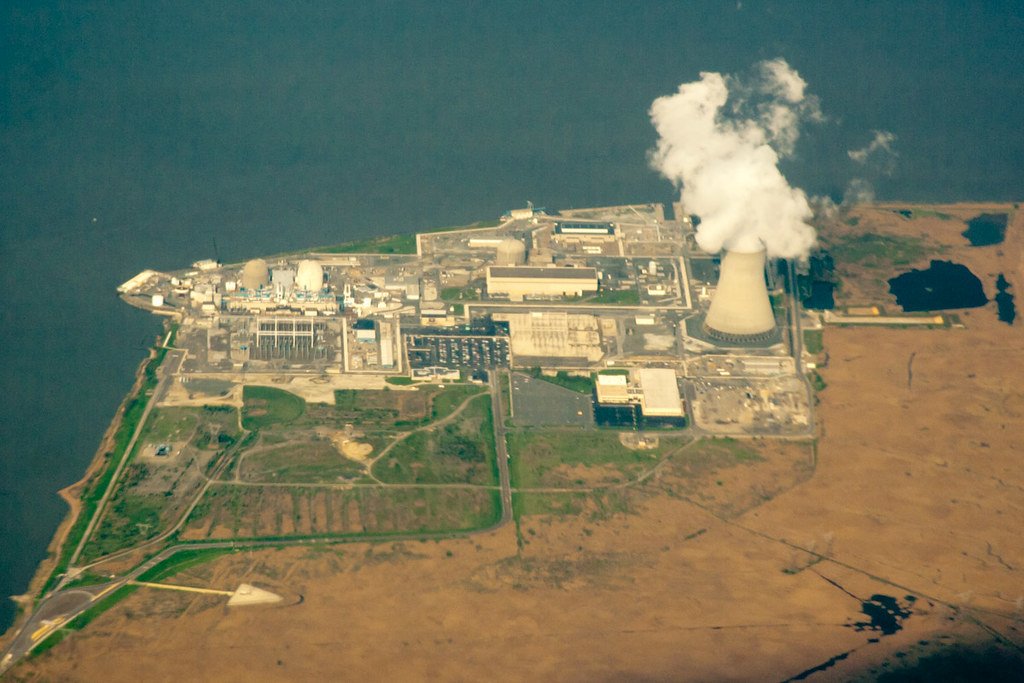
Credit: (AP Photo/Charlie Riedel)
Public Service Electric & Gas is seeking to spend $848 million over four years to upgrade its electric and gas grids, the third time in eight years it has sought regulatory approval for large-scale investments in modernizing its infrastructure.
The upgrade plans align with policies adopted by the New Jersey Board of Public Utilities to spur the state’s gas and electric utilities to invest in projects that will make their systems more resilient to extreme storm events and even easier to adapt to less centralized power systems, otherwise known as distributed power resources, like microgrids, in energy jargon.
The latest proposal, dubbed the Infrastructure Advanced Program (IAP), is up for BPU review at a time when ratepayers are facing rising heating bills this winter as a spike in natural gas prices also is pushing up the cost of electricity. Natural gas provides heating to about 75% of homes in New Jersey, as well as generating more than 40% of the state’s electricity.
Unlike previous infrastructure upgrades advanced by PSE&G recently, the latest proposal is not as expensive. The state’s largest utility, with 2.3 million electric and 1.9 million gas customers, won a scaled-down program of $842 million in 2019 after initially proposing a $2.5 billion program. In 2014, the BPU approved another infrastructure upgrade of $1.2 billion, less than the $2.6 billion PSE&G had sought.
In the latest filing, PSE&G seeks approval to invest $708 million in 13 electric upgrades and $140 million in its gas system. In the filing, the company said its infrastructure improvement program will focus on last-mile improvements to customers’ neighborhoods, plant and station upgrades and electric-vehicle charging capacity for its own fleet.
The utility’s case for big spending
PSE&G said the program would help the state achieve its Energy Master Plan clean-energy goals and provide residential customers with greater reliability and resiliency to meet changing energy needs, according to Michael Jennings, a spokesman for the utility. These investments would create hundreds of well-paying jobs and help stimulate the New Jersey economy, he said.
“The IAP’s “Last Mile’ upgrades represent the largest portion of the proposal and would enhance electric reliability at the neighborhood level, support the rapid transition to EVs (electric vehicles), and enable a greater blend of renewable energy resources into the existing grid,’’ Jennings said.
These investments are necessary, in part due to the COVID-19 pandemic, which has turned homes into more people’s workplaces and the need for more electric charging stations, a trend requiring a more reliable network at its fringes, according to the utility.
But that is not likely to diminish criticism from opponents, who questioned why many of these upgrades were not done previously as part of the utility’s obligation to provide safe, affordable and reliable service.
What critics say
“I view most of this as make work projects,’’ said Steven Goldenberg, a frequent critic of PSEG, the utility’s parent company. “It is remarkable for a company that touts its award-winning utility, there is so much infrastructure that is more than 65 years old. Why wasn’t it addressed in the past?’’
Goldenberg also lashed out at the utility’s plan to invest $150 million to install electric charging stations at PSE&G locations to help transition its fleet of utility cars to zero-emission vehicles.
“Under no scenario should ratepayers pay for the utilities’ own charging stations,’’ he said. “If they want to be seen as green as they claim, they should be putting skin in the game and not burden ratepayers with paying for it.’’
Besides the infrastructure improvements, the BPU also approved a year ago of new program allowing PSE&G to spend $707 million over the next four years to install smart meters in homes and businesses of its customers.
Evelyn Liebman, associate director of AARP New Jersey, also questioned the need for a lot of the expenditures proposed by PSE&G. “Again, it is a lot of money,’’ she said, referring to the latest infrastructure proposal. “It is important to carefully analyze the program and make sure it makes the system more resilient.’’
Ratepayers already pay $300 million a year in subsidies designed to keep three nuclear plants in South Jersey, mostly owned by PSEG.
— Editor’s note: This story has been updated to give correct numbers for PSE&G electric and gas customers.