
 Credit: (John Reitmeyer/ NJ Spotlight News)
The Legislature’s nonpartisan fiscal experts told lawmakers they expect the state to collect less revenue than Gov. Phil Murphy’s administration is forecasting as pressure on the economy is “only building up.”
The difference between the administration’s revenue forecasts and those unveiled on Thursday by experts from the Office of Legislative Services totals more than $1 billion when measured across the remaining months of the current fiscal year and the full fiscal year that begins July 1.
That gap in raw dollars is fairly significant given the many requests for additional spending on things like school aid and social services that have been aired during recent public budget hearings.
But for a state that now spends more than $50 billion annually, the $1 billion difference also represents only about 1% of the total budgeted spending in the 2023 and 2024 fiscal years. New Jersey has been building its budget reserves in recent years. That means no major changes are expected for the budget year that ends in June, even if the OLS projections prove to be more accurate than the administration’s.
‘We have seen revenue growth slow this winter and are expecting a weaker spring tax-filing season compared to last year.’ — Treasurer Elizabeth Maher Muoio
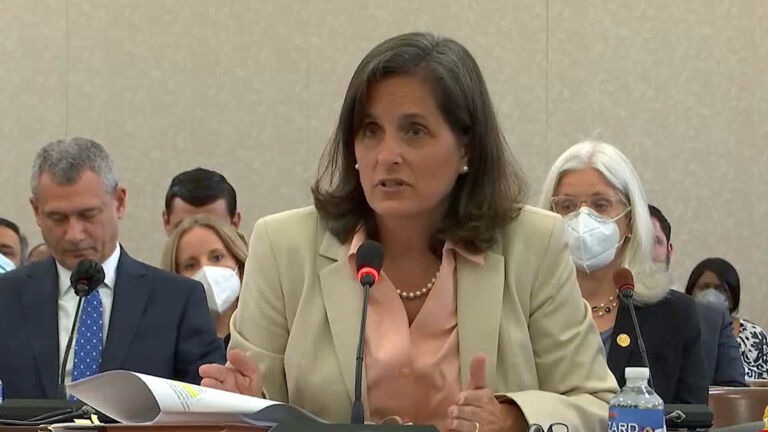
The discussion of the state’s big-picture revenue outlook came during a meeting of the Senate Budget and Appropriations Committee that also featured Treasurer Elizabeth Maher Muoio, who detailed the projections her department issued late last month.
Such projections lay the foundation for how the budget will be managed through the end of the current fiscal year, as well as dictate how much revenue is likely to be available to spend during the fiscal year that begins July 1.
Hanging over the preparations for the next state budget are concerns about the broader economy, as ongoing efforts to rein in inflation play out, such as the raising of interest rates by the Federal Reserve.
During Thursday’s hearing, OLS budget and finance officer Thomas Koenig noted that as “federal expansionary fiscal and monetary policies have run their course and inflation-fighting intensifies with certain banks walloped out of existence, the pressure on the economy is building up.”
“And with it pressure on state revenue collections,” Koenig said.
’Economic uncertainties’
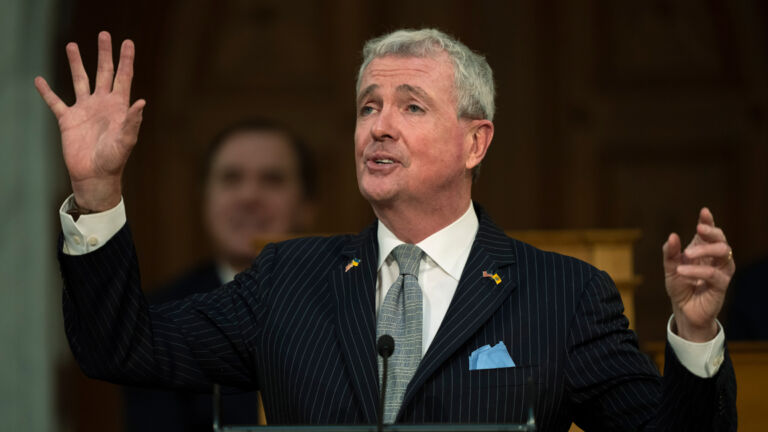
In all, Murphy’s proposed budget for the 2024 fiscal year calls for year-over-year spending to increase to $53.1 billion, even as total revenues are projected to decline slightly through the end of June 2024.
That slight decline is projected to come although revenues for the 2023 fiscal year are expected to climb roughly $3.7 billion higher than the original estimates, according to the administration’s latest forecasts.
Muoio downplayed the difference between the two sets of forecasts, saying they are “very close” overall.
She also pointed to signs that revenue collections are already beginning to decelerate in the run-up to the always-crucial April income tax season.
“There are economic uncertainties looming in the coming months as higher U.S. interest rates continue to affect the housing market, consumer behavior and the banking industry,” Muoio said. “We have seen revenue growth slow this winter and are expecting a weaker spring tax-filing season compared to last year.”
Earlier, the OLS officials also pointed to the ongoing tax season and noted the forecasts would be subject to another round of revisions before a final budget is enacted.
And while the gap in the forecasts between OLS and Treasury appears to be large in raw dollars, the OLS officials cautioned there is “general convergence” between their forecasts and the administration’s forecasts across the two fiscal years.
The legislative analysts also noted they had more time to compile their own revenue projections. The administration was required to release its forecasts late last month before any of the recent trouble in the banking industry emerged.
“Our forecasts are not far apart, diverging only mildly due to the slightly different timing of our estimates, as well as our moderately different interpretations of an ambiguous economic landscape,” said OLS revenue and economic policy analyst Oscar Mendez.
Corporate-business tax, school aid
The largest portion of the $1 billion difference is in the 2024 fiscal year, with OLS projecting about $680 million less in overall revenues than the administration projected through the end of June 2024. A big portion of that difference is in the forecast for the gross income tax, with OLS coming in about $275 million less than the administration.
Making up a large share of the $375 million forecast difference for the balance of the 2023 fiscal year is the corporate-business tax, with OLS projecting $275 million less will be collected than the administration projected.
But also influencing the revenue projections are several changes in tax policy that are either scheduled or proposed to go into effect during the 2024 fiscal year.
‘Now is the time to plan for the future and this administration is proud to present a budget which puts us in a position to withstand potential economic shocks.’ — Treasurer Elizabeth Maher Muoio
Among them is a planned phaseout of a special surcharge that for the last several years has been levied on businesses with net incomes topping $1 million annually. The initial loss of revenue from that policy change — which progressive advocacy groups have criticized as a giveaway to wealthy corporations — totals $322.5 million during the 2024 fiscal year, according to the administration’s estimates.
Meanwhile, a proposal Murphy included in his own budget plan calls for expanding the state’s child tax-credit at an estimated cost of $123 million during the 2024 fiscal year.
Koenig reminded lawmakers during his testimony that much progress has been made over the last several years in building up budget reserves, which are on target to top $10 billion under the administration’s forecasts.
Such reserves help cushion against the type of mid-year cuts that became a near routine in New Jersey during the years that followed the 2007-2009 Great Recession, when the state maintained only modest reserves but often saw significant revenue volatility.
Despite the progress in this area, the size of the state’s budget reserves has been raised frequently by those who have called for increased spending, such as to restore aid cuts that many school districts are facing this year under New Jersey’s school-funding laws.
But Muoio cautioned during her own testimony that New Jersey’s current budgeted surplus, totaling about 19% of spending, would still fall short of the national average for states, which is closer to 25%.
“Now is the time to plan for the future and this administration is proud to present a budget which puts us in a position to withstand potential economic shocks,” she said.
