
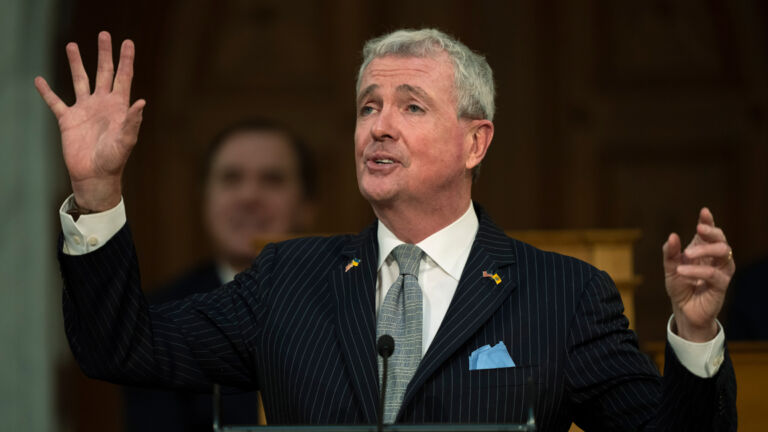
 Credit: (Screengrab from NJ Legislature)
Steadily growing tax collections have enabled New Jersey in recent years to address long-standing fiscal challenges, like paying down debt, fully funding pension obligations and boosting budget reserves.
But the Murphy administration’s tax-collection forecast for the fiscal year that begins July 1 calls for overall revenue growth to begin to cool amid concerns that an economic slowdown is looming or may already be underway.
Indeed, total annual spending would decline slightly during the 2024 fiscal year under Gov. Phil Murphy’s proposed budget when funds earmarked this fiscal year for supplemental appropriations and additional debt relief are factored in.
And that’s only if the administration’s latest revenue forecasts hold up over the next 15 months.
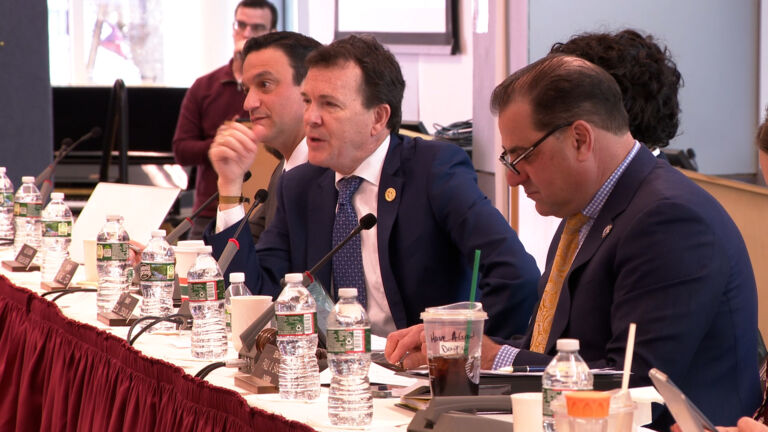
The big-picture revenue outlook is among the items due to be discussed Thursday when Treasurer Elizabeth Maher Muoio is scheduled to appear before the Senate Budget and Appropriations Committee. It will be her first appearance before lawmakers since Murphy unveiled a $53.1 billion spending plan for the 2024 fiscal year late last month.
The committee will also hear from fiscal experts from the nonpartisan Office of Legislative Services who are preparing to present their own revenue projections, including for the remaining months of the current fiscal year and the full fiscal year that begins July 1.
‘Vital’ information
Getting the latest information about the state’s revenue outlook is “vital” as lawmakers work on a new budget, said Senate Budget and Appropriations Committee Chair Paul Sarlo (D-Bergen).
“We want to be fully informed of economic conditions that have an impact on the state’s fiscal circumstances and budget during the year ahead,” Sarlo said.
Lawmakers have already begun to take testimony from the public on Murphy’s proposed spending plan.
In all, Murphy’s proposed budget … would increase annual spending to a record high of $53.1 billion, with allocations set to increase for things like public-worker pensions and K-12 public-school aid.
Among the issues generating the most passionate discussions so far have been the amounts budgeted for aid to K-12 public schools and the fate of a tax surcharge levied for the last several years on top-earning businesses in New Jersey.
Last month, the Murphy administration revised the revenue forecast for the current fiscal year based on better-than-expected collections during the early months of the fiscal year.
Budget add-ons
Nearly $3.7 billion was added to the original projections that were incorporated into the $50.7 billion spending plan for the 2023 fiscal year that Murphy and lawmakers enacted last June.
At the same time, the administration’s forecast for the fiscal year that begins July 1 calls for a slight decline in revenues through June 30, 2024.
The Budget in Brief document released by the administration last month cites national economic forecasts that suggest 2023 will be marked by slowed economic growth.
“The economic outlook has softened recently for both New Jersey and the United States, as rising interest rates and persistently high inflation erode purchasing power and slow the pace of the economy,” according to the Budget in Brief.
Moreover, the latest revenue report from Treasury indicated state tax collections have likely begun to fall off last year’s pace in some key areas.
Overall revenues remained about 2% higher year-over-year through the end of February, but collections for the month of February itself were down by more than 5% compared to the same month last year.
The income tax — the largest single source of revenue for the state budget — saw a 3% decline in February collections compared to the same month last year. Treasury officials said the decline was primarily attributable to weaker estimated payments.
Jobs, other factors
New Jersey had another month of solid job growth in February, but the state unemployment rate increased slightly, to 3.5%, as the overall labor force also grew, according to the latest jobs report from the Department of Labor and Workforce Development. The national unemployment rate also increased in February, to 3.6%, according to federal jobs data.
In all, Murphy’s proposed budget for the 2024 fiscal year would increase annual spending to a record high of $53.1 billion, with allocations set to increase for things like public-worker pensions and K-12 public-school aid.
Murphy’s proposed budget would also maintain about $2 billion in spending on the state’s “Anchor” property-tax relief program, which provides eligible homeowners with an up to $1,500 relief benefit, and eligible renters with benefits totaling $450.
At the same time, the state’s budget reserves are also expected to grow to $10 billion by the end of the 2024 fiscal year under the administration’s latest forecast.
But total annual spending in fiscal year 2024 would actually decrease slightly from the $54.5 billion the state is on course to spend during the 2023 fiscal year, due to nearly $1.5 billion in planned supplemental spending and more than $2 billion in revenue earmarked for debt relief.
The state Constitution gives the governor the role of starting each budget season by proposing a new annual spending plan, but lawmakers have the responsibility of drafting an annual appropriations bill before the July 1 beginning of the new fiscal year.
The treasurer is typically the first administration official to appear before lawmakers to discuss a governor’s proposed budget, followed by other department heads and key officials. In addition to Thursday’s hearing, Muoio is also scheduled to appear before members of the Assembly Budget Committee on Monday.
