
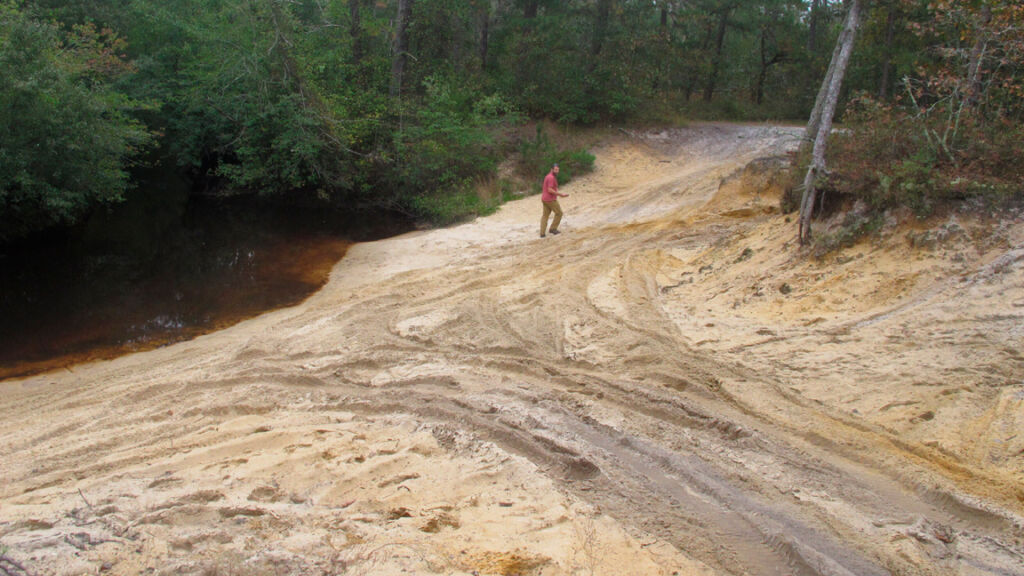
Drivers of off-road vehicles in Wharton State Forest will likely have to follow a new map showing where they are allowed to take their vehicles and may have to pay a fee to access some parts of New Jersey’s biggest state park.
The plans are possible outcomes from a major review of how the public uses the 124,000-acre South Jersey tract — the state’s latest effort to resolve years of conflict between the drivers and other users such as hikers, birdwatchers and canoeists.
The Department of Environmental Protection on Wednesday unveiled the results of a wide-ranging survey of how people use the park, which parts they use the most, and how the state could improve the park’s delivery of those services.
The agency intends to use the survey’s findings to find a solution to the long-running confrontation between drivers of pickup trucks, dirt bikes and all-terrain vehicles, and other forest users who say the drivers have created a “Wild West” where their vehicles destroy the natural environment and make it harder for other users to enjoy the vast Pinelands forest.
‘We have challenges with what I believe is a small percentage of people who are coming into the forest and abusing the space…’ — John Cecil, Department of Environmental Protection
John Cecil, the DEP’s assistant commissioner of State Parks, Forests and Historic Sites, said a small minority of off-road drivers appear to be responsible for most of the damage which results in deeply rutted roads, illegal tracks created through the forests by unregistered vehicles, flooded trails and trash-strewn sites.
“We have challenges with what I believe is a small percentage of people who are coming into the forest and abusing the space with ATVs, motorcycles, heavy-equipped offroad vehicles, souped up trucks, damaging roads, going off road, damaging wetlands. That’s ultimately the issue we are trying to address but really framed in the context of public safety,” he told reporters at a briefing before the report was published late Wednesday.
Open, close
Cecil said he expects to keep most of the forest open and accessible to the public with existing routes, but some places — which he did not name — should simply be closed because they are unsuitable for public use.
“They are flooded for most of the year, and are effectively impassable,“ he said. “We think they should just be closed. No one should be going down there because it causes too much damage, or it is too sensitive, and it is beyond our capability to maintain it.”
Two possible outcomes of the review, Cecil said, are a new map showing where drivers can and cannot legally drive in the Wharton tract, and a permit system for some heavily impacted areas, modeled on a permit system at Island Beach State Park.
 Credit: (AP Photo/Wayne Parry)
A map that more clearly defined where drivers may legally take their vehicles was last published by the DEP in 2015 but quickly withdrawn after what critics said was a storm of protest by the off-road lobby which argued that the map reduced the areas to which they were permitted access.
The details of a new map are not settled, but it seems likely that one will be published after the current review, Cecil said, in answer to a question at the media briefing.
“I have not gotten pushback on a map. We had a legislative member saying a map makes a lot of sense. I feel like that’s a really obvious and intuitive conclusion to come to, but I want to listen to all the comments tonight,“ he said, ahead of an online seminar to present the results of the study to the public. “We don’t know where we are unless we have a map, so inherently it seems that we are going to get to that place. “
Possibility of permits
But it is less clear that a permit system for some heavily used areas of the forest will be launched, Cecil said.
“We know that there are some routes that are really challenging; maybe there is a way we can keep those open but if we require folks to have a permit, that allows us to know that they are properly equipped, that they have got the right vehicles and equipment to get themselves out if they are stuck, or know how to call for help,“ he said.
In meetings with stakeholders including mayors of Pinelands towns, state lawmakers, and the New Jersey Pinelands Commission, Cecil said he had found a lot of resistance to a permit system, in part because it is modeled on the Island Beach system. But he said that if officials launch permits in the Wharton forest, they would not cost users nearly as much as the Island Beach equivalent and would not be a revenue generator for the state.
‘I myself will not be getting a permit, and will be taking it to court, if need be.’ — David Demsey, off-road driver
During the online seminar, which was attended by around 350 people at its busiest, friends and foes alike of off-roading in the Pinelands argued against any new permit system.
 Credit: (NJDEP)
Heather McGarvey, a mother of seven in Shamong Township, a Pinelands community in Burlington County, said she was opposed to permits and every other aspect of the DEP plan.
“Living in the high-tax state of New Jersey, we can barely afford to get through day to day, and you are going to ask us to spend more money just so that my kids can go out and walk in the woods that we pay property tax to maintain,” she said.
More pushback
Diane Mason, who described herself as a hiker and a paddler in the forest, also argued against permits. She said only “responsible” people would bother getting permits while those who already break the law by driving off-trail or with vehicles that are not street-legal, would continue to abuse the forest.
Instead, the DEP needs to step up enforcement of existing laws, which are often not enforced by park police, Mason said. “Park police have a reputation for being complicit in the problem, not solving the problem.”
David Demsey, an off-road driver and outspoken defender of access to the forest, said he would never buy a permit. “I myself will not be getting a permit, and will be taking it to court, if need be,” he said.
The DEP announced the survey in September and gave the public six weeks to fill it out. The agency received 1,610 completed surveys, mostly from New Jersey but also from as far away as Salem, Oregon. Among its findings were that 65% said the DEP should develop a plan to responsibly and sustainably manage state park lands, while the remainder said it should not.
Among 1,508 written responses, the survey found that 60 said there should be more off-road vehicle access to the forest while 92 said there should be no access for the vehicles, and 132 said there should be more enforcement of existing laws. Other responses included 392 people who called for restricted access; 332 who said access should be kept as is, and 172 who said there should be no restrictions on access.
Next, Cecil said the DEP will develop new signage, brochures and a map showing the areas that would be newly allowed or off-limits to off-road vehicles, and then hold another round of public information sessions in the late summer or fall.
