 Biologists in New Jersey have been charting the death spiral of the Pickering’s morning glory for decades.
Found today only in about a dozen remote locations in the Pine Barrens, the early summer bloom, noted for its pure white, star-shaped clusters, is on a path to extinction.
One day not long ago, a conservationist who’s tracked the bloom for years discovered that somebody had dumped about a ton of construction debris on top of one of few remaining patches of the little flower.
“It appeared to be the remains of an entire house,” said Emile DeVito, an ecologist with the New Jersey Conservation Foundation. “The roof, the walls, shingles, the whole thing.”
Environmental advocates interviewed by NJ Spotlight News said covert dumping in the 1.1 million-acre Pinelands preserve has spread deep into the woods alongside a twin scourge, illegal off-road driving that has destroyed native habitats and rendered roads and trails impassable.
 Credit: (NJ Conservation Foundation)
Every year, hundreds of volunteers across the seven-county Pinelands area in central and South Jersey trudge into the woods to collect trash. Every year, they come out with thousands of pounds of refuse.
NJ Spotlight News returned to visit the Pinelands this fall as part of “Hazard NJ,” its series of podcasts and stories examining prominent state Superfund projects, many of which face new challenges posed by climate change and shifting storm patterns. The Pinelands has long faced the pressures of development in its sensitive areas. Now climate change is adding to pressures in the Pinelands with its increased threats of wildfires and rising salinity levels in it waters.
‘Tires, toilets, mattresses’
Kerry Jennings, the president of the nonprofit Forked River Mountain Coalition, said his group has been collecting garbage for the past 29 years in the 30,000-acre Ocean County preserve, which offers stretches of picturesque wilderness rare in America’s most densely populated state.
Over the years, coalition volunteers have carried about 1.4 million pounds of rubbish out of the preserve.
“Almost anything you can imagine, we’ve hauled it out of the woods,” said Jennings. “Tires, toilets … mattresses; every once in a while, a boat.”
Another volunteer group, made up entirely of off-road enthusiasts who say they are promoting responsible four-wheeling in the Pinelands, has mounted the Annual 4-Wheel Drive Cleanup for the past 21 years.
‘There are areas of the woods that are so bad, like parts of the Brendan Byrne State Forest, just walking into them I get depressed.’ — Jason Howell, Pinelands Preservation Alliance
The October event has proven so popular that organizers — who have their own Facebook page — now pre-register volunteers and offer commemorative badges, apparel and door prizes during a drawing at the Pic-A-Lilli Inn in Shamong Township. Souvenir merchandise offered this year included T-shirts, hoodies and tote bags.
Ray Lopez, an organizer of the cleanup, said the group sends scouts into different areas of the Pineland to determine what areas are hit hardest.
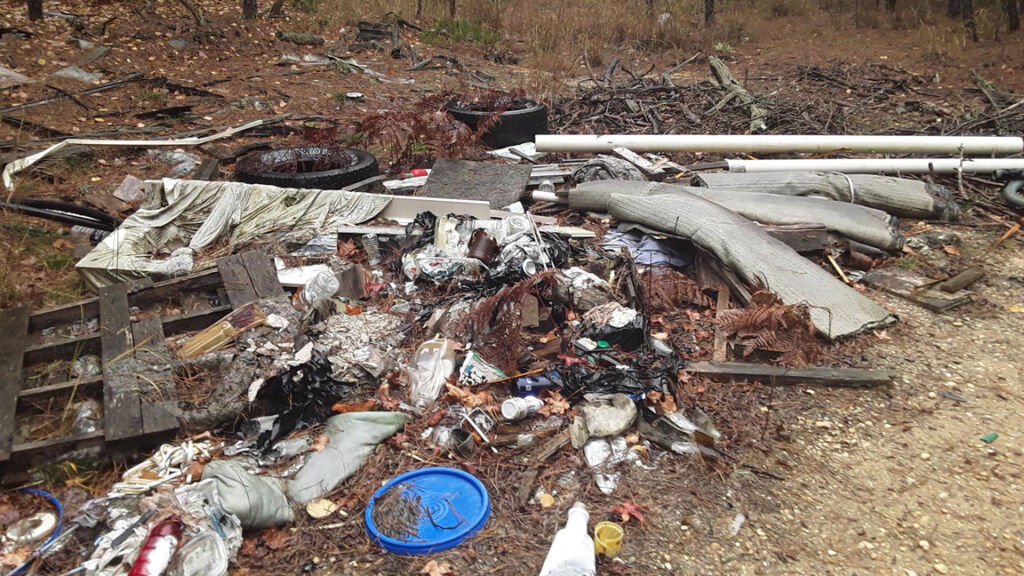
“We’ll always find cans and bottles, but have also found mattresses, toilets, jet skis, construction debris, piles of roof shingles, vehicles, abandoned campers, and areas where it looks like the contents of an entire house were spilled out onto the middle of a trail,” Lopez said.
Conservationists point to state neglect
The mountains of trash in the Pinelands are, in the view of conservationists who deal with it every day, the fruit of neglect by a state that has gutted spending on public lands and failed to adequately protect and maintain public parks and wilderness spaces.
 Credit: (4-Wheel Drive Cleanup)
They point out that staffing in state parks and preservation areas has fallen by 30% since 2006, a span which has seen the state budget grow by more than one-third, up to $50 billion, and post significant surpluses in the last two fiscal years.
The backlog of deferred capital projects in New Jersey’s 51 state parks and preservation areas now surpasses $500 million, the state acknowledges, with vandalized natural areas and decaying amenities increasingly being closed off to visitors.
‘There’s burnout … These are dedicated and very committed people. But when you are constantly stripped of resources, it can get demoralizing.’ — Michael Van Clef, Ecological Solutions
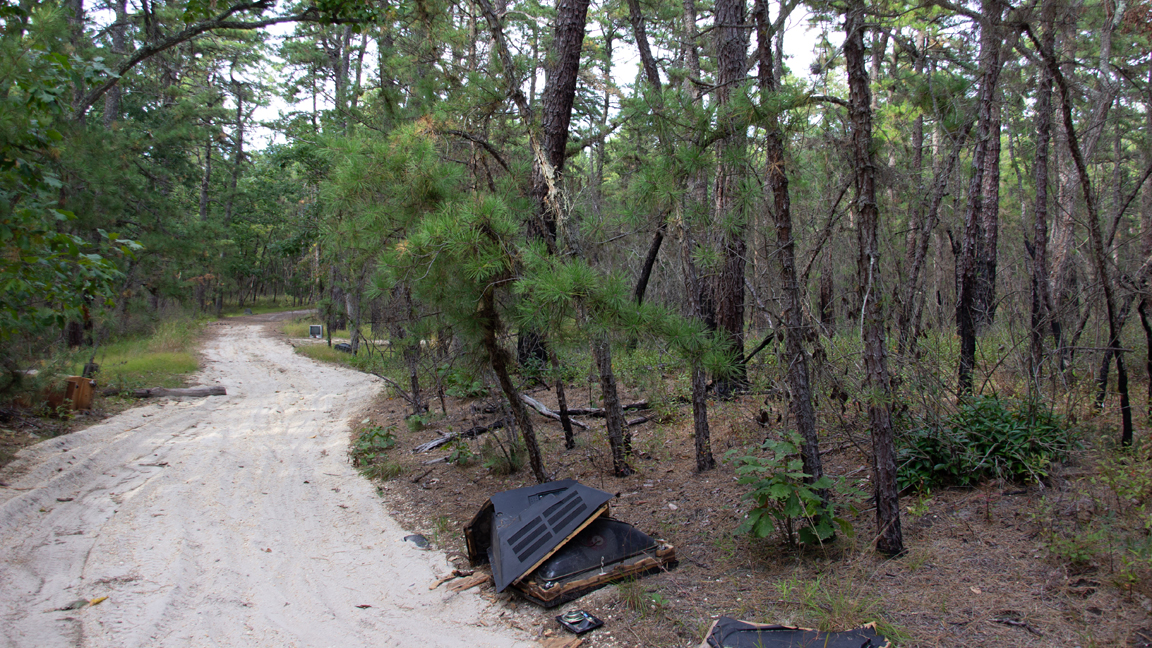
In the 1.1 million-acre Pinelands preserve — recognized in 1988 by UNESCO as one of the world’s most unique biospheres — road damage from unregulated all-terrain vehicle use is so bad that firefighting crews are unable to access some areas. Vandals who dumped old televisions and other trash forced closure of the fire tower at Apple Pie Hill in Burlington County. The 60-foot tower offered visitors views of an unbroken wilderness in all directions.
“If the state had the will to manage these forests, to enforce the laws and staff the parks, we’d be able to get a handle on a lot of this stuff,” said Jason Howell, a staffer with the nonprofit Pinelands Preservation Alliance who has led volunteer groups that have removed more than 100 tons of refuse from the pines.
“There are areas of the woods that are so bad, like parts of the Brendan Byrne State Forest, just walking into them I get depressed,” Howell said.
 Credit: (Michael Sol Warren | NJ Spotlight News)
To be sure, New Jersey is not the only place where public lands and parks have been stressed by budget cuts and lack of enforcement. Experts say the numbers of park rangers, police and wildlife managers have dwindled in many state preserves and national recreation area even as records numbers of visitors keep showing up.
Staff cuts
But New Jersey is lagging behind many of its neighbors: A 2022 study funded by a consortium of private conservation groups found that New Jersey’s operating budget for park management is just two-thirds of the national average for all states, only one-third of Pennsylvania’s and just one-sixth of New York’s.
The study, done by Ecological Solutions, a consulting firm based in Great Meadows, found that the number of superintendents overseeing New Jersey’s parks, marinas and public forests has been slashed from 45 to 15 in recent years. Staff at Wharton State Forest, a 123,000-acre preserve in the heart of the Pinelands, has fallen from 25 in 2002 to just eight last year.
At the same time that the state has been cutting management staff, it has acquired new lands at a rapid pace. There’s been a 13% increase in acquired park acreage since 2008, the study found. “Everybody is in favor of acquiring new lands, but taking care of it becomes an afterthought,” Michael Van Clef, the study’s author, told NJ Spotlight News.
Remaining park staffers, Van Clef said, are demoralized.
“There’s burnout,” he said. “These are dedicated and very committed people. But when you are constantly stripped of resources, it can get demoralizing.”
DEP cleanup campaigns have found some of the worst locations for illegal dumping in the Wharton and Brendan T. Byrne state forests.
Joel Mott is a spokesman for the New Jersey Pinelands Commission, a state agency created in 1979 to “preserve, protect, and enhance the natural and cultural resources” of the 938,000-acre Pinelands National Reserve of South Jersey.
He said the commission and its staff of about 40 planners, analysts and scientists is basically a land-use agency that works with local communities to control development. While the commission cooperates with park officials and various groups to clean up trash and reduce damage from illegal off-road vehicles, he said, it is not responsible for policing the woods.
“We’re not set up to manage the forest,” Mott said.
Penalizing the violators
Caryn Shinske, a spokeswoman for the state Department of Environmental Protection, said Thursday that state officials responsible for overseeing parkland were attending an out-of-town conference and could not comment. She declined to answer questions about staffing cuts.
Over the past decade, the DEP has launched several campaigns to thwart midnight dumpers in the Pinelands and other New Jersey public lands. Efforts like the “Don’t Waste Our Open Space” campaign, which publishes names and photos of people caught dumping, has netted dozens of violators and sought fines ranging up to $50,000.
 Credit: (AP Photo/Wayne Parry)
The DEP cleanup campaigns have found some of the worst locations for illegal dumping in the Wharton and Brendan T. Byrne state forests in the Pinelands, along with the Delaware and Raritan Canal State Park. But in the words of former DEP commissioner Bob Martin, state enforcement officers “can’t be everywhere all the time.”
The Pinelands preserve, unlike other noted natural areas like Yellowstone or Acadia national parks, is home to dozens of active and growing communities. The state’s goal has been to channel growth into certain zones rather than prohibit it throughout the preserve.
Superfund sites amid the wilderness
The result, environmentalists point out, is an area that mixes pristine wilderness with scarred and contaminated stretches that remain a blight. “It’s a mixed bag, and one the state has not done a great job controlling,” said Jeff Tittel, former head of the New Jersey Sierra Club. “There’s a long history of stuff being dumped on the Pines.”
A recent study by the Pinelands Commission found there are still more than a dozen uncapped municipal landfills located in the preserve, with several of them still emitting effluents considered to be of “high” concern. The region is also home to several Superfund sites, including a landfill at Fort Dix in Burlington County.
The 6-acre inactive Lipari Landfill in Gloucester County took in more than 3 million gallons of liquid waste between 1958 and 1971, including paint thinner, formaldehyde compounds and other industrial solvents, according to the Environmental Protection Agency. The Superfund site has been called one of the most toxic dumps in America.
Environmental advocates point out that all this trashing of the Pinelands and our other public lands comes at a time when parks and outdoor recreational areas are more popular than ever. Park attendance in New Jersey and across the nation has reached record levels as people have emerged from pandemic isolation. Travel experts also say that inflation-pinched Americans embracing cheaper vacations are also rediscovering the parks.
“These lands are precious assets,” said Van Clef, author of the New Jersey park study. “Now, more than ever, we should be putting resources into them, not taking them out.”