This whale was bound to draw attention.
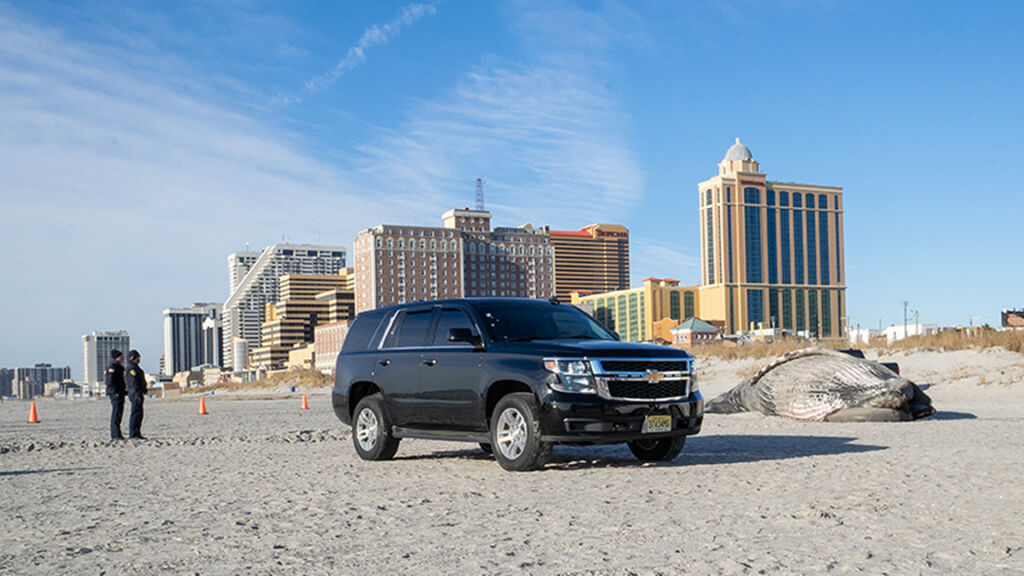
Unlike a similar one that washed up a month ago in Strathmere, a sleepy barrier island hamlet in Cape May County, this 33.5-foot female humpback rolled ashore on Saturday morning on Atlantic City’s downtown beach. Twenty-four hours later, its carcass, by then dozed up to the edge of the dunes, where it would soon be buried, was surrounded by small plastic campaign signs imploring onlookers to “Protect Our Coast: Stop the industrialization of our oceans.”
The placards, colored in red, white and blue, were a clear indication that the whale was now a reeking lightning rod for a growing anti-wind farm movement in South Jersey. But, say experts, the stranded whales highlight the complex ecology of the species and the busy waters in which they live, and that not one factor is to blame but many — some of which even they still don’t fully understand.
The whale was the sixth to wash up dead or dying on New Jersey and New York beaches in 33 days. Two — an adult female humpback and a female sperm whale — appeared on Long Island shorelines in early December. In New Jersey, an infant sperm whale was discovered in Keansburg, Monmouth County, in early December, while the three other strandings, all humpbacks, were in South Jersey. Saturday’s incident was the second in Atlantic City in two weeks; a similar sized humpback washed up not far away on Dec. 23. In July, a 25-foot humpback also beached in North Wildwood.
‘Clean Ocean Action has been working to protect these waters for about the last 40 years, and never have we ever heard of six whales washing up within 33 days.’ — Cindy Zipf, Clean Ocean Action
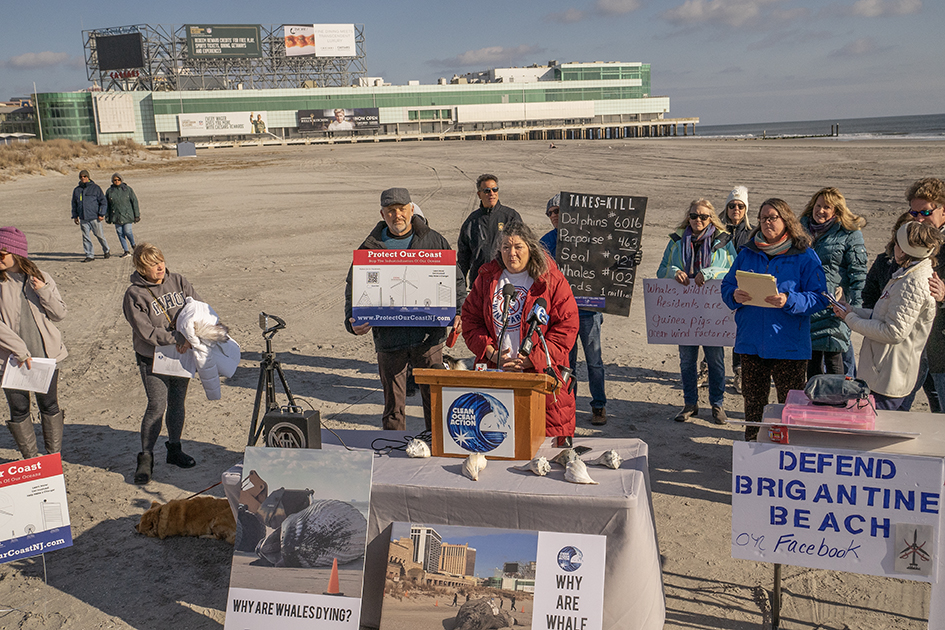
On Monday, standing before a podium set up on the sand, directly above where Saturday’s humpback was buried, the smell of decomposition still hanging in the air, Clean Ocean Action’s executive director, Cindy Zipf, announced that the advocacy group, along with others, had prepared a letter to President Joseph Biden, calling on him “to take immediate steps to address this alarming and environmentally harmful trend.”
“Clean Ocean Action has been working to protect these waters for about the last 40 years, and never have we ever heard of six whales washing up within 33 days,” Zipf said. “The only thing different this year than in the past years is the enormous amount of offshore preconstruction and development activities occurring by the offshore wind industry.”
Federal protections
The humpback, with its distinctly white, knobby pectoral fins and ribbed underside, is one of six baleen whale species found in the western North Atlantic Ocean. The 19th century whaling industry decimated humpbacks, and, after whalers fished themselves out of existence, gear entanglement from other commercial fisheries kept the species’ numbers from rebounding. Noise harassment and propellor strikes from vessel traffic are currently the whale’s major threats; both have increased exponentially over the past century, due in large part to the rapid growth of global maritime shipping.
With federal protection and intensive conservation efforts, the humpback rebounded and was delisted as an endangered species in 2016. According to the North Atlantic Marine Mammal Commission, the humpback population is about 35,000 — still less than a third of the pre-whaling estimate, but far better than others in the baleen family, like the right whale, whose remaining population of around 300 makes it the most endangered whale on the planet.
 Credit: (Chuck Staab)
In terms of humpback sightings, this past year has been like no other in recent memory, said Kevin Wark, a multi-generational commercial fisherman from Long Beach Island who has worked the waters off New Jersey and New York for some 40 years.
“I’ve never seen so many humpbacks in the ocean,” Wark said. “I was out there yesterday, and there are still whales around — it’s crazy.”
‘I think the whales are being drawn to shore by the menhaden population.’ — Kevin Wark, a commercial fisherman from Long Beach Island
Wark said shifting abundance in food sources, due in large part to record increases in water temperature and other extreme changes in ocean chemistry, has influenced how humpbacks move through their range — especially right now, when the species is migrating south to warmer waters. Wark pointed to the decline in the humpback’s traditional prey, like krill, mackerel and herring, and an increase in menhaden, as critical to better understanding why we may be seeing so many humpback strandings.
“Menhaden populations are strong, and the whales have learned that they’re an easy target,” said Wark, who consults with the state and federal government and offshore wind companies on marine life impacts, and who regularly ferries out to the companies’ lease areas Rutgers University fisheries researchers conducting their own impact surveys. “We don’t see the mackerel and herring, which do tend to be further from shore, whereas menhaden will come right up in the surf. So, I think the whales are being drawn to shore by the menhaden population.”
‘Unusual mortality events’
Beginning in 2016, the National Oceanic and Atmospheric Administration began monitoring what the agency calls an “unusual mortality event,” which are incidents of significant marine mammal die-offs that are deemed to require immediate federal attention. That year, 26 whales stranded between Florida and Maine, two in New Jersey. Last year, there were four strandings in the state. Of the 174 humpbacks that have washed up onto East Coast shorelines since 2016, about half have undergone “partial or full” necropsies, and, of those, 40% showed “evidence of human interaction, either ship strike or entanglement.”
During an examination of the Atlantic City humpback on Sunday, workers from the Marine Mammal Stranding Center and the Atlantic Marine Conservation Society, who conducted the necropsy, identified on the whale a head injury consistent with a vessel strike. Full results of the necropsy have not yet been completed.
“The only way to solve people’s angst and fears is to do thorough necropsies to make sure we have some kind of idea the cause of these mortalities,” Wark said. “But with this population explosion, and as much human activity that’s going on in these in these waters — barges and tugs and ships, clam boats and people steaming everywhere — this is not a surprise to me.”
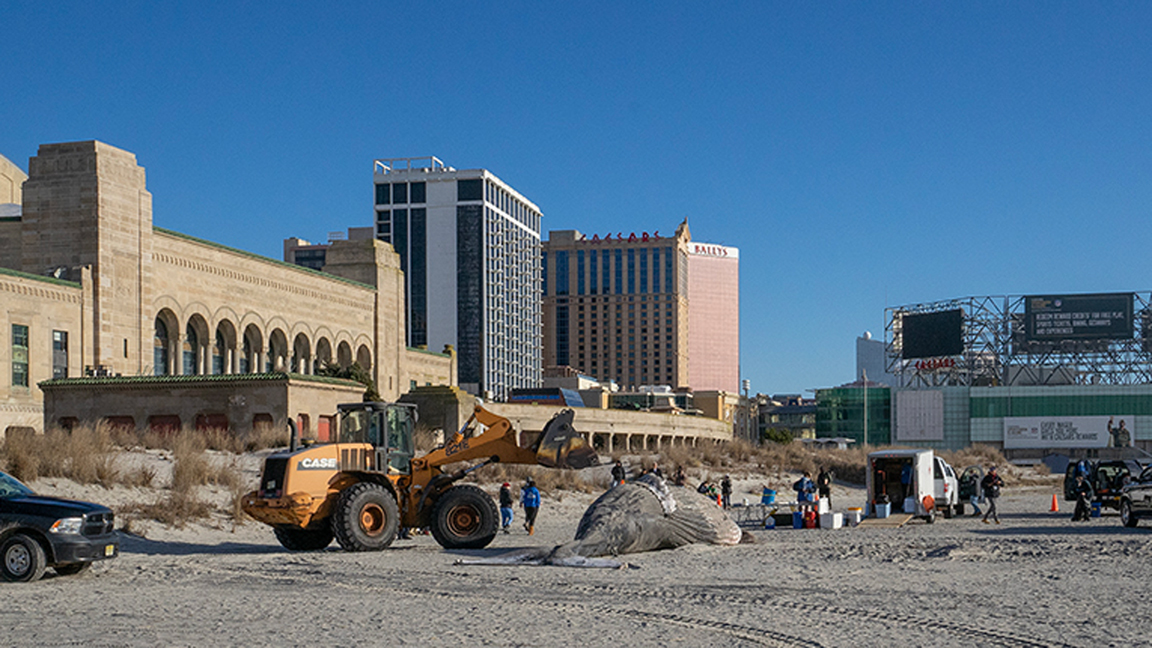 Credit: (Andrew S. Lewis)
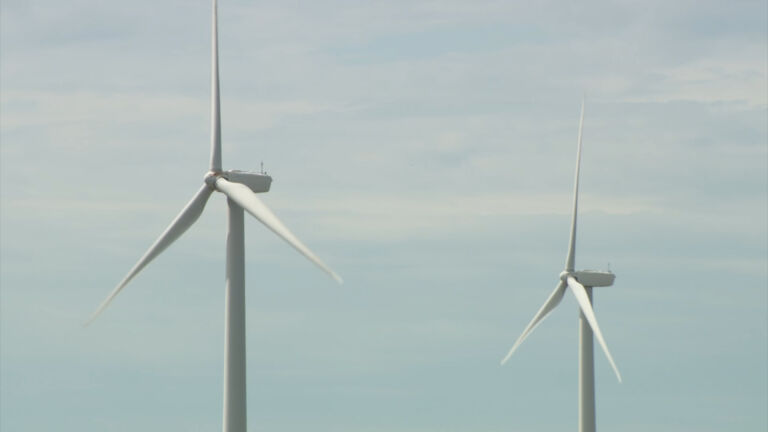
On Monday, Zipf acknowledge that she did not know what exactly is causing this recent spate of humpback deaths, but she, along with the representatives of the other advocacy groups standing beside her, suggested that the culprit is seafloor surveying currently being conducted by Ørsted, a Danish energy company, and New Jersey-based PSEG. The partners intend to build Ocean Wind 1 and 2, which will consist of some 200 GE Haliade-X turbines between 15 and 27 miles off the South Jersey coastline with the capacity to power over 1 million homes annually. Ocean Wind 1’s first set of turbines are expected to begin delivering power in late 2024.
Ørsted’s plan
According to a construction and operations plan submitted to the Bureau of Ocean Energy Management, Ørsted’s seafloor surveys consist of a suite of methods, including remote sensing technologies like sonar and magnetic mapping, boring samples, cone penetration and vibrocore testing — which entails drilling a metal rod into the seafloor that provides data on subsurface soil conditions. Wind companies use that information to determine which areas of seafloor are suitable for the turbines’ foundations, which will reach more than 150 feet beneath the seabed.
At the press conference in Atlantic City on Monday, Greg Cudnik, a recreational boat captain from Long Beach Island, pointed out that, that morning, Ørsted had posted a notice to mariners citing two vessels currently working within the Ocean Wind 1 lease area, collecting soil samples from the sub-seafloor. He suggested that cone penetration testing being conducted by one of the ships, the 272-foot Regulus, could have discombobulated the juvenile whale, causing it to be separated from its mother, at which point it collided with a vessel or was hit after dying.
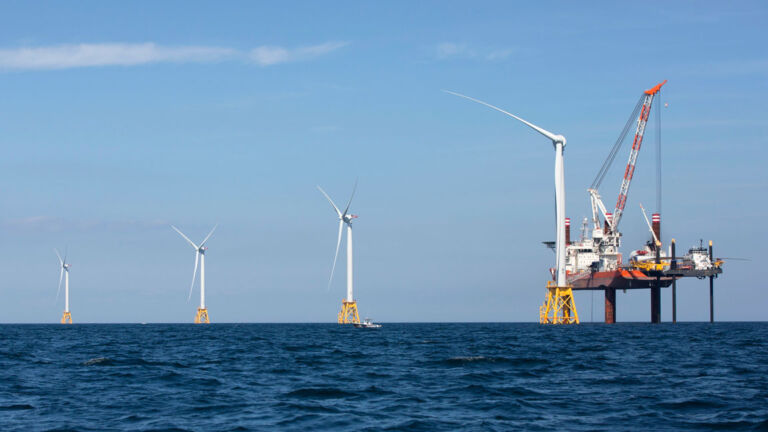
“As the crow flies, they’re straight out there, 15 miles at most,” Cudnik said, referring to the current position of one of the Regulus that morning. “If it’s such a perfect coincidence, I want [Ørsted] to pick my lottery numbers.”
A complicated problem
According to Michelle Fournet, an acoustic ecologist who heads the Marine Bioacoustics and Behavior Lab at the University of New Hampshire, however, determining the cause of the recent humpback deaths is not that simple.
“There are a lot of impacts of noise,” Fournet said. “But, for baleen whales, the idea that a seismic sound could cause a stranding the way that it does for odontocetes isn’t actually based in known science.”
It is ‘irresponsible to assign blame to offshore wind energy development before a routine full investigation is completed.’ — Allison McLeod, New Jersey League of Conservation Voters
By odontocetes, Fournet was referring to toothed whales, which are far more sensitive to noise than baleen whales. Fournet stressed that baleen whales are also impacted, and can be injured by seismic, sonar and other anthropogenic noise.
“But in order to be taken seriously as conservationists, we need to make sure that we are addressing the right problems at the right time, and right now, we are still trying to figure out how big a problem it is and what the issue is,” Fournet said. “That doesn’t discount the fact that noise almost without a doubt is impacting these animals, and that the animals that stranded were probably exposed to high levels of noise over the course of their life. But it’s a complicated problem.”
In a statement released on Thursday, Allison McLeod, the policy director for the New Jersey League of Conservation Voters, expressed concern over Clean Ocean Action and its partners’ position that the offshore wind industry is to blame. Citing the Marine Mammal Stranding Center’s observation that the whale stranded in Atlantic City on June 7 had sustained a head injury consistent with a vessel strike, McLeod said, “The vessels on this offshore wind survey, which are equipped with [third-party] marine mammal observers, have not reported any such incidents. It is therefore irresponsible to assign blame to offshore wind energy development before a routine full investigation is completed.”
In her statements on Monday, Zipf also stressed the need to know more, but argued that Ørsted was simply moving too fast.
“We’re not opposed to the idea of offshore wind development,” she said. “But we want to make sure it’s done right, and the key to that would be developing a pilot study first to evaluate what kinds of harm could happen, and, if they are going to happen, how can we avoid them.”
‘…we have got to figure out a way to come up with solutions that honor the ecology, and also acknowledge the reality of human society. — Michelle Fournet, acoustic ecologist, Marine Bioacoustics and Behavior Lab at the University of New Hampshire
In response to the humpback strandings, Ørsted issued a statement that said in part: “When offshore, we combine human surveillance and state-of-the-art technical equipment to avoid any impact on marine wildlife as we build projects to advance New Jersey’s clean energy ambitions. These ambitions are critical to combating climate change, which is one of the leading threats to the environment and marine life, including whales. It’s important for all ocean users to continue working with state and federal officials to further advance science-based and smart policies that protect critical marine life, while addressing climate change.”
Wark pointed out that the ocean he knew as a 23-year-old in 1986, when he got his first fishing boat, is a shadow of the one he sees today.
“The mackerel are missing, the shad are gone, the whiting are gone, the hake are gone — there’s just so much gone,” Wark said. “The environment is really just collapsing around me. I have to earn a living and fishing is nothing like it was.”
The stakes have never been higher for the oceans, and, through the eyes of Wark and Fournet, the status quo of the last century is one mired in catastrophe.
“One thing that without a doubt is true, is we are never going to take people out of the ocean,” Fournet said. “So, we have got to figure out a way to come up with solutions that honor the ecology, and also acknowledge the reality of human society.”