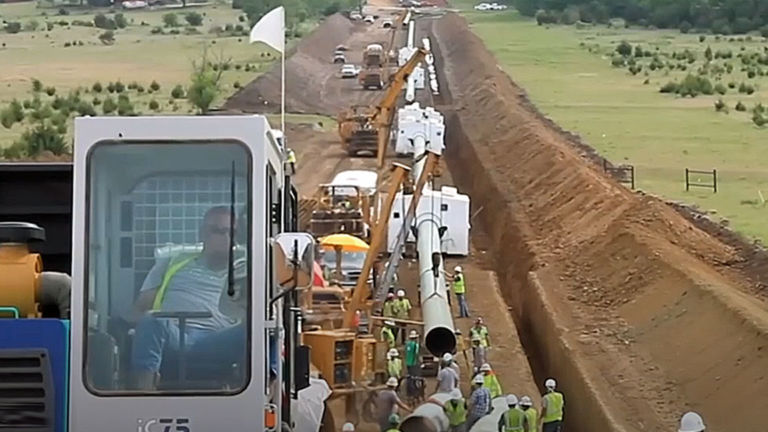
Credit: (AP Photo/Keith Srakocic)
A federal agency this week approved expanding an interstate natural gas pipeline, despite opposition from state officials and environmental groups who argued the project saddles ratepayers with costs for unnecessary new natural gas capacity.
The Federal Energy Regulatory Commission on Wednesday granted a certificate for a Williams Company subsidiary to move forward with projects involving the Transco pipeline, by modifying and building compressor stations in New Jersey and building new pipeline segments in Pennsylvania.
The $980 million project is the latest enhancement of the state’s energy infrastructure to draw fire from clean-energy advocates, who have been unsuccessfully pressing the Murphy administration to halt new fossil fuel projects during a worsening climate crisis.
‘This essentially is New Jersey footing the bill for a project that is not needed and has significant impact on overburdened communities.’ — Tom Gilbert, New Jersey Conservation Foundation
In this instance, however, the New Jersey Board of Public Utilities, joined by the state Division of Rate Counsel, were allied with pipeline opponents. In filings with FERC, the two agencies argued that a study adopted by BPU concluded the state is unlikely to experience shortages in natural gas through the end of this decade.
That conclusion was challenged by all four of the state’s gas utilities, which have agreed to purchase the additional gas capacity for next winter’s heating season. Transco designed the project to increase capacity of its existing pipeline system by 829,000 dekatherms per day.
FERC’s rationale
In its decision Wednesday, the federal commission found that construction and operation of the project will provide more reliable service on peak winter days and will supply diversity, which could lead to lower costs for customers.
In a statement, a Williams spokesman on Wednesday said the company was pleased by FERC’s decision. “We look forward to continuing our work with regulators and other stakeholders on this critical project that will enhance existing energy infrastructure and increase much needed access to clean and reliable for consumers in the Northeast, and particularly for our customers in New Jersey.’’
Clean-energy advocates argued otherwise.
“Clearly, there is no need for this project,’’ said Tom Gilbert, co-executive director of the New Jersey Conservation Foundation, citing studies by the BPU and one by its own consultant. “This essentially is New Jersey footing the bill for a project that is not needed and has significant impact on overburdened communities.’’
The project will lead to a 16% increase in the state’s emissions of greenhouse gas annually, undermining New Jersey’s goal of slashing such pollution by 50% by 2030, according to Ed Potosnak, executive director of the League of Conservation Voters of New Jersey.
“We can’t make progress if we take one step forward and two steps back,’’ he said.
New Jersey’s utilities have subscribed to buy 56% of the new gas capacity provided by the project. In its findings, FERC ruled New Jersey’s study concluding the state had enough gas capacity available until 2030 was only relevant for the state, but not for where the rest of the new gas capacity is targeted.
Prematurely obsolete?
In New Jersey, the project, dubbed the Regional Energy Access Expansion, calls for building a new compressor station in West Deptford in Gloucester County, expanding existing compressor stations in Somerset County and modifying a station in Middlesex County.
Other opponents fear the project will become prematurely obsolete as the state phases out its reliance on fossil fuels, leaving New Jersey ratepayers footing the bill for stranded costs.
The coalition of environmental groups plan to file a motion for a rehearing with FERC and are asking the Murphy administration and its Pennsylvania counterparts to do the same. They want both states to use available delegated state authority to deny the project.