
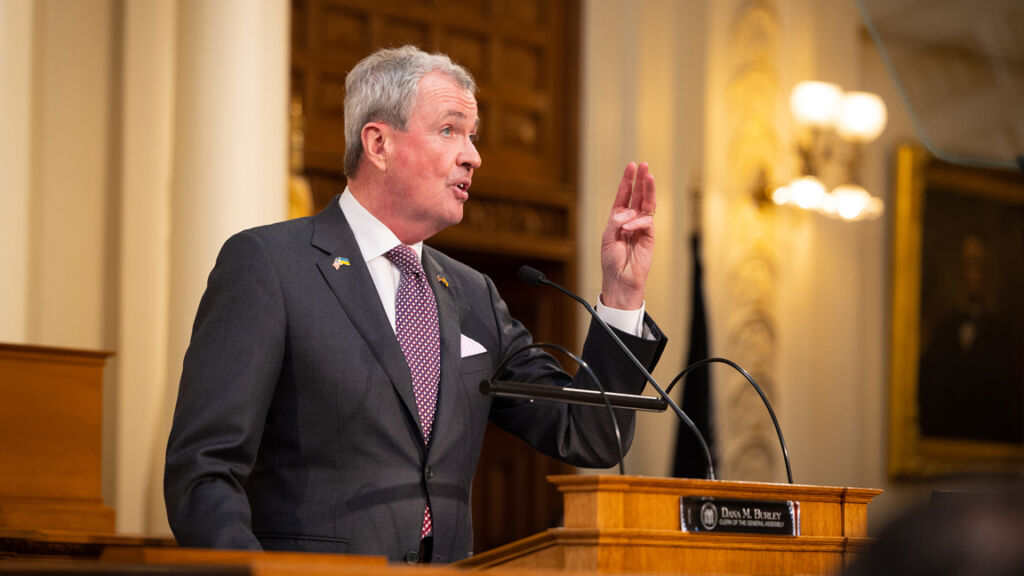
Gov. Phil Murphy is due to present a new annual budget to lawmakers next month, but he has already unveiled a key detail that could have major consequences for the state’s bottom line.
A tax surcharge on the profits of New Jersey’s highest-earning businesses, which has generated hundreds of millions of dollars in revenue in recent years, will be allowed to expire as planned at the end of 2023, Murphy confirmed during an interview last week with Bloomberg Television.
“That’s where I’m at as we speak,” Murphy, a second-term Democrat, said during the interview during which he also pledged no new taxes in general would be levied during the fiscal year that begins July 1.
The corporate-business tax surcharge was put in place at the beginning of Murphy’s first term. It was extended under a law the governor and lawmakers enacted in 2020, during the early months of the COVID-19 pandemic, a time when the administration was forecasting a significant drop-off in revenues.
Since then, revenues have instead surged to record highs. The latest revenue report from the Department of Treasury for the current fiscal year indicated tax collections were running about 3% ahead of last year’s totals as of the end of December, the halfway of point of the state’s July-to-June fiscal year.
Murphy’s latest plan for the corporate-business tax surcharge is being praised by many Republicans and business groups. They have long contended the surcharge put New Jersey at a competitive disadvantage when trying to attract new businesses and encourage corporate relocation to the state.
A key lawmaker, Senate Budget and Appropriations Committee Chair Paul Sarlo (D-Bergen), has also praised Murphy’s declaration, saying it is in line with his own views on the surcharge, which was initially enacted only as a temporary tax policy.
Voices of opposition
But the New Jersey Policy Perspective think tank, a leading advocate for progressive tax reform, has a different take, suggesting such a move would create a huge budget hole, while also representing the “absolute worst of trickle-down economics,” according to Nicole Rodriquez, the organization’s president.
In all, the corporate-business tax is projected to generate more than $5 billion during the current fiscal year, which ends June 30, to help support the state’s overall $50.7 billion operating budget. It is the third-largest source of tax revenue for the budget, behind the income and sales taxes.
‘To be clear, this would not benefit mom-and-pop businesses but corporations like Amazon and Walmart that make billions of dollars every year off the backs of low-paid workers.’ — Nicole Rodriguez, New Jersey Policy Perspective
All three major tax sources were outperforming last year’s totals through the first six months of the fiscal year, and overall revenues were $585 million ahead of last year’s totals as of the end of December 2022, according to the report released Friday by Treasury. However, Treasury officials have indicated they are sticking to projections that call for total revenues to eventually fall off last year’s pace by the end of June.
Revenue generated by the corporate-business tax for the most part supports the budget’s general fund, with some exceptions, including portions that are constitutionally dedicated to funding environmental initiatives, including land preservation.
The surcharge, which is levied only on businesses earning over $1 million annually, was put in place in 2018, in part as a response to hefty corporate tax cuts enacted by former President Donald Trump.
Spearheaded by former Senate President Steve Sweeney (D-Gloucester), the surcharge was also offered up as a temporary alternative to a personal-income tax surcharge for those earning $1 million or more annually. Murphy had been seeking to enact such an increase to help raise more revenue for priorities like public-school aid and public-worker pension funding.
The original plan for the corporate-tax surcharge called for it to be phased out by 2021. But it was extended in 2020 when the Murphy administration projected the pandemic would trigger deep revenue losses. That forecast — which was also used to justify a roughly $4 billion debt issue, as well as the establishment of a millionaires tax — ultimately proved to be inaccurate.
‘I welcome the Governor’s support in ending the surcharge when it expires at the end of the year.’ — Sen. Paul Sarlo
Instead, tax collections soared in the wake of aggressive federal aid and stimulus packages, helping generate enough revenue to leave New Jersey with a projected budget surplus of nearly $7 billion in the current fiscal year.
The law to extend the corporate-tax surcharge requires it to expire at the end 2023, which is an election year for both houses of the Legislature, with all 120 seats up for grabs in the fall.
Recent estimates from the Treasury have indicated a $300 million loss of revenue during the fiscal year that begins July 1, if the surcharge is allowed to expire as scheduled.
NJPP estimates the loss of revenue will grow to $600 million over a full fiscal year if the surcharge is not left in place.
“This is a tax cut for some of the biggest businesses in the world, plain and simple,” NJPP president Nicole Rodriguez said. “To be clear, this would not benefit mom-and-pop businesses but corporations like Amazon and Walmart that make billions of dollars every year off the backs of low-paid workers.”
But in his public comments, Sarlo, the longtime chair of the Senate’s budget panel, called the expiration of the surcharge “tax relief that will help fuel the economy and continue to ensure that New Jersey is an affordable place to operate.”
“I welcome the Governor’s support in ending the surcharge when it expires at the end of the year,” Sarlo said.
For its part, the New Jersey Chamber of Commerce is also hailing Murphy’s recent comments, including his pledge to forego raising taxes in the next fiscal year.
“All of this makes our state more competitive and affordable,” said Tom Bracken, the organization’s president and chief executive officer. (Bracken is a member of the board of NJ PBS.)
